Air Filter and Regulator: A Clear Side-by-Side Guide
A rigorous, objective comparison of separate air filters and regulators versus integrated filter-regulator units for home workshops and DIY projects. Practical sizing, installation, and maintenance guidance.


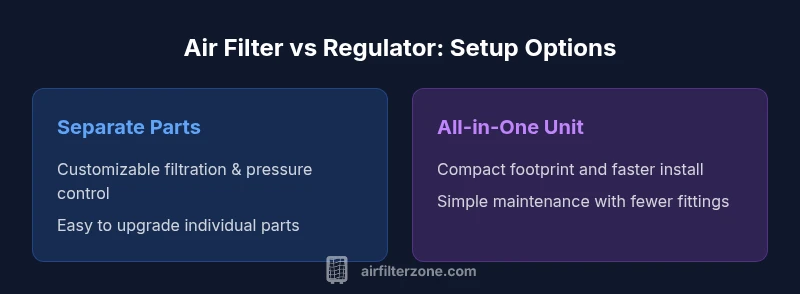
An inline air filter plus regulator generally offers more customization and flexibility, while an integrated filter-regulator unit provides a compact, easier-to-install solution. For most DIYers and home shops, the integrated unit saves space and simplifies maintenance, but separate components win when high flow, precise control, or future upgrades are priorities.
Core principles of air filter and regulator systems
Air filters and regulators are essential parts of a pneumatic system, protecting downstream tools from moisture, particulates, and pressure fluctuations. An air filter removes contaminants from the compressed air stream, while a regulator maintains a stable downstream pressure for tools that require consistent performance. In practice, many setups pair a filter with a regulator in sequence, ensuring clean air at the desired pressure. For homeowners and hobbyists, understanding these two components and how they interact helps you design a reliable system that reduces tool wear, minimizes leaks, and improves overall efficiency. According to Air Filter Zone, selecting the right air filter and regulator setup hinges on system needs and maintenance goals, which informs both configuration and upkeep strategies.
How an inline filter and regulator work together
In a typical two-part arrangement, compressed air flows first through a coalescing or particulate filter, which traps liquids and solids. Downstream, the regulator reduces and stabilizes pressure, preventing tool damage and improving performance consistency. The combination can be configured with additional drains, gauges, and shutoff valves to tailor performance. The separation of responsibilities — filtration and pressure control — makes it easier to upgrade one component without replacing the other. For DIYers, this modularity can be advantageous when projects scale or change in complexity.
Performance determinants: flow, pressure, and filtration rating
Key metrics determine suitability: CFM/SCFM (flow at a given pressure), PSI range, and micron rating (filtration efficiency). Higher flow demands larger filters and regulators with suitable adjustment ranges. If the micron rating is too coarse, contaminants slip through and tools may wear faster. Conversely, an excessively fine filtration can introduce excessive pressure drop, reducing efficiency. In practice, match the unit’s capabilities to your tools, workload, and duty cycle, and ensure the regulator’s maximum set pressure aligns with tool requirements.
Separate filter + regulator: advantages and setup
Pros of a two-component setup include maximum customization, easier future upgrades, and potential cost savings by replacing one part at a time. You gain flexibility to select higher-capacity filters or precision regulators suited to specific tools. However, the installation is more complex, with more connections to seal and potential leak points. Maintenance requires attention to both components, and space planning matters to accommodate two devices in close proximity. For high-demand configurations, this approach often delivers the best long-term performance.
Integrated filter-regulator units: advantages and tradeoffs
Integrated units combine filtration and pressure regulation in a single housing, offering a compact footprint and simpler installation. They are typically easier for beginners and home garages, reducing assembly time and potential leaks from additional fittings. The tradeoffs include less customization and potential limits on upgrading one function without replacing the entire unit. In spaces where wall or bench real estate is limited, integrated units deliver notable convenience without sacrificing essential filtration and pressure control capabilities.
Sizing your system: selecting CFM, PSI, and micron ratings
Effective sizing begins with a clear picture of your tools’ requirements and duty cycles. Identify the maximum CFM your compressor and tools will demand, the required downstream PSI stability, and the filtration level needed for your environment. Micron ratings commonly range from 0.01 to 5 microns, with finer ratings offering better contaminants removal at the expense of potential pressure drop. For DIY setups, a balanced choice often means a mid-range micron rating, a regulator capable of maintaining the lowest downstream pressure you use, and a filter with ample dirt-holding capacity.
Installation best practices: layout, connections, and drains
Plan a logical flow: compressor → dryer (if present) → filter → regulator → tools. Use quality fittings and compression or metal-to-metal seals to minimize leakage. Position the unit for easy drain access and routine inspection. Install a built-in or manual drain to remove condensate, and consider a pre-filter in dusty environments. Regularly check for leaks at joints and threads, and ensure gauge readings are stable over time. Proper mounting, vibration isolation, and shielded wiring (where applicable) also prevent nuisance failures.
Maintenance and troubleshooting: leaks, drips, and regulator drift
Regular maintenance reduces downtime and tool wear. Inspect seals and gaskets, lubricate moving parts if the unit requires it, and replace filters per the manufacturer’s guidance. Regulator drift—where output pressure slowly changes—signals a need for adjustment or part replacement. Common mistakes include over-tightening fittings, failing to drain condensate, or ignoring filter clogging. Establish a routine checklist: visual inspection, pressure verification, filter replacement schedule, and drain operation.
Use-case scenarios: DIY shop vs home garage vs auto workshop
A small DIY garage with light tooling may benefit from an integrated unit due to space efficiency and straightforward maintenance. A home workshop that uses a mix of impact wrenches, sanders, and air blowers may prefer a separate filter and regulator to optimize performance for each tool. In an auto shop or industrial space with continuous, high-demand tooling, modular components can deliver the best reliability and serviceability, while allowing bulk purchases and straightforward upgrades as requirements evolve.
Cost considerations and total cost of ownership
Initial costs vary by configuration: separate components may have lower per-part prices but higher installation costs, while integrated units save time and space but may require replacement if a single component fails. Over the long term, consider maintenance costs, part availability, and potential downtime. Evaluate total cost of ownership by factoring in replacement part frequency, labor for maintenance, and the impact of failure on tool efficiency and lifespan. Balancing upfront investment with long-term reliability is essential for DIYers and homeowners.
Comparison
| Feature | Separate Filter + Regulator | Integrated Filter-Regulator Unit |
|---|---|---|
| Setup complexity | Two components with multiple connections to manage | Single compact unit with integrated controls |
| Maintenance flexibility | Independent parts allow targeted replacements | Limited to the unit’s integrated maintenance options |
| Pressure control | Potential for independent pressure tuning per stage | Single control point governs output pressure |
| Flow capacity | High flow possible with larger parts | Typically optimized within unit’s rated range |
| Space footprint | Requires more space for two devices | More compact footprint in a single enclosure |
| Cost and availability | Lower per-component cost; scalable upgrades | Higher upfront cost; simpler procurement |
| Best for | Customization and upgrade flexibility | Space-constrained installations and ease of use |
What's Good
- Flexibility to mix and match components for specific needs
- Easier replacement of individual parts as wear occurs
- Potentially lower upfront costs for some setups
- Better scalability for high-flow systems
What's Bad
- More plumbing connections increase leak risk and maintenance
- Larger footprint and more complex installation
- Two components require more space and maintenance time
Integrated units are the better default for compact spaces; separate parts excel where customization and high flow matter.
For small spaces and straightforward maintenance, choose an integrated filter-regulator. If your workflow demands modular upgrades or higher flow, stick with separate filter and regulator components and plan for more connections.
FAQ
What is the main difference between using separate air filters and regulators versus an integrated filter-regulator unit?
The main difference is flexibility versus simplicity. Separate parts let you tailor each component to specific needs and upgrade one without replacing the other, while an integrated unit offers a compact footprint and easier initial install. Your choice should align with your space, workflow, and upgrade plans.
Separate parts give you customization and ease of replacement, while integrated units save space and simplify setup.
When is a separate filter and regulator advantageous?
Separate components shine when you need high flow, precise control for different tools, or a path to future upgrades. They also allow selecting higher-capacity filters or specialized regulators for particular tasks. Expect a more involved installation and maintenance routine.
Choose separate parts when you need maximum customization and future upgrades.
What should I look for when sizing an air filter regulator system?
Focus on required CFM, downstream PSI stability, and the filtration micron rating. Ensure the regulator can hold the desired pressure under load, and select a filter with enough dirt-holding capacity for your duty cycle. Avoid oversized filters that drop pressure unnecessarily.
Size for your tools' needs and ensure your regulator maintains the pressure you actually use.
How do I prevent leaks in a filter-regulator installation?
Use high-quality fittings, proper sealing methods, and avoid over-tightening. Regularly inspect for tightness, drains, and hose connections. A proactive leak-detection routine reduces wear on the compressor and improves efficiency.
Check fittings and drains regularly to prevent leaks and save energy.
Can I retrofit an existing system with an integrated unit?
Yes, retrofit is possible, but you’ll need to assess mounting, feed lines, and drainage compatibility. Ensure the integrated unit’s port sizes match your existing lines or be prepared to adapt with appropriate fittings. Plan for a short downtime during replacement.
You can retrofit, but check fittings and space first.
Are integrated units suitable for high-flow industrial compressors?
Integrated units can handle moderate to high-flow needs if chosen with an appropriate rating and downstream capacity. For extreme, continuous industrial use, modular setups may offer better scalability and serviceability. Always verify the unit’s flow and pressure specifications against your load.
They can handle high flow if rated properly, but for extreme loads, modular setups are safer.
Quick Summary
- Choose integrated units for space savings and simple setup.
- Opt for separate filter and regulator when customization and high flow are priorities.
- Size your system by CFM, PSI, and micron ratings to match tools and usage.
- Plan for maintenance access and leak prevention during installation.
- Evaluate total cost of ownership over time, including replacement parts.