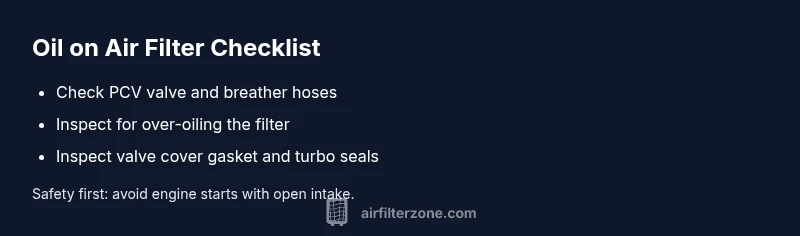
Why Does My Air Filter Have Oil On It? Diagnosis and Fixes
Discover why your air filter has oil on it, how to diagnose the source, and practical fixes for car and home filters. Air Filter Zone provides step-by-step guidance to prevent engine damage.


Oil on an air filter usually indicates an issue in the engine breathing path or an over-oiled filter. Start by checking for over-oiling after cleaning, then review the PCV valve and breather hoses. If unresolved, inspect for leaks and verify engine oil levels. See the full step-by-step guide below.
Understanding why your air filter has oil on it
If you're wondering why does my air filter have oil on it, the short answer is that oil reaches the filter through the engine's breathing path or from over-lubrication. According to Air Filter Zone, diagnosing oil on an air filter starts with understanding how oil can reach the intake and trap on the filter. This matters whether you're dealing with a car, motorcycle, or a home HVAC unit. In most cases, the issue is not catastrophic, but it signals a fault in the oil management path, such as a faulty PCV valve, a leaky breather hose, or an over-oiled filter element. By identifying the exact route, you can stop oil from contaminating the filter and starving the engine of clean air. The goal is to prevent a chain reaction that can hurt efficiency, increase emissions, or cause misfires. Read on to learn how to pinpoint the responsible system and apply a safe fix.
Common scenarios and quick checks
Oil on a filter can come from several scenarios. The simplest is an over-oiled filter that was not allowed to drain before installation after cleaning. Another frequent cause is PCV system problems, where crankcase pressure pushes oil vapor or droplets into the intake. A damaged valve cover gasket or breather hose can also leak oil into the intake path. In turbocharged engines, oil in the intake can appear on the filter if seals fail. Finally, using the wrong type of filter or oiling a non-oiled filter may deposit oil on the media. Quick checks focus on the oiling step, PCV function, and hose integrity.
How oil travels from the engine to the filter
Oil can migrate into the intake in a few ways. The PCV valve regulates crankcase gases that may carry oil droplets into the intake. The breather hose or valve cover breather can vent oil vapor. In forced-induction engines, turbo seals can force oil into the intake. A filter that has been over-oiled will saturate the media and show oil on its surface. Understanding these paths helps you trace the origin. When you inspect, look for visible oil on the filter media or around the housing, and note whether the oil is fresh or burnt.
Diagnosing the source: a practical flow
Begin with quick, safe checks and document what you find. Check the oil level and recent maintenance history to rule out overfill or recent oiling changes. Inspect the PCV valve and the crankcase breather hose for signs of clogging, wear, or disconnection. Look for oil leaks around the valve cover gasket and associated seals. If you have a turbo, inspect turbo seals and related plumbing for oil seepage. Remove and inspect the filter; note the location of any oil on the media vs the housing. This flow helps you differentiate between an over-oiled filter and a true engine oil leak.
Practical fixes you can try (non-destructive)
If the issue appears to stem from over-oiling, recheck the filter's oiling amount and ensure it drains fully before installation. When diagnosing PCV problems, clean or replace the PCV valve and inspect the breather hose for cracks or disconnections. For leaks around gaskets or hoses, reseal or replace affected parts. In turbocharged engines, address any seals or piping that may be leaking. Always run a short test drive after each fix to observe changes and avoid mixing troubleshooting steps.
Safety considerations and best practices
Safety first: disconnect the battery before accessing the intake system to prevent accidental starts. Wear gloves and eye protection when inspecting oil leaks or removing hoses. Work in a well-ventilated area, keep flammable vapors away from ignition sources, and never force parts that are stuck. If you smell burnt oil or see oil spraying from seals, stop and consult a professional to avoid engine damage.
Prevention: keeping oil off your air filter
Prevention starts with correct filter selection and installation. Use the recommended filter type and oiling method for your engine, and never over-oil an oiled filter or misfit a non-oiled filter. Regularly inspect the PCV system and replace faulty hoses or valves. Maintain proper engine oil level and quality, and perform periodic checks during service intervals to catch early signs of leaks or abnormal oil usage. Small, consistent maintenance reduces the risk of future filter contamination.
When to replace parts and consult a professional
If oil leakage persists after your checks, replace the faulty PCV components, hoses, gaskets, or seals as needed. In turbocharged or high-performance engines, persistent oil in the intake may indicate more serious issues requiring a mechanic with diagnostics tools. When in doubt, schedule a professional inspection to prevent engine damage and ensure air quality is not compromised.
Steps
Estimated time: 60-90 minutes
- 1
Power down and locate the air filter
Turn off the engine and remove the intake cover or airbox. Take photos of hoses and clamps to document original configuration. This gives you a safe baseline and prevents reassembly errors.
Tip: Label each hose clamp before removing to simplify reassembly. - 2
Inspect the filter media for oil
Carefully remove the filter and examine the media for oil saturation, shiny slicks, or residue. Note whether oil is fresh (amber) or burnt (darker) to infer potential sources.
Tip: If over-oiled, let the filter dry completely before reinstalling. - 3
Check the PCV valve and breather hose
Remove and inspect the PCV valve for blockage and replace if stuck. Inspect the breather hose for cracks or disconnections that could route oil into the intake.
Tip: Test the PCV valve by shaking it; a rattling valve often indicates proper operation. - 4
Inspect valve cover gasket and hoses
Look for signs of oil seepage around the valve cover gasket and the breather hose connections. Tighten clamps and reseal as needed, or replace gaskets if oil leakage is visible.
Tip: Clean any oil traces before reassembly to avoid mistaking new leaks. - 5
Inspect turbo seals (if applicable)
If you have a turbocharged engine, check seals and intake piping for oil seepage that could travel toward the filter. Replace worn parts as needed.
Tip: Consult service data for your turbo model to identify typical oil traces. - 6
Reinstall with correct filter type and oiling level
Use the correct filter type (dry vs pre-oiled) and apply only the recommended oil amount if you are re-oiling a filter. Ensure all connections are secure.
Tip: Avoid over-tightening clamps to prevent damage. - 7
Test drive and observe
Start the engine and run it for a few minutes, then inspect again for moisture or fresh oil near the filter housing. A short test drive helps confirm the fix.
Tip: Listen for unusual sounds or misfires during the test drive. - 8
Document results and plan next steps
Record results of checks and fixes. If oil returns, escalate to professional diagnostics to avoid engine damage.
Tip: Keep a log of maintenance actions and symptoms.
Diagnosis: Oil on air filter
Possible Causes
- highOver-oiled air filter after cleaning
- highPCV system issues leading to oil in intake
- mediumDamaged valve cover gasket or breather hose
- lowEngine oil leaks into intake (turbo or seals)
- lowUsing the wrong filter type or installation error
Fixes
- easyReassess oiling amount and ensure proper drainage of treated filters
- mediumInspect and replace PCV valve and breather hoses as needed
- mediumCheck valve cover gasket and related seals for leaks; reseal or replace
- hardInspect turbo seals and intake plumbing for oil seepage; repair as needed
- easyCorrect filter type and reinstall following manufacturer guidance; seek pro help if unsure
FAQ
Why is oil on my air filter a problem for my engine?
Oil on the air filter can carry contaminants into the engine and unbalance air-fuel mixtures. It often signals a PCV issue or over-oiling the filter. Left unaddressed, it can lead to reduced performance and increased emissions.
Oil on the air filter can hurt performance and emissions, usually pointing to a PCV issue or over-oiling. Address it by checking the PCV system and oiling level.
Can I reuse a soaked air filter after cleaning?
Reuse is not recommended if the filter is saturated with oil. Oil saturation can reduce filtration efficiency and allow contaminants to pass. Replace the filter if it is soaked or heavily soiled.
If the filter is soaked in oil, replace it. Reusing a dirty or oily filter can let contaminants into the engine.
Should I replace the PCV valve if oil is on the air filter?
Yes. A stuck or degraded PCV valve is a common source of oil migration into the intake. Replacing the valve often resolves the root cause and prevents future occurrences.
Check the PCV valve; replace if stuck or worn to prevent oil from leaking into the intake.
How can over-oiling the air filter cause problems?
Over-oiling can saturate the media and cause oil to be drawn into the intake, especially under boost or high vacuum. Follow manufacturer guidelines for oiling amounts.
Over-oiling the filter can push oil into the intake and onto the filter media, reducing filtration efficiency.
When should I seek professional help?
If symptoms persist after basic checks, or you notice oil leaks around seals or turbo components, consult a mechanic. Complex engine oil routing issues require diagnostics tools.
If the problem persists after basic checks, it's time to get a professional diagnostic.
Watch Video
Quick Summary
- Start with the simplest check: over-oiled filter
- Inspect the PCV system and breather hoses first
- Look for leaks around valve covers and gaskets
- Use correct filter type and oiling practices to prevent recurrence
- Seek professional help if uncertainty remains after checks