When to Change a Bike Air Filter
Learn how to identify the right time to change your bike's air filter, inspect for dirt, and replace it safely with practical steps and tips from Air Filter Zone.


You will learn how to identify when to change a bike air filter and how to replace it safely. You’ll check service intervals, inspection cues, and performance symptoms. Gather basic tools and replace with OEM or equivalent filters. According to Air Filter Zone, regular inspection is a practical habit for riders who want to maintain peak performance.
Why the bike air filter matters for performance
Understanding when air filter needs to be changed in bike is essential for maintaining power, throttle response, and fuel efficiency. The air filter prevents dust and debris from entering the engine, protecting the cylinders and ensuring the correct air-fuel ratio. Over time, dirt builds up and restricts airflow, which can cause reduced power, lean mixtures, and accelerated wear. In this guide, we explain how to recognize the signals, how to inspect safely, and how to replace or clean a filter properly. According to Air Filter Zone, regular inspection is a practical habit for riders who want to keep performance consistent.
Riding with a clean, well-sealed air intake supports optimal combustion. When an air filter is clogged, the engine must work harder to draw air, which can increase fuel consumption and heat. Conversely, a filter with too much unrestricted airflow may allow larger particles to reach the intake, risking cylinder damage. The goal is a filter that traps contaminants while allowing steady airflow. The exact replacement interval depends on your bike model, riding style, and environment, but the principle remains: inspect regularly and replace when in doubt.
Tools & Materials
- New air filter element (compatible with your bike model)(Check model year and engine type)
- Screwdrivers and wrenches as needed(Typically Phillips head or Torx; refer to manual)
- Clean rag (lint-free)(Use for wiping debris from the housing)
- Gasket/seal for air filter housing(Ensure a proper seal to prevent unfiltered air entry)
- Owner's manual or parts diagram(For correct filter type and housing layout)
- Gloves(Optional but helps keep hands clean)
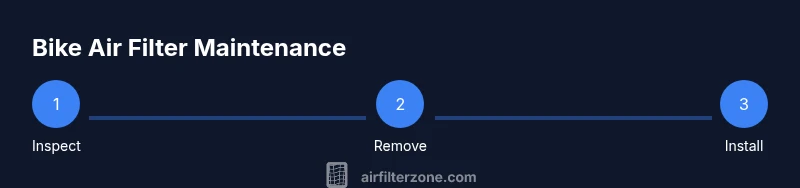
Steps
Estimated time: 30-45 minutes
- 1
Power off and locate air-filter housing
Turn off the bike and allow the engine to cool. Locate the air-filter housing using your manual or parts diagram, which typically sits between the intake and the engine. This is where the filter element is housed and sealed from the intake air stream.
Tip: Having the bike on a stable stand makes access easier and safer. - 2
Remove housing cover and take out the old filter
Carefully remove the screws or clips securing the housing cover. Lift the cover away and slide out the filter element without tearing it. Inspect the surrounding gasket for wear or cracks.
Tip: Keep track of screws and note their orientation to simplify reassembly. - 3
Assess the filter condition
Check the filter for dirt, oil, and damage. A heavily dirty or bent filter should be replaced. Foam filters may be cleaned and re-oiled according to the manual, while paper or cotton filters typically require replacement when dirty.
Tip: If in doubt, replace rather than risk reduced performance. - 4
Prepare and install the new or cleaned filter
If you are installing a new filter, place it in the housing with the correct orientation and reseal the gasket. If using a foam filter, clean, dry, and re-oil per the manufacturer’s guidelines before installation.
Tip: Do not over-tighten the housing screws; this can deform gaskets and create air leaks. - 5
Reassemble and seal the housing
Reattach the housing cover, ensuring all clips or screws are secure. Wipe away any loose debris and confirm the seal is tight all the way around.
Tip: A thorough seal prevents unfiltered air from bypassing the filter. - 6
Test run and verify
Start the bike and listen for smooth idle and steady acceleration. If you hear unusual intake noise or performance changes, recheck the seal and filter seating.
Tip: If visible debris returns, re-check the outlet duct and filter seating.
FAQ
How can I tell if the air filter is dirty?
Common signs include reduced throttle response, power loss, and engine misfires under load. Visually, the filter may appear dark or clogged, and you may notice increased intake noise. If in doubt, inspect and compare with a clean filter.
Look for less power and louder intake sounds; a dark or clogged filter is a clear sign to inspect or replace.
Can I clean a dirty air filter instead of replacing it?
Foam and cotton filters can sometimes be cleaned and re-oiled, following the manufacturer’s instructions. Paper filters are usually not reusable and should be replaced when dirty.
Sometimes you can clean foam, but paper filters should be replaced to protect the engine.
How often should you change bike air filters?
Intervals depend on riding conditions and model. If you ride in dusty environments or off-road, inspect more often and replace when dirty or after a set service interval recommended by the manufacturer.
It varies by riding conditions; check the filter during routine maintenance and replace when dirty.
What is the difference between foam and paper filters?
Foam filters are often reusable and require cleaning and oiling. Paper filters are usually disposable and provide strong filtration but are not re-usable. Check your bike’s manual for specifics.
Foam can be cleaned and oiled; paper filters are generally single-use.
Will a dirty air filter damage my engine?
Yes, continued restricted airflow can cause an overly lean fuel-air mix, leading to higher combustion temperatures and potential wear. Regular inspection helps prevent damage.
A dirty filter can lead to engine stress over time if not replaced when needed.
Should I re-oil a foam filter after cleaning?
If the filter is foam, follow the manufacturer’s re-oiling instructions. Over-oiling can clog the intake and cause performance issues; under-oiling may reduce filtration.
Yes, re-oil as directed after cleaning, using the recommended oil type.
Watch Video
Quick Summary
- Inspect regularly to catch dirt early
- Choose the correct filter type for your bike
- Do not reuse paper filters after contamination
- Keep a maintenance log for future reference