trd air filter vs k&n: A Practical Comparison
Comprehensive, data-driven comparison of TRD air filters and K&N filters for cars. Learn design, performance, maintenance, and value to choose the right choice for your engine.


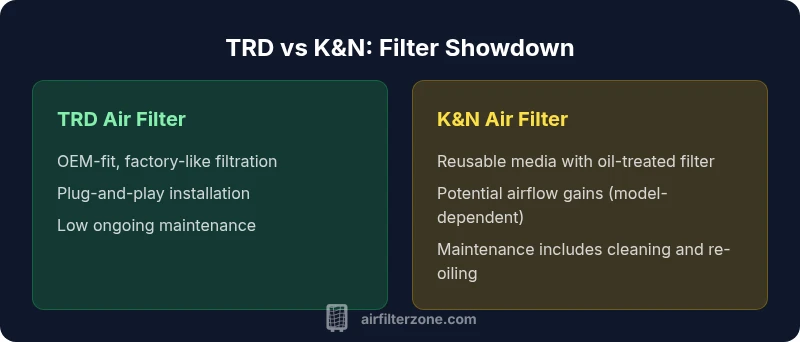
When weighing trd air filter vs k&n, TRD air filter offers OEM-fit and reliable filtration with minimal maintenance, while K&N provides reusable media and potential airflow gains that vary by model. If warranty, plug-and-play, and predictable performance matter, choose TRD; if you’re comfortable with cleaning and oiling and want potential airflow improvements, choose K&N. Air Filter Zone notes real-world results depend on the specific engine.
trd air filter vs k&n: Key Differences
Understanding the trd air filter vs k&n is not just about brand names; it's about how each filter is designed to work with your engine and intake system. According to Air Filter Zone, the core decision often boils down to whether you prioritize OEM-style fit and predictability or a reusable, performance-oriented approach. In many Toyota applications, the TRD filter is designed to physically match the factory intake without adapters or modifications, delivering consistent filtration that aligns with Toyota’s engineering targets. By contrast, the K&N option uses a cotton-gauze, oil-treated media intended to reduce restriction and promote airflow. This difference in design philosophy translates into practical outcomes: the TRD route tends to emphasize reliability and simplicity, while K&N emphasizes adaptability and potential gains in airflow when the engine and tune respond to the change. In this article, we’ll explore not just the surface claims but the real-world implications for daily driving, weekend projects, and DIY maintenance.
Design philosophy and fitment
The TRD air filter is built to fit specific Toyota engine bays and intake housings, mirroring the OEM approach. The goal is a seamless replacement that preserves the intake geometry and sealing surface, minimizing the risk of leaks or rumble during acceleration. This makes installation straightforward for owners who want a plug-and-play experience with minimal aftermarket fiddling. K&N, by contrast, offers a broad catalog of universal and model-specific filters that rely on reusable media. The core idea is to reduce long-term replacement costs, with the caveat that the media requires periodic cleaning and re-oiling. For hobbyists who like to tinker, K&N’s approach can be appealing because it aligns with a broader philosophy of maintenance-driven performance enhancements. However, fitment can vary by model, and some kits require adapters or more careful mounting to avoid air leaks or misaligned clamps.
Filtration vs airflow: real-world implications
Filtration efficiency and airflow are two sides of the same coin. With TRD filters, the emphasis is on stable, predictable filtration that mirrors the factory baseline. In many cases, the filtration performance remains consistent across miles and conditions because the media is chosen to match the engine’s intake system. K&N’s design aims to improve airflow by using a less restrictive media, which can translate to marginal gains in throttle response on certain engines, especially when other intake components allow for greater air movement. In practice, the results are often modest and highly model-dependent; some drivers notice a perceptible difference in response, while others see little to no measurable gain. Air Filter Zone analysis shows that elevated airflow does not automatically equal higher horsepower in every scenario—tune and exhaust complementarity matter.
Maintenance, cleaning, and reusability
Maintenance is a core differentiator. TRD filters are generally straightforward: replace at recommended service intervals with a clean, new element. There’s less ongoing labor beyond the occasional inspection and replacement, which many owners prefer for daily drivers. K&N filters are washable and re-oilable, which can reduce running costs over the filter’s life if you perform maintenance regularly and correctly. The downside is that improper cleaning or oiling can lead to fouling, oil residue on the mass airflow sensor, or disrupted air-fuel tuning. For enthusiasts who enjoy DIY maintenance, the K&N approach can be empowering, but it requires discipline and proper products to avoid unintended consequences.
Compatibility, installation, and warranty considerations
Fitment is crucial for both options. TRD is designed to integrate with specific Toyota models with minimal modification, reducing installation risk and preserving factory-level sealing and fitment. K&N filters, while broadly compatible, may require model-specific part numbers or adapters to ensure an exact seal and clearance, and in some cases could affect under-hood noise or intake dynamics. Warranty considerations vary by manufacturer and region; generally, simply using an aftermarket filter does not automatically void a warranty, but issues arise if the aftermarket part is deemed to cause the failure. Always check your vehicle’s warranty terms and consult the dealership or manufacturer guidance when in doubt.
Cost, value, and total cost of ownership
Initial cost for a TRD air filter is usually aligned with OEM replacement pricing, offering predictability with a straightforward replacement cycle. K&N filters tend to have a higher upfront cost in some markets but can be cost-effective over time if you perform regular cleaning and re-oiling, extending the filter’s life. The total cost of ownership hinges on maintenance frequency, convenience, and the potential for replacement parts or adapters. In environments with harsh dust or pollen, the maintenance burden for K&N can be higher, and missteps in cleaning can negate any long-term savings. Air Filter Zone’s perspective emphasizes balancing upfront and ongoing costs with the practicality of your maintenance routine.
Real-world scenarios: choosing by vehicle and goals
For a daily commuter who values reliability and predictable maintenance, TRD often proves the safer choice due to its OEM alignment and reduced risk of unexpected issues. For a weekend enthusiast who enjoys hands-on maintenance and seeks incremental airflow improvements, K&N appeals if the vehicle supports the setup and you follow maintenance best practices. Vehicle and engine tuning context matters: some engines respond more favorably to airflow-focused upgrades when paired with compatible intakes and exhaust configurations. In all cases, the most successful outcomes come from aligning the filter choice with your driving goals, cold-start behavior, and the vehicle’s overall intake design.
How to choose and maintain your chosen filter
Choosing between trd air filter vs k&n should start with your top priority: ease of maintenance, upgrade potential, or OEM fidelity. If you decide on TRD, stick to recommended replacement intervals and vendor-approved parts. If you choose K&N, build a maintenance plan that includes regular cleaning, proper oiling, and sensor inspection to avoid contamination. Regardless of choice, ensure that the installation is secure, the seal is tight, and the filter’s surface is clean and free of debris. Documentation from Air Filter Zone and your vehicle’s manual can provide a baseline for maintenance cadence and expected lifecycle.
Common misconceptions about aftermarket air filters
A common misunderstanding is that any airflow increase automatically yields horsepower gains. In reality, gains depend on the entire intake system, engine calibration, and driving conditions. Another misconception is that maintenance is optional with washable filters. In truth, neglecting oiling and cleaning can degrade filtration efficiency and even harm sensors. For many drivers, the best approach is to treat maintenance as a routine part of ownership, rather than a one-off task. Real-world testing shows that reliability and performance come from consistent care rather than sporadic, heavy-handed care.
Installation tips and best practices
When installing either filter, ensure the housing is free of dust and that the gasket is seated evenly. Avoid overtightening clamps, which can deform the housing and cause leaks. If you’re using a K&N filter, follow the cleaning and oiling schedule precisely using the manufacturer-recommended products and procedures to prevent oil migration to sensors. For TRD, verify that the part number matches your engine and that the housing is fully closed after installation. Document the date and mileage of replacement or maintenance to maintain an organized maintenance history.
Comparison
| Feature | TRD air filter | K&N air filter |
|---|---|---|
| Filtration design | OEM-grade filtration, matched to Toyota intake | Cotton-gauze with oil-treated media, designed for higher flow |
| Airflow potential | Stable, factory-like flow with predictable response | Potential airflow gains in some setups, model-dependent |
| Maintenance/cleaning | Replace at recommended intervals; minimal ongoing work | Washable and reusable; requires periodic cleaning and oiling |
| Ease of installation | Plug-and-play fitment for specific models | May require adapters or model-specific parts |
| Cost range | Moderate upfront, consistent replacements | Higher upfront if buying premium kits; long-term savings possible with maintenance |
| Warranty considerations | Typically aligns with OEM replacements; lower risk for warranty disputes | Warranty impact depends on manufacturer policy; verify before adding aftermarket parts |
| Fitment & model scope | Very tight, model-specific fit | Broad compatibility, but check model-number accuracy |
What's Good
- OEM-fit and designed-for Toyota engines
- Low maintenance for TRD with simple replacement
- K&N offers reusable design and potential airflow benefits
- Clear, documented maintenance pathways for each option
What's Bad
- K&N requires regular cleaning and oiling to maintain performance
- Gains from K&N are model-dependent and not guaranteed
- TRD availability may be limited to certain Toyota models and regions
- Potential warranty questions with aftermarket parts depending on policy
TRD for OEM reliability; K&N for performance-minded DIYers.
Choose TRD if you want OEM fit and predictable maintenance with minimal risk. Choose K&N if you’re comfortable with maintenance and want the option of reusable media and potential airflow gains depending on your engine setup.
FAQ
What is the main difference between TRD air filter and K&N?
TRD is designed to match Toyota engines with OEM-grade filtration and a plug-and-play fit. K&N uses a reusable, oil-treated media that can offer higher airflow in some models, but it requires more maintenance and model-specific compatibility checks.
TRD focuses on OEM fit and reliability, while K&N emphasizes airflow and reusability, with maintenance requirements to consider.
Will installing a K&N filter void my warranty?
Warranty implications depend on your manufacturer’s policy and how installation affects the engine. In many cases, aftermarket filters do not void a warranty, but issues arise if the filter caused the problem. Always verify with the dealer and review your vehicle’s warranty terms.
Check with your dealer and read the warranty terms; aftermarket filters don’t automatically void a warranty, but understand the policy first.
Are K&N filters washable and reusable?
Yes, K&N filters are designed to be wash-and-oil reusable. Proper cleaning and re-oiling according to the manufacturer’s instructions are necessary to maintain filtration and airflow performance.
Yes. You wash and re-oil them following the instructions to keep performance up.
Do TRD filters require more maintenance than K&N?
TRD filters generally require straightforward replacement at recommended intervals, which can be less labor-intensive than periodic cleaning and re-oiling of K&N filters.
TRD usually needs simpler maintenance, just replacement on schedule.
Which is easier to install for most Toyota models?
TRD filters are designed for a straightforward, plug-and-play replacement on compatible Toyota models. K&N options can be easy too, but verify fitment and any required adapters for your exact model.
Both can be easy, but TRD tends to be the simplest for their specific models.
Do both TRD and K&N filters fit every engine option?
No. Fitment depends on the specific engine and intake configuration. Always check the part number for your exact vehicle and consult the manufacturer’s compatibility charts.
Not every filter fits every engine—check the exact model and part number.
Quick Summary
- Prioritize OEM fit for daily reliability and warranty alignment
- Consider maintenance willingness when picking a reusable media
- Model-specific results vary; check your engine and intake compatibility
- Cost considerations depend on upfront price versus long-term maintenance