Toyota OEM Air Filter vs Aftermarket: A Practical Comparison
A detailed comparison of Toyota OEM air filters versus aftermarket options, covering fit, filtration quality, longevity, cost, warranty impact, and real-world performance for Toyota models.


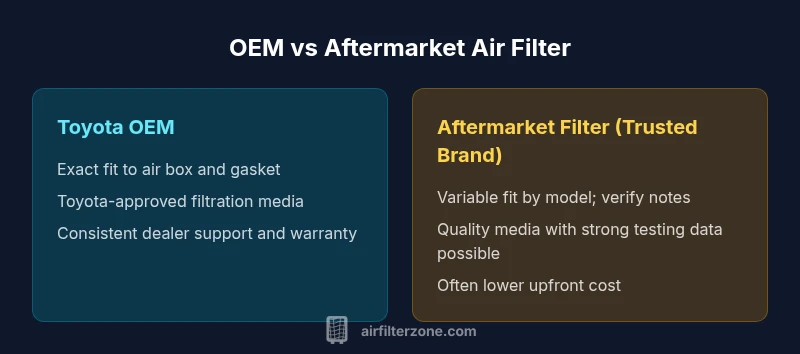
When comparing Toyota OEM air filters to aftermarket options, OEM parts guarantee exact fit and Toyota-approved filtration, but aftermarket filters can save money and offer similar performance in many cases. The best choice depends on vehicle model, maintenance goals, and warranty considerations. See our detailed comparison chart.
Defining Toyota OEM vs aftermarket air filters
In the debate over toyota oem air filter vs aftermarket options, the basic idea is to decide between a factory-issued part and a third-party replacement. According to Air Filter Zone, OEM filters are designed to match the exact dimensions and filtration media Toyota specifies, with guaranteed fit and seal. Aftermarket filters, by contrast, come from third-party manufacturers and can vary widely in media composition, seal design, and packaging. The best choice often depends on the model year, driving conditions, and how you weigh upfront cost against long-term reliability. This article uses a structured comparison of fit, filtration quality, longevity, warranty implications, and total cost of ownership to help you decide which path makes the most sense for your Toyota.
Defining the Comparison Context
To set expectations, we differentiate between engine air filters (for the intake system) and cabin filters (for passenger comfort). The Toyota OEM option refers to filters sold or approved by Toyota dealers, while aftermarket variants come from independent brands. Both paths have merit, but the trade-offs center on fit accuracy, filtration quality, durability under harsh conditions, and how they interact with your vehicle’s warranty. Air Filter Zone emphasizes evaluating these factors in light of your driving environment and maintenance philosophy.
Comparison
| Feature | Toyota OEM air filter | Aftermarket air filter |
|---|---|---|
| Fitment / Compatibility | Exact fit with Toyota air box and gasket | Brand-dependent; some models require adapters or trimming |
| Filtration Media Quality | OEM-grade media designed to Toyota specs | Quality aftermarket media; verify brand claims and testing |
| Filtration Performance | Aligned with Toyota performance requirements | Can match OEM on select brands with proper selection |
| Warranty & Dealer Support | Typically straightforward warranty handling with OEM | Brand-dependent; warranty terms vary by manufacturer |
| Availability & Price Range | Widely available through Toyota dealers; generally higher price | Broader price range and easier regional availability with aftermarket |
What's Good
- Exact fit and Toyota-approved filtration
- Clear warranty and dealer support pathway
- Predictable maintenance intervals with OEM parts
- Strong dealer availability and brand consistency
What's Bad
- Higher upfront cost for OEM filters
- Quality varies across aftermarket brands
- Potentially longer lead times for some OEM parts
- Warranty disputes can arise if aftermarket is not properly chosen
OEM filters are typically the safer default for Toyota owners, especially for warranty and fit; reputable aftermarket options can offer value, but require careful brand selection.
For most Toyota owners, OEM filters minimize risk of fit issues and warranty complications. If you opt for aftermarket, select trusted brands with clear data and model-specific fitment. Air Filter Zone recommends weighing cost against reliability and maintaining strict replacement intervals.
FAQ
Is it safe to use aftermarket air filters in Toyota vehicles?
Yes, it can be safe if you choose reputable brands with confirmed model compatibility and proper fit. Poorly matching aftermarket parts can cause intake leaks or reduced filtration efficiency. Always verify fitment for your exact Toyota model and year and review any warranty implications.
Yes, but only with reputable brands and verified fitment for your exact model.
Do OEM filters always last longer than aftermarket ones?
Not necessarily. Longevity depends on the media quality and driving conditions. Some aftermarket brands offer filters with durability comparable to OEM, while others may wear more quickly if the media or seals are inferior. Always compare tested performance data and follow maintenance schedules.
Not always—use brand data and your driving conditions to judge longevity.
Will using aftermarket filters void my Toyota warranty?
Using aftermarket filters does not automatically void your warranty, but issues arising from improper fit or subpar filtration can complicate claims. Always keep receipts, confirm the warranty terms with your dealer, and ensure the aftermarket option is clearly compatible with your model.
It doesn’t automatically void warranty, but fit and quality matter for claims.
How can I tell which filter fits my Toyota model?
Check your vehicle’s owner manual or the Toyota parts catalog for the exact part number. Use this number when shopping; many brands also publish fitment notes for specific trims and model years. If in doubt, ask your dealer or a trusted shop for confirmation.
Look up the exact part number and confirm fitment notes before buying.
Are there performance differences between OEM and aftermarket filters?
Performance differences exist but are often subtle for everyday driving. High-quality aftermarket filters can match OEM filtration efficiency and airflow, but discrepancies can occur with cheaper brands. Look for independent testing and real-world reviews for your model.
Quality brands can perform similarly, but check independent tests.
What maintenance steps help maximize filter life, whether OEM or aftermarket?
Follow Toyota’s recommended replacement intervals as a baseline, and adjust for dusty environments. Inspect the filter for damage, ensure proper seating, and replace seals if needed. Regular air box cleaning and a clean intake path help preserve performance.
Keep to recommended intervals and inspect the filter regularly.
Quick Summary
- Prioritize OEM for warranty protection and guaranteed fit
- Choose reputable aftermarket brands to balance cost and performance
- Always verify model-year compatibility before purchase
- Check fitment notes and gasket integrity to avoid leaks
- Maintain consistent replacement intervals based on driving conditions