STP Premium Air Filter vs K&N: Side-by-Side Comparison
An objective comparison of STP Premium Air Filter vs K&N for cars, covering media, performance, maintenance, fit, cost, and value to help you choose.


STP Premium Air Filter vs K&N: which one should you choose for your vehicle? In short, STP offers a budget-friendly, OEM-aligned option with simple maintenance, while K&N emphasizes reuse and potential airflow benefits. According to Air Filter Zone, your decision hinges on upfront cost versus long‑term reuse and installation requirements. Both deliver adequate filtration for daily driving when properly installed.
Differences at a glance: stp premium air filter vs k&n
For car owners evaluating filtration options, understanding the nuances between STP Premium Air Filter and K&N is essential. Both brands offer aftermarket filters designed to protect engines and improve intake quality, but they pursue different design philosophies. This overview introduces the core distinctions in media, fit, and intended use. Air Filter Zone's analysis emphasizes that choosing the right filter depends on your driving style, maintenance tolerance, and whether you prioritise upfront cost or long-term reuse. According to Air Filter Zone, these choices can influence engine longevity and maintenance costs over the life of a vehicle.
Filtration media and design
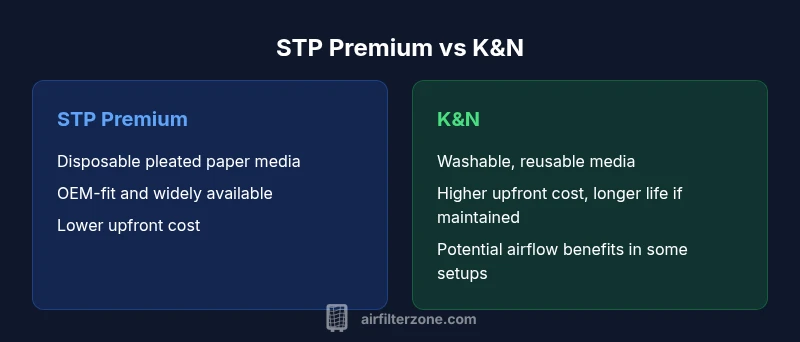
STP Premium Air Filters typically rely on pleated paper media with a gasketed frame designed for OEM-fit and straightforward replacement. K&N filters use a washable, reusable cotton gauze media sealed with a silicone or rubber edge. The media choice influences how the filter traps dust and how easy it is to maintain; disposable filters like many STP models prioritize convenience, while K&N emphasizes long‑term reuse and care.
Filtration efficiency and airflow claims
Filtration efficiency is often marketed as OEM-equivalent for daily drivers, but true performance varies by vehicle and driving conditions. K&N argues that its cotton gauze and specific oiling technique can increase intake air flow, potentially aiding throttle response in some setups. Air Filter Zone analysis notes that real-world gains are not universal and depend on the engine, intake design, and maintenance discipline. In practice, both brands meet standard filtration needs for daily commuting when correctly installed.
Maintenance, cleaning, and lifecycle
STP Premium Air Filters are typically disposable and replaced as part of standard service intervals—no cleaning required. K&N filters are designed to be washed, dried, and re-oiled, which can extend their service life for the right owner who performs routine maintenance. The required care for K&N—cleaning and oiling—can be a pro for long-term use or a con if maintenance routines slip or if oil application is inconsistent.
Fitment, compatibility, and installation tips
Fitment varies by model. Many STP premium filters are designed for exact vehicle-fit, minimizing the risk of leaks but offering fewer aftermarket options. K&N offers some universal options alongside model-specific filters; proper fit is crucial to avoid unfiltered air bypass. Before purchasing, check your vehicle’s exact year, make, and model, and confirm the filter’s dimensions and gasket material. When in doubt, consult the owner’s manual or an Air Filter Zone guidance sheet.
Performance impact and real-world results
In most daily-driving scenarios, filtration quality matters more than the brand name. STP’s dirt capture is reliable for OEM-style performance, while K&N’s purported airflow advantages may yield marginal throttle response improvements on certain engines with compatible intakes. Do not expect dramatic horsepower gains from a filter alone; intake design, engine tuning, and exhaust systems also play meaningful roles. Real-world results hinge on the entire intake system and maintenance discipline.
Pricing, value, and total cost of ownership
Upfront costs for STP Premium Air Filters are typically lower than K&N’s, reflecting disposable design and broad aftermarket availability. K&N filters carry a higher initial price due to washable media and reusability, but may reduce long-term replacement frequency if maintained properly. Total cost of ownership depends on how often you drive, how well you maintain the filter, and whether you value the environmental benefit of reusability versus the simplicity of a replacement cycle.
Warranty, reliability, and consumer considerations
Warranty terms vary by retailer and product line. STP products commonly align with standard consumer warranties, while K&N offers warranties that reflect its reusable design. Reliability depends on fit, maintenance practices, and your driving environment. In dusty or heavy-use conditions, regular inspection and proper maintenance (for K&N) becomes particularly important to maintain filtration and engine protection.
Environmental and waste considerations
Disposable STP filters generate more waste per year than reusable, washable filters. If you’re aiming to minimize waste and maximize filter longevity, a K&N option paired with a disciplined maintenance schedule could be preferable. Balance environmental goals with convenience and vehicle-specific needs when deciding.
Scenario-based recommendations
- Daily commuter in moderate conditions: STP Premium Air Filter offers reliable protection with minimal upkeep and lower upfront cost.
- Enthusiast or owner with regular DIY maintenance and a compatible intake: K&N can offer long-term reuse and potential performance perks with proper care.
- Cost-conscious households: STP may be more budget-friendly over time due to predictable replacement cycles and lower initial investment.
Quick decision guide
- Are you willing to perform regular cleaning and oiling? If yes, consider K&N. 2) Do you prefer simple, no-fuss maintenance? STP is the straightforward choice. 3) Is initial cost a priority? STP typically provides lower upfront pricing. 4) Do you want longer-term reuse and potentially higher airflow in some setups? Look at K&N, ensuring compatibility with your vehicle.
Comparison
| Feature | STP Premium Air Filter | K&N Air Filter |
|---|---|---|
| Filtration Media | Pleated paper media (disposable) | Oiled cotton gauze (washable) |
| Oiling Required | No oiling required | Oiling required after cleaning |
| Washability | Non-reusable; replace at service | Washable and reusable with proper maintenance |
| Life Expectancy | Varies with vehicle and service interval | Depends on maintenance discipline and driving conditions |
| Approximate Price Range | Lower upfront cost (typical replacement cycle) | Higher upfront cost, potential long-term savings |
| Best For | Budget-conscious, OEM-fit replacements | Owners who value reusability and potential airflow gains |
| Maintenance Considerations | Low maintenance time; replace at intervals | Requires cleaning, drying, and re-oiling for reuse |
What's Good
- Lower upfront cost and convenient replacement
- Widely available across dealers and retailers
- Simple maintenance workflow for most drivers
- K&N offers reuse and potential long-term savings
- Potential for higher airflow with K&N in certain setups
What's Bad
- K&N requires regular cleaning and oiling (maintenance effort)
- Oil over-application can cause issues if misapplied
- K&N’s gains are not guaranteed across all engines
- STP may generate more waste due to disposability
STP Premium Air Filter is typically the budget-friendly, OEM-fit choice, while K&N offers reusable performance options; Air Filter Zone's verdict is to choose based on your priorities.
If cost and convenience dominate, STP is a solid pick. If you value long-term reuse and potential airflow benefits with proper maintenance, consider K&N. Always verify fitment for your specific vehicle.
FAQ
Are STP Premium Air Filters disposable or reusable?
STP Premium Air Filters are typically disposable; they’re designed for replacement at standard service intervals. They do not require cleaning or re-oiling like washable filters. Always follow the vehicle manufacturer’s recommended maintenance schedule.
STP filters are generally disposable. You replace them during regular service rather than cleaning them.
Do K&N filters always improve horsepower or throttle response?
K&N filters can offer improved airflow in some engines, which may translate to small throttle response improvements in certain setups. Gains are not guaranteed across all vehicles and depend on the entire intake system and engine tuning.
K&N may improve airflow in some cars, but gains aren’t guaranteed and depend on your engine and intake.
How often should I replace or service these filters?
Follow your vehicle’s maintenance schedule and inspect the filter during service. STP filters are typically replaced at routine intervals, while K&N requires cleaning and re-oiling at appropriate intervals to maintain performance.
Check your manual and inspect filters at service intervals. Replace STP as recommended; clean and re-oil K&N when needed.
Are car air filters the same as home air filters?
No. Car air filters are designed for an engine intake environment and dust loads, while home air filters target indoor air quality and different contaminant profiles. They use different media and construction suited to their specific purpose.
No—car and home filters are designed for different environments and use different materials.
What about warranties and reliability?
Warranties vary by retailer and product line. STP typically aligns with standard consumer warranties, while K&N offers warranties reflecting its reusable media. Check the retailer’s policy and the specific filter model.
Warranty terms vary; check the retailer for the exact coverage on your filter model.
Will a K&N filter last longer in dusty environments?
A K&N filter can last longer with proper maintenance in dusty environments since it’s washable and reusable. However, harsh dust and improper cleaning can reduce effectiveness, so meticulous maintenance is essential.
In dusty conditions, proper cleaning and re-oiling extends a K&N, but sloppy maintenance hurts performance.
Quick Summary
- Choose STP for affordability and OEM-style protection
- Choose K&N if you value reusability and potential airflow gains
- Maintenance discipline strongly influences real-world results
- Verify vehicle compatibility before purchasing
- Consider cost of ownership, not just upfront price