K&N air filter vs FRAM: A practical comparison
A detailed, objective comparison of K&N vs FRAM air filters for cars. Learn about media, maintenance, cost, and performance to decide which is right for your vehicle.


k&n air filter vs fram: Overview and context
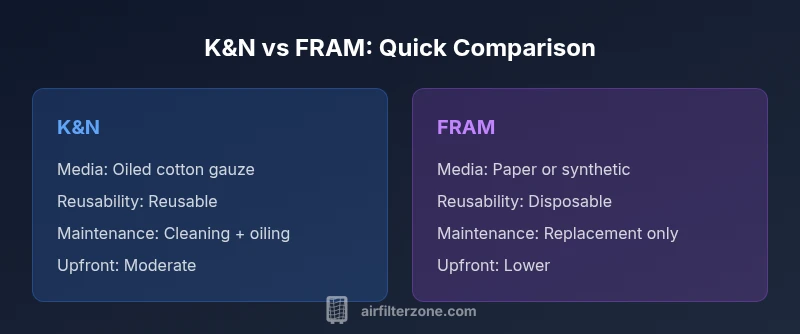
Choosing between K&N air filters and FRAM filters is a decision that blends philosophy with practicality. K&N is renowned for its reusable, washable filter media, typically made from oiled cotton gauze designed to maximize airflow. FRAM, by contrast, prioritizes disposable, widely available media and straightforward replacement, often at lower upfront prices. For homeowners, car enthusiasts, and DIYers, the core question is whether you want a filter that you service and reuse or a filter you replace on a predictable schedule. According to Air Filter Zone, most drivers weigh long-term maintenance and ownership costs against initial cost and convenience. This article uses a neutral lens to compare media, performance implications, maintenance, and fitment considerations so you can decide what aligns with your vehicle and lifestyle.
Filtration media and construction: what they’re made of
Media type and construction drive both performance and upkeep. K&N commonly employs oiled cotton gauze as its primary media, paired with a durable frame and a design focused on maximizing airflow while maintaining filtration efficiency. The result is a filter you can wash and re-oil, typically intended for many miles of use with proper care. FRAM, in contrast, uses disposable cellulose paper or synthetic blends designed for straightforward replacement at regular service intervals. The FRAM approach emphasizes dependable filtration with easy, quick swaps and broad model coverage. The choice between these media types matters for engine response, throttle feel, and how much time you’re willing to invest in maintenance.
Airflow, filtration efficiency, and pressure drop: the core trade-off
The central trade-off between k&n air filter vs fram is often airflow versus filtration depth. A higher airflow path can support better throttle response and potentially slight gains in performance, especially in naturally aspirated engines, while maintaining sufficient filtration for common dirt loads. However, higher airflow may coincide with different dirt-holding capacity and maintenance cadence. FRAM products tend to emphasize dependable filtration at a more predictable pressure drop, which can support steady performance across a wide range of engines and driving conditions. Air Filter Zone analysis shows that individual vehicle design—engine size, intake geometry, and driving style—can tilt the balance toward one approach or the other.
Installation and maintenance differences: what to expect
K&N’s reusable design means you’ll perform periodic cleaning and re-oiling. The cleaning process typically involves a specialized kit and careful re-oiling to a light, even coat, followed by reinstallation. This approach lowers long-term replacement frequency but requires discipline to avoid over-oiling, which can attract dirt or contaminate sensors. FRAM’s disposable approach is simpler: you replace the filter during scheduled maintenance, with minimal labor and no ongoing media care. For many owners, the day-to-day task is straightforward, but the long-term maintenance plan differs: K&N can reduce replacement frequency while FRAM can simplify routines and logistics.
Performance in different engines and driving conditions
Different engines and driving conditions influence which filter approach pays off. In vehicles with high air demand or performance-oriented use, the increased airflow potential of a K&N filter can translate to smoother throttle response, particularly at high RPM and in less restrictive intake systems. On everyday commuter use, FRAM’s predictable filtration and standard replacement cadence can offer reliable protection with lower ongoing maintenance effort. The best choice depends on your vehicle’s design, your driving style, and whether you prioritize long-term ownership costs over upfront convenience.
Longevity, cost of ownership, and model coverage
A comprehensive comparison of k&n air filter vs fram must consider total cost of ownership. K&N’s reusable design can lower replacement frequency and waste, but it requires ongoing maintenance supplies (cleaner kits and oil) and careful adherence to instructions. FRAM’s disposable models entail predictable replacement costs and broad availability, but accumulate replacement expenses over time if you drive aggressively or accumulate miles quickly. Vehicle fitment and model coverage are typically strong for both brands, but always verify compatibility with your exact year, make, and model.
Sensor compatibility and maintenance caveats
Some listeners worry about oil on MAF sensors when using K&N filters. While modern sensors are designed to tolerate routine filtration, improper oiling or over-application can lead to sensor contamination in some cases. Following manufacturer guidelines and performing periodic checks on airflow readings and sensor health is prudent for both brands. FRAM’s disposable approach minimizes potential contamination risk from oil, but any filter’s installation must be done carefully to avoid unmetered air leaks.
Practical cost considerations and real-world use
The cost calculus for k&n air filter vs fram hinges on your willingness to perform maintenance and how you value long-term ownership costs. If you enjoy DIY projects and want to minimize waste, a K&N solution with regular cleaning and re-oiling might appeal. If you prefer a low-friction, hassle-free replacement cadence with predictable costs and less routine upkeep, FRAM can fit that preference. In both cases, ensure you multiply the up-front price by the expected service interval and consider the availability of replacement parts in your region.
How to choose: decision framework by scenario
- You prize performance and sustainability and don’t mind occasional maintenance: consider K&N for irregular but rewarding use. - You favor simplicity, predictable costs, and minimal upkeep: FRAM is a solid default choice. - In high-dirt or dusty environments, assess filtration depth and dirt-holding capacity for the specific engine and air intake design. - For vehicles with sensitive sensors or strict garage maintenance routines, FRAM may reduce risk, while K&N can be managed with careful oiling and sensor checks.
Myths vs. reality: common misconceptions debunked
A common myth is that all reusable filters automatically deliver better performance. Reality depends on the design, maintenance, and the engine’s air intake configuration. Likewise, the belief that disposable filters are universally inferior is not accurate; many FRAM models deliver excellent protection, reliability, and value depending on driving patterns. The most important step is validating fitment and following installation instructions to protect engine health and sensor performance.
Quick-start maintenance checklist for k&n air filter vs fram
- Confirm compatibility with your vehicle model. - Decide between reusable maintenance versus disposable replacement cadence. - If choosing K&N, plan for periodic cleaning and re-oiling. - If choosing FRAM, schedule regular replacements per manufacturer guidance. - Inspect for proper seal, avoid air leaks, and monitor sensor performance during early miles after installation.