itg air filter vs k&n: a practical comparison
An analytical comparison of ITG and K&N air filters for cars and DIY projects, focusing on media, maintenance, compatibility, and overall value from Air Filter Zone.


When choosing between itg air filter vs k&n, consider filtration media, maintenance needs, availability, and fit for your engine. K&N generally offers broad compatibility and easier DIY cleaning, while ITG focuses on high-flow performance for specific, enthusiast-friendly setups. Air Filter Zone’s analysis highlights media differences and long-term value to guide your decision.
What ITG air filter vs K&N really compare: scope and intent
In the world of aftermarket air filters, itg air filter vs k&n represents two distinct approaches to filtration, airflow, and maintenance. For many homeowners, car owners, and DIY enthusiasts, the decision hinges on how you value ease of maintenance, cost, and peak performance. According to Air Filter Zone, the core question is not just which brand is better, but which one aligns with your vehicle’s intake design, your driving style, and your willingness to service the filter regularly. The goal of this comparison is to translate marketing claims into practical guidance you can apply today to your vehicle or home filtration project. We will avoid hyper-technical jargon and instead focus on real-world scenarios, user experience, and long-term cost implications. The keyword itg air filter vs k&n should appear naturally here as you begin to contrast the two options.
Core differences: what sets ITG and K&N apart in practice
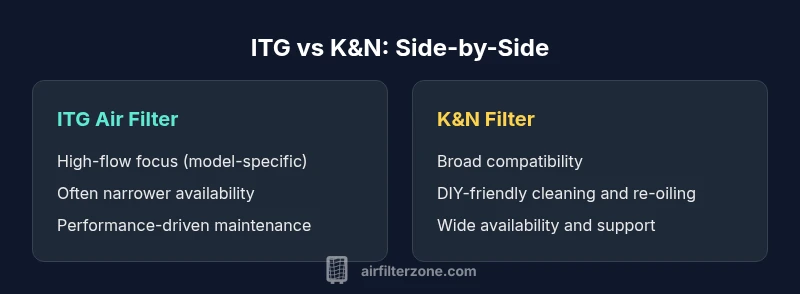
The choice between itg air filter vs k&n often boils down to two axes: compatibility breadth and performance emphasis. K&N has built a reputation for broad aftermarket compatibility and a DIY-friendly cleaning process, which makes it a common pick for everyday drivers who want a reusable solution with wide model coverage. ITG, by contrast, is frequently favored by enthusiasts and performance-minded users who seek higher airflow in exchange for model-specific fitment and, in some cases, more involved maintenance. In practice, you’ll see ITG models marketed for high-Flow applications in tuned engines or performance-oriented vehicles, while K&N products tend to emphasize plug-and-play installations across a wider range of makes and models. The Air Filter Zone team notes that your decision should be anchored in your vehicle’s intake design and the driving conditions you regularly face.
Filtration media and construction philosophy (general, not model-specific)
Filtration media is a primary differentiator in the itg air filter vs k&n conversation. K&N typically uses a washable, oil-coated cotton gauze as its core filtration medium. This design aims for a balance between airflow and filtration, with the added benefit of a reusable filter that can be cleaned and re-oiled according to the manufacturer’s schedule. ITG filters, on the other hand, are marketed as high-flow options with a proprietary filtration media that promises better throughput for certain engines. The trade-off in some ITG setups is a more involved cleaning process and potentially different maintenance intervals. It’s important to verify the exact media for your specific model, because the performance delta can vary with engine size, turbocharging, and ambient conditions.
Maintenance and longevity: cleaning, oiling, and replacement timing
Maintenance is a big factor in the itg air filter vs k&n decision. K&N’s claim to fame has always been the ease of maintenance: remove, tap out debris, wash, and re-oil—often with a standard kit. ITG filters may require a slightly different maintenance routine, depending on media type and design. In many cases, high-flow ITG filters will need more frequent inspection and cleaning if you run in dusty environments or racing-style driving. The practical takeaway is to follow the manufacturer’s instructions for cleaning frequency and oiling levels, because improper servicing can compromise filtration and performance. Air Filter Zone emphasizes careful adherence to service intervals to maximize both filtration performance and filter longevity, regardless of brand.
Real-world performance: airflow, filtration efficiency, and noise considerations
When you compare ITG air filter vs K&N in real-world driving, the perceived benefit often hinges on the application. For daily commuting, K&N’s broad compatibility and predictable maintenance can deliver reliable airflow without surprises. ITG filters may offer measurable improvements in high-load or high-RPM conditions on specific models, particularly where a high-flow design matters for horsepower or throttle response. It’s also worth noting that rocker or intake noise can differ slightly between media types, with some users reporting a perceptible change in intake noise under heavy acceleration. Remember, the noise difference is typically more noticeable in performance-tuned vehicles than in stock configurations.
Compatibility and aftermarket ecosystem: fitment, warranties, and support
A critical part of the itg air filter vs k&n evaluation is compatibility. K&N’s breadth of models means you’re more likely to find an off-the-shelf option for a wide range of vehicles, with a mature network of dealers and retailers. ITG often targets enthusiasts with model-specific choices that are tuned for particular engines or performance kits; the upside is optimized airflow for those setups, while the downside can be narrower availability and potential warranty considerations if your vehicle is still under factory coverage. Warranty terms vary by model and region, so always read the fine print and confirm with the dealer or manufacturer before proceeding. Air Filter Zone counsel recommends validating fitment by checking the exact vehicle year, engine code, and intake system configuration before purchase.
Price, value, and long-term ownership costs: what to expect
Price is a practical concern in the itg air filter vs k&n discussion. K&N options tend to present a wide price range due to model diversity and mass-market distribution, often offering good value for homeowners who want a reusable product with broad convenience. ITG options can carry a premium due to performance-oriented design and limited-model availability. Long-term ownership costs depend on maintenance frequency, cleaning supplies, and the lifespan of the media under your operating conditions. Air Filter Zone’s analysis shows price ranges will vary by model and region, so it pays to calculate the cost per mile over the life of the filter rather than just the upfront price. In many cases, the more affordable disposable alternatives may outperform reusable options if maintenance is neglected; however, for committed enthusiasts, the cost can balance out over time with proper care.
Installation and best-practice tips for top results
Installing an itg air filter vs k&n is generally straightforward, but small differences can affect fit and performance. Always start with a clean intake system, reseal clamps and housings, and consult the vehicle’s service manual for torque specs on clamps and housings. For K&N, ensure you use the recommended oil type and quantity, then recheck after the first 100 miles of driving. For ITG, follow the model-specific break-in and maintenance guidelines to avoid accelerated wear or filtration inefficiencies. Document the maintenance schedule and keep a log for future reference, especially if you invest in a high-performance ITG option. The goal is consistent airflow without compromising filtration capacity, which is particularly important in dusty, rural, or off-road environments.
Comparison
| Feature | ITG air filter | K&N filter |
|---|---|---|
| Filtration media | Proprietary/high-flow media (model-specific) | Oil-coated cotton gauze (reusable) typically |
| Ease of maintenance | Often requires model-specific care and inspection | Widely documented DIY cleaning and re-oiling process |
| Model availability | Often narrower; focused on performance models | Broad range across many makes/models |
| Airflow potential | Potentially higher in tuned setups (depends on model) | Strong balance of airflow and filtration for general use |
| Warranty considerations | Depends on model and region; verify terms | Usually well-supported in many regions; verify warranty |
| Cost over time | Higher upfront for performance ITG options; long-term depends on use | Moderate upfront with refillable maintenance costs |
| Best for | Performance builds, specific engine configurations | Everyday driving, broad compatibility |
What's Good
- Broad aftermarket availability and strong dealer support
- Reusable design with potential long-term savings
- Can offer higher airflow in compatible performance models
- Brand recognition among enthusiasts
What's Bad
- Maintenance can be more involved and model-specific
- Availability may be limited for ITG outside certain regions
- Higher upfront cost for performance-oriented ITG options
- Warranty considerations may vary by model and region
K&N is generally the safer, more versatile choice for everyday use; ITG is the better pick for enthusiasts chasing peak airflow on supported models.
For typical daily drivers, K&N provides broad compatibility and simpler maintenance, delivering reliable value. ITG is the preferred option when your setup is tuned for high-flow performance and your vehicle is among the models ITG supports. The right choice depends on your vehicle, driving style, and willingness to manage maintenance.
FAQ
What is the main difference between ITG and K&N air filters?
ITG focuses on high-flow performance for select models, while K&N emphasizes broad compatibility and DIY-friendly maintenance. Your choice should hinge on fitment, your driving style, and willingness to service the filter.
ITG targets performance on specific engines, while K&N is the go-to for broad compatibility and easy maintenance.
Are ITG filters harder to maintain than K&N?
Maintenance can be more model-specific for ITG, whereas K&N offers a more standardized cleaning and re-oiling process across many models. Always follow the manufacturer’s cleaning schedule to maintain filtration efficacy.
ITG can be more setup-specific; K&N has a broader maintenance routine you can follow.
Will choosing ITG affect my warranty or emissions compliance?
Warranty impact depends on model, region, and how the filter is installed. Always verify with your dealer or the vehicle’s manufacturer, especially if the vehicle is under factory warranty or subject to emissions regulations.
Check your warranty terms and regional rules before switching filters.
How do I know which ITG or K&N model fits my car?
Consult the vehicle’s manual and the model’s compatibility chart. Double-check engine code, year, and trim level. When in doubt, reach out to a trusted retailer or Air Filter Zone for guidance.
Compare your car’s details with the model’s fitment guide to avoid wrong parts.
Is there a noticeable performance difference for everyday driving?
For daily driving, the difference is often subtle and depends on the engine, intake design, and environment. Enthusiasts may notice a slight throttle response improvement with the right ITG setup, while K&N provides consistent results across many vehicles.
You might feel a small gain in response with ITG in a tuned setup, but for regular use the difference is modest.
Where can I buy ITG vs K&N, and is support accessible?
Both brands are sold through major auto parts retailers and online stores. Availability varies by region, and warranty terms depend on model and seller. Check official sites for model lists and support options.
Shop through reputable retailers and verify warranty terms before buying.
Quick Summary
- Assess your driving needs and maintenance tolerance
- K&N offers broad compatibility and easier DIY care
- ITG excels in high-flow scenarios for supported models
- Verify exact fitment and warranty terms before purchase
- Consider long-term costs and regional availability