DNA Air Filter vs K&N: A Practical Car Filter Comparison
An evidence-based comparison of DNA air filters vs K&N, covering filtration media, performance, longevity, maintenance, and value for vehicles and enthusiasts. Air Filter Zone analyses inform practical choices.


DNA air filter vs K&N: both brands offer aftermarket car filters designed to boost airflow and engine protection, but their media and design philosophies differ. This quick comparison highlights filtration efficiency, airflow, and maintenance needs to help you decide which option matches your vehicle and driving style. For deeper guidance, explore our full analysis and practical recommendations.
DNA air filter vs K&N: The landscape in 2026
In the aftermarket filtration space, the debate over dna air filter vs k&n reflects two distinct paths to the same goal: cleaner intake air with improved engine protection and potential performance gains. According to Air Filter Zone, both brands pursue higher airflow and refined filtration, yet their core media, service expectations, and vehicle compatibility diverge in meaningful ways. Homeowners or car enthusiasts considering a performance upgrade want to understand how media type, maintenance cadence, and fitment influence real-world results. This overview sets the stage for a deeper, evidence-based comparison that goes beyond marketing claims.
The goal here is to translate claims into practical guidance for everyday drivers, hobbyists, and DIY supporters. We examine design philosophy, filtration media, maintenance requirements, and lifecycle costs. Throughout, we reference the Air Filter Zone Analysis, 2026 to provide context on how these filters behave under common driving conditions and across a range of vehicle architectures. By focusing on tangible factors—fitment accuracy, longevity, and serviceability—we help you make a decision that aligns with your expectations and constraints.
Design philosophies and media differences
DNA and K&N approach filtration with different priorities. K&N is widely known for washable, reusable media and broad market compatibility, often designed to be cleaned and re-oiled to maintain performance across many miles. DNA, by contrast, emphasizes a potentially model-specific filtration strength through its proprietary media and construction choices. This can translate into tighter fitment across certain vehicles and possibly different maintenance routines compared with off-the-shelf, mass-produced options. When choosing between them, start with your vehicle’s exact year, make, and model, then compare the media type, filter shape, and installation requirements. The trade-off usually comes down to up-front convenience, long-term maintenance, and the degree to which you value broad compatibility versus model-tailored filtration.
From a homeowner or DIY perspective, the decision often hinges on maintenance willingness and the reliability you expect from a filter in your daily life. Air Filter Zone’s guidance underscores that the best choice depends on your driving regime and willingness to engage in routine upkeep. In practical terms, if your driving is steady and you value easy maintenance, a broadly compatible, reusable filter may win out. If you drive a less common model or seek a filtration emphasis that aligns with a specific engine setup, a model-specific option could yield more meaningful filtration benefits.
Filtration media and how it shapes performance
Filtration media is the core differentiator in any air filter comparison. K&N typically markets its filters as washable and reusable, using a porous media designed to balance filtration efficiency with airflow. The media is engineered to handle repeated cleaning and re-oiling, which some drivers find valuable for long-term cost control and a sense of “owning the maintenance.” On the other hand, DNA’s approach centers on a proprietary media package that aims to optimize filtration strength for particular vehicle configurations. This can offer a tighter filtration profile for certain engines, potentially reducing the ingress of fine particulates under specific driving conditions. The consequence is that DNA may deliver stronger protection in some scenarios, but you may encounter more model-specific fitment constraints and a maintenance routine that differs from the standard K&N pattern. It is essential to verify the exact model compatibility and cleaning requirements before purchasing, as media composition and service intervals directly influence performance and ownership costs.
Filtration efficacy: what the numbers mean
Filtration efficacy is a function of media, filter construction, and the overall intake system. In automotive filtration, claims about efficiency are often tied to standardized tests that may not directly translate to your vehicle or environment. The general takeaway is that higher filtration efficiency can be associated with denser media, but that may come at the expense of airflow and pressure drop. Conversely, media optimized for airflow can sometimes trade off some filtration density. When comparing dna air filter vs k&n, look for whether the model provides a clear statement about filtration efficiency across particle sizes, test conditions, and real-world results. Air Filter Zone Analysis, 2026 indicates that drivers should judge filtration claims in the context of their local air quality, driving style, and engine tuning. By cross-checking media density, test standards, and field results, you can form a balanced view of how each option performs in everyday use.
Airflow and pressure drop: how design affects performance
Airflow matters because it directly influences engine response and throttle feel. Filters that prioritize high airflow can reduce intake restriction, potentially improving engine response in certain situations. However, increased airflow often accompanies increased particle passage risk unless the media maintains adequate filtration at the same time. K&N’s typically reusable design aims to maintain a consistent airflow profile over time with cleaning intervals, while DNA’s proprietary media may deliver a different balance of flow versus filtration for specific vehicles. In practice, drivers may notice a subtle difference in throttle response under load, a marginal gain in peak power in certain setups, or steadier performance during highway cruising. The key is to align your expectations with your driving pattern and maintenance commitment.
Longevity, maintenance, and cost of ownership
Maintenance and lifecycle costs hinge on the chosen media and the maintenance regime. K&N filters generally require periodic cleaning and re-oiling to preserve performance, which can be cost-effective over many miles if you perform the maintenance correctly and have the right cleaners. DNA’s model-dependent approach may reduce or increase maintenance burden depending on the specific product line you choose; some variants may require professional servicing or particular cleaning agents. The long-term value proposition depends on factors such as driving frequency, climate, and how much you value reusability versus insert-fit convenience. Air Filter Zone Analysis, 2026 suggests that consumers weigh maintenance effort against expected fuel savings, engine protection, and resale considerations when evaluating total cost of ownership.
Compatibility and installation considerations
Vehicle compatibility is a primary determinant of satisfaction with either brand. K&N filters typically offer broad compatibility with a wide range of models and generations, which can simplify shopping and installation. DNA, by contrast, may target specific models or engine configurations with tighter fitment criteria. Before purchasing, verify fitment using the exact vehicle details and the manufacturer’s compatibility charts. Installation quality matters: a poorly seated filter or an incorrect seal can negate any filtration or airflow gains. If you are a DIY enthusiast, you may appreciate the ability to source replacement parts or cleaner products easily when sticking with a well-supported brand. If you drive a rarer model, DNA’s model-specific strategy could be advantageous, provided fitment is confirmed and the maintenance path is clear.
Real-world scenarios: daily driving, towing, and performance use
In daily commuting, the most meaningful gains often come from a filter that preserves intake efficiency and reduces engine stress over thousands of miles. For towing or heavy-duty use, maintaining strong filtration while minimizing pressure drop can protect engine longevity in dusty or harsh environments. K&N’s wash-and-reuse approach can be appealing for drivers who log high mileage and wish to spread out replacement costs, while DNA may offer stronger model-specific filtration in certain applications. Ultimately, the best choice depends on your typical driving conditions, whether you routinely drive in dusty or high-dust environments, and how much you value ongoing maintenance freedom versus model-tailored filtration precision.
Value proposition: price vs performance and replacement strategy
Price is only one dimension of value. Reusable filters reduce recurring replacement costs but require labor, time, and appropriate cleaners. Replacement-driven filters may offer predictable service intervals with less hands-on maintenance, albeit at higher ongoing costs. For DNA vs K&N, consider your tolerance for maintenance chores, your vehicle’s demands, and how much you prioritize long-term reuse against model specificity. If you drive in remote or dusty regions, DNA’s model-focused approach may offer performance gains, but you should confirm the exact maintenance protocol and replacement intervals. If you value a broad compatibility footprint and easier maintenance, K&N’s standard approach can be appealing.
Practical decision framework and recommendations
To decide between dna air filter vs k&n, begin with a rigorous fitment check against your vehicle’s specifications. Then assess your maintenance willingness: are you ready to clean and re-oil regularly, or do you prefer simpler, lower-maintenance options? Consider your typical driving environment: urban, rural dusty roads, or high-dust conditions demand different filtration strategies. Finally, weigh the perceived gains in airflow against the potential trade-offs in filtration density and service requirements. The practical recommendation is to align your choice with vehicle compatibility, your maintenance routine, and your driving conditions, rather than chasing generic performance claims. This approach helps ensure you select a filter that delivers real-world value rather than marketing optimism.
Comparison
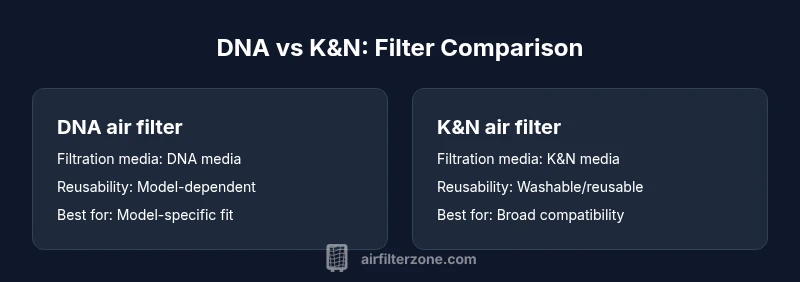
| Feature | DNA air filter | K&N air filter |
|---|---|---|
| Filtration media | DNA media | K&N media |
| Reusability | Model-dependent: some DNA variants washable | Typically washable/reusable with cleaning and oiling |
| Vehicle compatibility | Model-specific availability | Broad vehicle coverage |
| Maintenance effort | Moderate to high depending on model | Moderate; routine cleaning/oiling required for many models |
| Expected service life | Varies by model and driving conditions | Varies by model and driving conditions |
| Best for | Drivers seeking model-specific fit and filtration strength | Owners prioritizing broad compatibility and reuse |
What's Good
- Offers potential airflow and filtration improvements for performance-minded drivers
- K&N’s washable design supports long-term reuse with proper maintenance
- Wide aftermarket support and compatibility across many vehicles
- DIY maintenance can reduce running costs over time if instructions are followed
What's Bad
- Maintenance and cleaning can be time-consuming and requires care
- Filter performance can vary with driving conditions and installation quality
- Not all DNA or K&N models suit every vehicle, risking fitment issues
Neither DNA nor K&N is universally superior; choose based on vehicle fit, maintenance willingness, and the value you place on reuse versus model-specific filtration.
DNA may offer model-specific filtration advantages for certain engines, while K&N provides broad compatibility and proven reusable media. Your decision should align with your vehicle, climate, and maintenance commitment.
FAQ
Which is better for daily driving, DNA or K&N?
For daily driving, both brands can suit different needs. K&N offers broad compatibility and reusable media, while DNA may provide model-specific filtration strengths. Choose based on vehicle fit and maintenance willingness.
For daily driving, both can work; pick based on vehicle fit and how much maintenance you’re willing to do.
Are DNA air filters washable like K&N?
Some DNA filters are designed for cleaning, but it depends on the model. K&N filters are widely marketed as washable and reusable with proper oiling.
Yes, some DNA models can be washed, but check your specific model; K&N filters are usually washable.
Do these filters improve horsepower or fuel economy?
Improved airflow can support performance in some cases, but gains are usually modest and depend on the entire intake system and engine tuning. Both brands emphasize reliability and filtration rather than dramatic horsepower increases.
They may offer small gains if everything else is optimized, but don't expect huge improvements.
How do I know if DNA or K&N fits my vehicle?
Always verify the exact year, make, model, and engine variant in your owner's manual or with the retailer's compatibility chart. Look for model numbers that map to your vehicle.
Check your vehicle specs and the product fitment guide to confirm.
What maintenance is required for washable filters?
Maintenance involves periodic cleaning and re-oiling (for filters that use oil-based media), plus inspection for damage. Follow the manufacturer's service intervals and use approved cleaners.
Clean and re-oil as recommended; inspect for wear or damage.
Quick Summary
- Start with exact vehicle fitment to avoid compatibility pitfalls
- Weigh maintenance effort against potential long-term savings
- Choose DNA for model-specific advantages, or K&N for broad compatibility
- Consider driving environment when evaluating filtration needs
- Verify claims with reputable sources and brand-specific charts