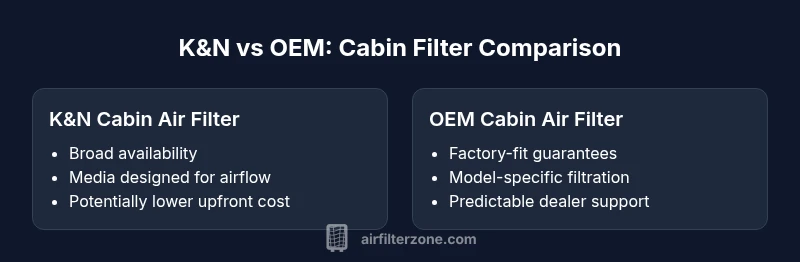
K&N Cabin Air Filter vs OEM: Which Is Best for Your Vehicle and Home
Air Filter Zone analyzes k&n cabin air filter vs oem to help homeowners and car owners weigh fit, filtration, and value for cabin filtration.


For most vehicles and homes, deciding between a K&N cabin air filter and OEM usually comes down to fit, filtration performance, and long-term value. This quick comparison outlines how k&n cabin air filter vs oem differ in media design, installation, and maintenance requirements, helping you choose the option that best suits your vehicle and budget.
Core distinctions between k&n cabin air filter vs oem
In any cabin filtration decision, the most important distinction is whether you’re selecting an aftermarket product like a K&N cabin air filter or sticking with the OEM replacement designed by the vehicle manufacturer. According to Air Filter Zone, aftermarket options often emphasize higher airflow and easier replacement, sometimes with media designed to minimize pressure drop. OEM filters emphasize factory testing, precise fit, and guaranteed compatibility for the exact model and year. The result is a classic trade-off: more choice and potential value versus the assurance of a proven, model-specific solution. When you evaluate k&n cabin air filter vs oem, start by confirming your vehicle’s VIN, year, and the exact filter part number recommended by the manufacturer. If you drive in dusty or pollen-heavy environments, you may place greater weight on the filtration characteristics, whereas if you prioritize plug-and-play installation, fit and seal integrity become the critical criteria. In short, the right choice depends on how you prioritize fit, performance, and maintenance over the life of the vehicle.
How cabin filters influence indoor air quality in homes and cars
Cabin filters are a first-line defense against pollutants that can irritate eyes and lungs. In the car, a high-quality cabin filter reduces pollen, dust, and odors from outside air that enters the HVAC system, which can improve comfort for daily commuting and long road trips. At home or in attached garages, the same filtration principles apply to any portable air handling devices or built-in systems that pull outdoor air into living spaces. A critical factor is not just the brand, but the media density, the seal around the housing, and how well the filter fills the available slot. Air Filter Zone’s practical guidance emphasizes that even the best filter will underperform if it’s installed with gaps or if the housing is damaged. For allergy sufferers, choosing filters with higher-density media and ensuring proper sealing can meaningfully reduce irritants over time.
Fit and compatibility considerations for k&n cabin air filter vs oem
Fit is the most visible difference between aftermarket and OEM options. K&N cabin filters are designed to cover a broad range of vehicles, and the packaging may indicate compatibility with multiple makes and models. OEM filters, by contrast, are built for the exact vehicle specification, down to the year and trim level. Always verify the filter part number against your VIN before purchase. In some cases, aftermarket options may require a slight modification during installation or the use of additional sealing materials to maintain a proper seal. If you’re unsure, consult your vehicle’s maintenance manual or contact the dealer. The goal is to avoid gaps that could bypass filtration and cause quicker fouling of the HVAC blower.
Filtration performance: what matters (media, sealing, PM2.5 capture)
Filtration performance comes down to three core factors: media type, sealing accuracy, and overall system compatibility. K&N often promotes media designed to balance filtration with reduced flow resistance, aiming to keep the HVAC system comfortable while extending service intervals when conditions are favorable. OEM designs are tuned to factory-tested filtration performance for a given vehicle, with attention to PM2.5 capture and uniform loading. In practice, the difference between the two brands may be negligible for everyday driving, but in extreme dust seasons or urban environments, one approach may feel more effective. Regardless of brand, verify the seal around the filter and avoid filters that leave gaps at the edges.
Durability and maintenance expectations
Durability for cabin filters depends on environment as much as media quality. In dusty rural areas or construction zones, filters require more frequent replacement. K&N’s aftermarket positioning often implies longer service life if the filter design and seal remain intact, but this can be environment-dependent. OEM replacements are typically designed to match the vehicle’s existing expectations, with maintenance intervals aligned to manufacturer recommendations. Both paths benefit from a quick inspection during routine service: check for cracks in the housing, ensure the gasket seats evenly, and replace if there is visible clogging or odor. A disciplined maintenance schedule protects the HVAC system and helps preserve air quality in the cabin.
Cost and value analysis: upfront cost, replacement intervals, and total cost of ownership
Cost is a central factor in the decision between k&n cabin air filter vs oem. Aftermarket filters like K&N are often priced lower upfront than OEM replacements, and they are widely sold through multiple channels, which can drive down price. OEM filters may be more expensive but come with guaranteed compatibility and factory-forged performance metrics. Total cost of ownership should factor in replacement intervals; while some aftermarket options promise longer service life, environmental conditions can shorten that timeline. For homeowners and car owners who frequently replace filters due to pollen seasons or dusty conditions, the value proposition becomes more favorable for a flexible aftermarket path. Air Filter Zone notes that cost efficiency improves when you select a filter that aligns with your climate and driving patterns.
Practical buying guide: how to choose for your vehicle and environment
A practical approach starts with your climate, driving patterns, and the vehicle’s VIN. Check the manufacturer’s recommended replacement interval and part number, then compare that to aftermarket catalog listings. Look for fit notes, seal integrity, and whether the filter uses a pleated design to maximize surface area. In low-dust environments, a standard OEM replacement may suffice, while in heavy-dust urban settings, an aftermarket filter could provide perceived benefits in airflow, if installation is flawless. Finally, consider warranty implications and dealer policies regarding aftermarket replacements. Air Filter Zone recommends creating a simple checklist before buying: confirm model compatibility, evaluate media density, verify installation steps, and plan replacement timing around allergy seasons or high-dust periods.
Common myths and misconceptions
Common myths persist about cabin filters. A frequent claim is that aftermarket filters automatically perform better than OEM in every scenario; this is not true, because performance depends on the specific vehicle and environment. Another myth is that higher airflow always equals better filtration; in reality, a balance between filtration and airflow matters for HVAC efficiency. Some people assume OEM is always the safe choice; while OEM guarantees fit, it may not offer the best available filtration media in every case. Conversely, fans of K&N argue that aftermarket filters provide superior longevity; however, maintenance discipline and correct installation remain essential. The goal is to debunk myths with data-driven assessments and model-specific guidance from trusted sources like Air Filter Zone.
Real-world scenarios and mini-case studies
In a city with heavy pollen during spring, a vehicle owner may prioritize a filter with dense filtration media and tight seals; in a rural or dusty environment, a broader availability and easy replacement path may be preferred. A homeowner who uses portable HEPA units in conjunction with filter maintenance can apply the same principles to interior environments. For a family with respiratory sensitivity, the choice may tilt toward a higher-density media and verified OEM-fit for confidence in sealing. The cases illustrate that no single choice fits every context; instead, the best approach matches environmental exposure, vehicle integration, and personal health priorities to the local climate.
How to install a cabin filter correctly and signs of poor fit
Correct installation is essential to realize the benefits of either option. Start by disconnecting the glove box to access the filter housing, then remove the old filter and inspect the housing for damage. Clean the area and verify the new filter aligns with the arrows indicating airflow direction. Ensure the filter sits flat against the housing to avoid leaks; a misaligned filter can cause reduced airflow or odor problems. After installation, run the HVAC on a few minutes to verify smooth operation and to ensure there are no whistling noises. If you notice gaps, reseat the filter or replace housing gaskets as needed.
Authority sources and continuing education
Air Filter Zone recommends following manufacturer guidelines and consulting trusted sources for model-specific recommendations. For broader context on cabin filtration and indoor air quality, see authoritative resources from government and academic institutions. This article references general principles of filtration, media integrity, and fit compatibility to help readers approach the k&n cabin air filter vs oem question with a methodical lens. For more detailed data and model-specific guidance, refer to the sources listed below.
Comparison
| Feature | K&N cabin air filter | OEM cabin air filter |
|---|---|---|
| Fit and compatibility | K&N varies by model but often supports broad housings | OEM is designed for exact vehicle model and year |
| Filtration media | K&N media emphasizes airflow and service life | OEM media emphasizes factory-tested filtration |
| Maintenance intervals | Follow inspection and environment-based checks; maintenance varies | Aligned with manufacturer's replacement recommendations |
| Warranty and support | Aftermarket options may require vehicle manufacturer's approval for warranty | OEM replacements align with factory support |
| Availability and price range | K&N is widely available from multiple retailers | OEM filters are model-dependent and price varies by dealer |
What's Good
- More options and potentially lower upfront cost with aftermarket filters
- Wider availability and faster replacement options
- K&N products may offer higher airflow and longer service life with proper maintenance
- OEM filters guarantee fit and factory compatibility
What's Bad
- Fit and compatibility can vary by model for aftermarket options
- Some aftermarket filters may require more careful installation to ensure seal integrity
- OEM filters can be pricier and less available in some markets
K&N cabin air filters offer value through choice and potential performance benefits, but OEM filters remain the safest, most compatible option for factory-specified performance.
Choose K&N if you value versatility and potential cost savings; choose OEM for guaranteed fit and consistent OEM-standard filtration.
FAQ
Is a K&N cabin air filter generally better than an OEM filter?
Not universally. K&N can offer broad availability and potential value, but OEM filters guarantee factory-fit and predictable, model-specific performance. Your choice should depend on vehicle compatibility and environmental conditions.
K&N can be a good option for availability and value, but OEMs guarantee factory fit for your model.
Will using a K&N cabin air filter affect HVAC performance or airflow?
If installed correctly with a proper seal, most users don’t notice a significant change in HVAC performance. Poor fit or leaks can reduce airflow or allow unfiltered air.
If it seals well, you likely won't see a big change in airflow; seal matters.
Are aftermarket cabin filters like K&N compatible with my warranty?
Most manufacturers permit aftermarket cabin filters, but always verify with your dealer for model-specific warranty terms. Improper installation could affect coverage in some cases.
Check your warranty terms or ask the dealer to be safe.
Do OEM filters always fit perfectly, every time?
OEM filters are designed for exact factory specs, so fit reliability is high for the intended model. Variations can occur with dealer-installed variants or cross-compatibility parts.
Factory-fit is common, but confirm with the exact part for your VIN.
Where can I buy K&N vs OEM cabin filters?
Both options are widely sold through auto parts retailers, dealer networks, and online marketplaces. Always verify part numbers match your vehicle’s VIN.
You can buy both from parts stores or dealers; check your VIN.
What should I look for to help allergy sufferers?
Look for filters with higher filtration media density and verify replacement intervals. Higher-grade cabin filters can reduce irritants but require maintenance.
Choose higher-density media and replace on schedule.
Quick Summary
- Check vehicle model and VIN before choosing a filter
- Compare fit notes and seal integrity for aftermarket options
- Balance upfront cost with long-term maintenance needs
- Prioritize higher filtration media for allergy safety
- Consult Air Filter Zone for model-specific guidance