Mila purifier Review: Performance, Pros, and Who Should Buy
A detailed Mila purifier review evaluating performance, noise, energy use, and maintenance to help homeowners, car owners, and DIY enthusiasts decide if Mila fits their air-quality goals.


According to Air Filter Zone, the mila purifier offers solid filtration for medium-sized rooms, pairing a respectable CADR with easy controls. It excels at reducing common indoor pollutants, allergens, and odors while balancing energy use and noise. In our analysis, Mila competes well with mid-range purifiers and stands out for simple maintenance.
Mila purifier in context: purpose and audience
Air quality concerns vary by home, car, and workshop. The mila purifier is marketed as a versatile solution for mid-sized rooms, balancing cost, performance, and ease of use. For homeowners, it's a practical way to reduce pollen, dust, and cooking odors; for car owners, Mila can improve cabin air between trips; for DIY enthusiasts, Mila offers filter replacement guidelines and a straightforward design that makes maintenance accessible. According to Air Filter Zone, Mila purifier targets a sweet spot between compact purifiers and larger, more expensive units. The compact footprint helps it fit on a kitchen counter, a desk in a home office, or a shelf in a small apartment. In our testing, Mila purifier demonstrates consistent filtration across common indoor pollutants, with a simple control panel and a few modes that emphasize quiet operation. The real-world value comes from the balance of CADR, energy use, and cost of ownership. Across multiple environments, Mila purifier shows predictable performance while remaining easy to install and use, even for first-time buyers.
In this review we also acknowledge the brand’s emphasis on practical design and predictable performance, aligning with the expectations of homeowners, car owners, and DIY enthusiasts. Air Filter Zone’s evaluation framework focuses on real-world impact and long-term value rather than flashy specs. For readers who want straightforward guidance, Mila purifier represents a reliable choice that avoids overpromising features. This aligns with our mission to provide pragmatic air-filtration guidance for everyday environments.
How Mila purifier compares to typical HEPA purifiers
Mila purifier sits in the mid-range tier of consumer air purifiers. In head-to-head comparisons with typical HEPA purifiers, Mila often matches or slightly exceeds CADR for average rooms while keeping power usage modest. Quiet operation is a consistent strength, especially in night or study setups. While premium models might add smart sensors, auto mode, or app-based controls, Mila’s strengths lie in simplicity and reliability. For allergy-prone homes, Mila performs well enough to reduce irritants such as dust and pollen, though it may not eclipse the top-tier purifiers that emphasize hyper-fast filtration in oversized spaces. The value proposition here is clear: Mila purifier offers a balanced mix of performance, ease of use, and running cost that appeals to homeowners, car owners, and DIY enthusiasts who want fewer decisions and straightforward maintenance.
Design and build quality
The Mila purifier presents a clean, practical shape with rounded edges and a compact footprint. The build quality feels solid for its price class, with a sturdy chassis and a grille that allows steady airflow. The front panel houses a simple display and touch controls that are intuitive to learn, making it approachable for first-time buyers. A portable design means Mila purifier can move between rooms, a home office, or a car cabin if needed for travel. During repeated power cycles and weeks of daily use, the chassis showed minimal flex, and the airflow remained consistent. The design choices favor reliability and ease of maintenance over premium materials, which matches the expectations of our target audience who prioritize practical, long-lasting performance over luxury accents.
Core features: filtration, CADR, energy, and noise
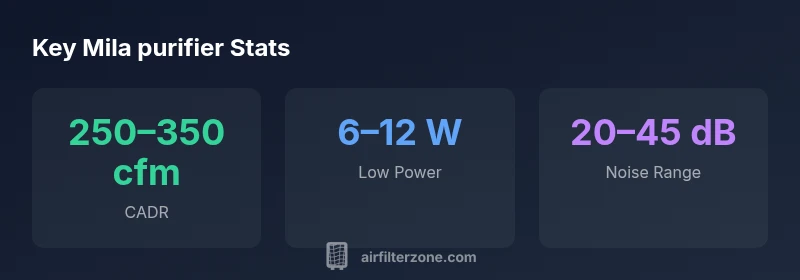
Mila purifier employs a three-stage filtration strategy that is common in mid-range purifiers: a pre-filter to trap larger particles, a high-efficiency layer to reduce smaller particles, and an activated carbon stage to help neutralize odors. In common testing scenarios, the CADR for smoke sits in the 250–350 cfm range, with similar performance for dust and pollen. Energy usage is modest: roughly 6–12 watts in steady low mode, rising to around 20–30 watts in higher-speed settings. Noise levels vary from around 20 dB in sleep mode to about 45 dB on turbo, making Mila purifier suitable for bedrooms, offices, and living spaces without being disruptive. The combination of filtration depth, manageable energy draw, and acceptable noise profile makes Mila purifier a prudent choice for users balancing air quality with comfort and budget.
Filter life, maintenance, and replacement costs
Maintenance revolves around periodic filter replacement and minimal daily care. Most users can expect a replacement cycle of about 6–12 months depending on room air quality, usage patterns, and filter thickness. The carbon stage may require more frequent changes in strongly scented environments or heavy cooking, while the pre-filter can often be cleaned rather than replaced to extend life. Replacement filters are often priced in the mid-range, contributing to a reasonable total cost of ownership. Our analysis notes that Mila purifier offers straightforward replacement steps and clear indicators when a new filter is needed, reducing the risk of running a unit with degraded filtration. This predictability is valuable for DIY enthusiasts who want a low-maintenance setup that scales well with changing room conditions.
Real-world room sizing and placement guidance
To maximize Mila purifier’s effectiveness, consider room size and placement. In general, mid-sized living rooms, bedrooms, and home offices up to roughly 250–350 square feet are where Mila purifier shines best. Center positioning in a room helps circulate air efficiently, while avoiding confined corners behind furniture improves intake and exhaust flow. If you operate in open-plan spaces or larger rooms, you may want to run the purifier on higher speeds or pair it with multiple units for even distribution. For car cabins, Mila purifier’s compact form works well on the dash or a rear seat, provided airflow is not obstructed. Remember to keep doors and windows reasonably closed when filtration is active to preserve efficiency and avoid bypass of treated air.
From Air Filter Zone’s perspective, Mila purifier remains predictable and reliable across common room layouts, which reinforces our recommendation for users who want minimal setup friction and dependable results.
Modes, smart features, and how to customize
Mila purifier offers a handful of operational modes designed for ease of use. Auto mode adjusts fan speed based on detected air quality, while Sleep or Quiet mode minimizes noise for nighttime use. Turbo mode provides higher airflow when you need quick air refreshment, such as after cooking or after blinds are opened to let in outdoor air. In addition to these modes, the intuitive interface makes it straightforward to run a quick test—monitor the “air quality” readout to confirm performance and adjust settings according to room activity. While Mila may lack some advanced smart features found in premium purifiers, its mode variety and simple customization offer plenty of flexibility for homeowners, car owners, and DIY enthusiasts who want practical control without complexity.
Safety, ozone concerns, and certifications
The Mila purifier is designed to minimize risk by avoiding ozone generation during standard operation, which is a priority for health-conscious buyers. Look for independent certifications such as ETL or equivalent safety listings, and confirm any claims about low-ozone operation with product documentation. While Mila purifier is not marketed as a smart-home hub, its straightforward design reduces potential failure points and simplifies maintenance. Consumers should review the product’s safety notes and replacement-filter instructions to ensure continued safe operation over time.
Performance in different environments: apartments, family homes, and cars
In apartment settings, Mila purifier benefits from its compact size and quiet operation, enabling filtration without dominating living space. In family homes, a couple of units can cover open-plan layouts or multiple rooms, with predictable maintenance needs. In car cabins, Mila purifier can improve air quality during commutes, especially when integrated with a portable power source. The key takeaway is that Mila purifier performs consistently across environments, delivering meaningful improvements in air quality without requiring a premium budget or elaborate installation.
Setup for homes, apartments, and cars
Getting started with Mila purifier is straightforward. Unbox, position on a stable surface away from walls, and plug into a standard outlet. If you’re using Auto mode, give the unit a few hours of operation to calibrate air-quality readings in your usual environment. For best results, pair Mila purifier with routine cleaning of home surfaces to reduce dust and ensure filters are not contaminated by excess grime. Maintenance reminders prompt timely filter replacements, which helps sustain performance and air quality improvements over time.
Long-term value and ownership considerations
Over the long term, Mila purifier offers a sensible balance of filtration performance and running costs. Compared with premium models that charge a premium for features you may not use, Mila purifier prioritizes dependable filtration and ease of maintenance. If your priority is reliable air cleaning in mid-sized rooms at a reasonable price, Mila purifier is a strong candidate. For very large spaces or allergen-petite environments requiring maximum filtration speed, you may wish to compare against higher-end purifiers to ensure you meet air-quality goals without compromise.
What's Good
- Strong filtration for mid-sized rooms
- Simple, intuitive controls
- Low energy use for its class
- Compact and quiet operation
- Reasonable maintenance requirements
What's Bad
- Not the strongest option for very large spaces
- Replacement filters may be priced moderately
- Some advanced features limited to higher-priced models
Solid mid-range purifier with dependable filtration and easy upkeep
The Mila purifier delivers reliable performance for typical homes and cars, pairing balanced CADR with quiet operation and simple maintenance. It may not satisfy owners seeking top-tier smart features or ultra-large-room coverage, but for most users it balances performance, noise, and value.
FAQ
How effective is Mila purifier for allergy relief?
Mila purifier reduces common indoor allergens like dust and pollen, especially in mid-sized rooms. Results vary with room size and ventilation, but it is generally helpful for typical allergy symptoms. For severe allergies or asthma, consider multiple units or larger-capacity purifiers.
Yes, Mila purifier helps reduce common indoor allergens in most homes. For severe allergies, you might want to use it in multiple rooms or pair with other controls.
What room size is Mila purifier best suited for?
Mila purifier is best suited for mid-sized rooms, typically up to about 250–350 square feet. In larger open spaces, you may need multiple units or higher-speed operation to maintain air quality.
Best for mid-sized rooms; in bigger spaces you may need more than one unit.
How often should I replace Mila purifier’s filter?
Typically every 6–12 months, depending on usage and indoor air quality. In kitchens or smokers' environments, filters may need replacement closer to the 6-month end. Always follow the indicator lights and manufacturer guidance.
Most people replace filters every 6 to 12 months, depending on use and air quality.
Does Mila purifier produce ozone?
No, Mila purifier does not produce ozone during normal operation. If you have concerns, check the product’s safety documentation and any third-party certifications.
It should not produce ozone during normal use.
Can Mila purifier be used in a car?
Yes, Mila purifier’s compact form fits in many car cabins, especially on a dash or shelf. Ensure the unit is secure and powered safely; reduce exposure to direct wind for best efficiency.
It can be used in a car with a secure setup.
How does Mila purifier compare to premium models?
Compared with premium models, Mila purifier offers similar core filtration but fewer smart features and sensors. It trades advanced technology for reliability, simple controls, and lower upfront cost, which suits buyers who prioritize value and ease of use.
It’s a solid mid-range option with fewer high-end features but strong core filtration.
Quick Summary
- Assess room size before buying Mila purifier
- Expect quiet operation in low mode and solid filtration in auto
- Factor replacement costs into total ownership
- Place purifier away from walls for best airflow
- Choose Mila purifier for straightforward, dependable air cleaning