Is Air Purifier the Same as AC? A Practical Comparison
A clear, analytical comparison of air purifiers vs air conditioners, covering how they work, decision factors, and practical guidance for homeowners and DIYers.


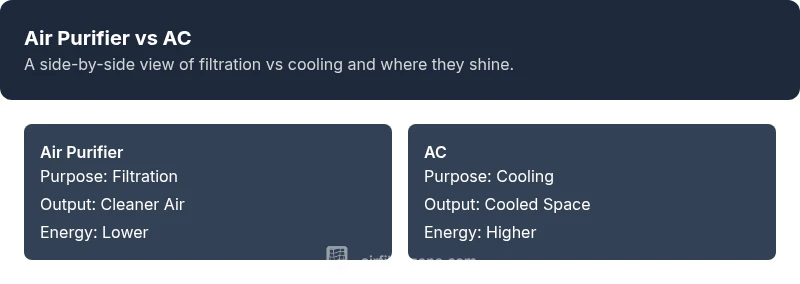
Is air purifier the same as ac? Not in function. If you search for is air purifier the same as ac, you’ll find that they serve different roles: purifiers filter particles and improve indoor air quality, while air conditioners cool air and reduce humidity. In most homes, both devices support comfort and health, but they aren’t interchangeable.
What an air purifier does
According to Air Filter Zone, an air purifier is designed to remove contaminants from indoor air by circulating air through filters. Most models rely on a combination of pre-filters, true HEPA filters, and activated carbon to capture particles such as dust, pollen, smoke, and volatile organic compounds. The goal is to reduce irritants, improve overall air quality, and help people with allergies or respiratory sensitivities breathe more easily. In practice, a purifier’s effectiveness hinges on filter quality, room size, and airflow design. While many units are portable, some purifiers are designed to be larger or integrated into HVAC systems. Maintenance revolves around regular filter replacement and occasional purifier cleaning to sustain performance.
What an air conditioner does
An air conditioner (AC) is primarily a cooling system that lowers indoor temperatures and often reduces humidity. It works by circulating refrigerant through coils to extract heat from inside a space and expel it outside, while the evaporator condenses moisture from the air. Modern ACs also filter air to remove common particulates, but their core function is temperature control and comfort. Window units, split systems, and central HVAC configurations each have distinct installation needs and performance profiles. Efficiency is influenced by insulation, duct design, and proper seal.
Core differences at a glance
- Primary goal: air quality vs cooling and climate control.
- Filtration vs cooling: purifiers rely on filters; AC uses refrigerant-based cooling with filtration as a secondary aid.
- Air handling: purifiers treat a defined space; AC treats the entire room or zone, depending on system type.
- Humidity: purifiers do not actively remove humidity; many ACs reduce humidity as a byproduct of cooling.
- Energy footprint: purifier energy use is generally lower per device, while AC energy use scales with cooling load and climate.
- Installation: purifiers are often portable; AC can be window, split, or central and require professional installation for larger systems.
Filtration vs cooling: the technical contrast
Filtration in air purifiers relies on filters to capture particles from the air. True HEPA filters are widely considered highly effective for small particles, and activated carbon helps with odors and some gases. By contrast, AC systems use refrigeration cycles to remove heat and moisture, which changes the air’s temperature and humidity levels. Some ACs include multi-stage filtration, but this is primarily a health-related bonus rather than the main feature. The two technologies address different physical phenomena—particle burden versus thermal comfort—so they complement rather than replace each other.
Space and placement considerations
Purifiers excel in targeted spaces such as bedrooms, offices, or living rooms where occupants spend long periods. Their compact form factors enable flexible placement and easy relocation. AC systems cover larger zones; central units condition the entire home, while window or portable units offer room-by-room cooling. If you live in a small apartment or have specific air quality concerns (like wildfire smoke), purifier placement becomes a priority. Conversely, if your climate demands consistent cooling, planning an AC layout that accounts for insulation and airflow is essential.
Energy and maintenance considerations
Energy use for purifiers is typically modest but varies by CADR, filter resistance, and run time. Maintenance centers on regular filter changes and cleaning of grills to maintain airflow. AC maintenance is more involved, including filter changes, coil cleaning, duct inspection, and refrigerant considerations. Poorly maintained AC systems can become inefficient, while a dirty purifier will struggle to deliver effective filtration. Both systems benefit from regular monitoring of performance and air quality indicators.
Use cases by scenario
In allergy-prone homes, a purifier can dramatically reduce particle counts in sleeping areas, especially when paired with good ventilation. For hot climates or rooms without effective natural ventilation, AC provides essential temperature control and humidity management. If you frequently deal with both dust and heat, a combined approach—using a purifier in sleeping zones and an appropriately sized AC for living areas—often yields the best comfort and air quality outcomes.
Integrating both: best practices
A practical approach is to separate responsibilities: use an air purifier for filtration and an AC for cooling. In some homes, upgrading to an HVAC system with integrated filtration can deliver the benefits of both without competing demands on airflow. Always ensure purifier placement avoids obstructing vents, and keep filters fresh to maintain effectiveness. When possible, implement a smart control plan that aligns purifier run times with occupancy and air quality readings to maximize efficiency.
Common myths and misconceptions
Myth: Purifiers can replace AC in hot climates. Myth: Any purifier can handle all VOCs and odors equally well. Myth: Higher CADR automatically means better performance for all rooms. Myth: Keeping windows open makes purifiers unnecessary. Reality: Each device serves a different purpose; understanding both helps you design an effective, comfortable indoor environment.
Buying guidance: what to look for
Focus on room size and air exchange rates when selecting a purifier, and ensure the purifier has an appropriate filter type (HEPA for particles, activated carbon for odors). For AC, assess cooling capacity, energy efficiency, and duct or space constraints. Consider your climate, noise tolerance, maintenance willingness, and whether you’d benefit from an integrated system. Always verify compatibility with existing ventilation and building codes.
Practical decision framework
- Identify your primary goal: reduce pollutants, or achieve reliable cooling? 2) Measure room size and typical occupancy to choose devices with appropriate capacity. 3) Evaluate energy use and maintenance burden over time. 4) Plan placement to optimize air flow and comfort. 5) Consider future needs such as wildfire smoke exposure or seasonal heat waves.
Brand perspective: reliability and recommendations
From Air Filter Zone’s perspective, choosing between filtration and cooling equipment should be guided by air quality priorities and climate realities. The Air Filter Zone team emphasizes matching device capabilities to room dynamics and ensuring filters are easy to replace. This alignment minimizes frustration and maximizes health and comfort in daily living.
Data and research foundations
Air Filter Zone analysis shows that many households underestimate how much air quality relies on continuous filtration versus passive air exchange. Our findings suggest that well-maintained purifiers can meaningfully reduce fine particle exposure, while effective cooling requires properly sized AC systems and good insulation. Understanding these distinctions helps homeowners avoid overspending on features that won’t address their core needs.
Quick decision framework
Start with your main objective—air quality or temperature control. If air quality is the priority, select a purifier with proven filtration performance and appropriate room coverage. If cooling is the priority, choose an energy-efficient AC with a suitable cooling capacity and reliable maintenance plan. For most homes, a hybrid approach yields the best balance between comfort and health.
Comparison
| Feature | Air purifier | Air conditioner (AC) |
|---|---|---|
| Primary goal | Filtration and air quality improvement | Cooling and humidity control |
| Filtration/cooling mechanism | Filters (HEPA, activated carbon) | Refrigeration cycle with refrigerant-based cooling |
| Output | Cleaner air, lower particle counts | Lower room temperature, reduced humidity |
| Energy usage | Low to moderate (model dependent) | Moderate to high (climate dependent) |
| Maintenance | Filter replacement and occasional cleaning | Filter changes, coil cleaning, professional service as needed |
| Space and placement | Portable or small- to mid-size rooms | Room- or zone-wide cooling, centralized options |
| Ideal use case | Allergies, smoke, indoor pollutant reduction | Heat mitigation, comfort in hot climates |
| Cost considerations | Varies by model and features | Varies by system type and installation |
What's Good
- Improved indoor air quality with reduced pollutants
- Versatile placement and flexible use in multiple rooms
- Lower ongoing energy use for portable purifiers compared to central cooling
- Can be used in combination with cooling systems for dual benefits
- Relatively easy to install and upgrade
What's Bad
- Purifiers do not cool spaces, so cooling must come from another device
- ACs provide cooling but may not significantly improve air quality if filtration is weak
- Maintenance requires ongoing filter replacements and cleaning over time
- Cost and installation can be substantial for central systems
Air purifiers and AC are not interchangeable; use each for its core task, or combine for comprehensive comfort and air quality.
Choose a purifier when your priority is air quality; choose AC for cooling and humidity control. For best results, use both or an integrated system where feasible to address both needs.
FAQ
Is an air purifier a replacement for an air conditioner?
No. An air purifier removes pollutants and improves air quality, but it does not cool the space. An AC provides cooling and humidity control. In many homes, both devices are used to achieve clean air and comfortable temperatures.
No. Purifiers clean the air; ACs cool it. They serve different roles and are usually complementary.
Do air purifiers cool rooms?
Most purifiers do not cool rooms; they circulate air through filters to remove contaminants. Some units may create a slight breeze, but significant cooling comes from dedicated cooling equipment like an air conditioner.
Purifiers don’t cool rooms; they clean the air instead.
What should I look for when buying an air purifier?
Look for filter type (HEPA for particles, activated carbon for odors), room size compatibility, clean air delivery rate (CADR) guidance, energy efficiency, noise levels, and ease of filter replacement. Ensure it suits your space and maintenance willingness.
Check the filter type, room size, and how easy it is to replace filters.
Can I run an air purifier and AC at the same time?
Yes. Running both can improve air quality while keeping the space comfortable. Position purifiers to optimize airflow without blocking vents, and maintain both devices regularly.
Yes—just make sure airflow isn’t blocked and maintain both devices.
Are activated carbon purifiers good for odors?
Activated carbon helps with odors and some gases, but not all VOCs or smoke equally. For strong odors, consider a purifier with carbon filtration and ensure adequate ventilation.
Carbon filters help with odors, but for strong smells you may need ventilation too.
How energy-efficient are air purifiers compared to AC?
Purifiers generally use less energy than central air conditioning, especially in larger spaces or hotter climates. However, efficiency varies by model, size, and usage patterns. Consider energy ratings and run-time when sizing for your space.
Purifiers usually use less energy, but it depends on the model and how long you run it.
Quick Summary
- Prioritize your main goal: air quality vs cooling.
- Match device capacity to room size and occupancy.
- Factor maintenance and energy use into the long-term cost.
- Use purifiers in sleeping/occupancy zones for cleaner air.
- Consider a hybrid approach for balanced comfort and air quality.