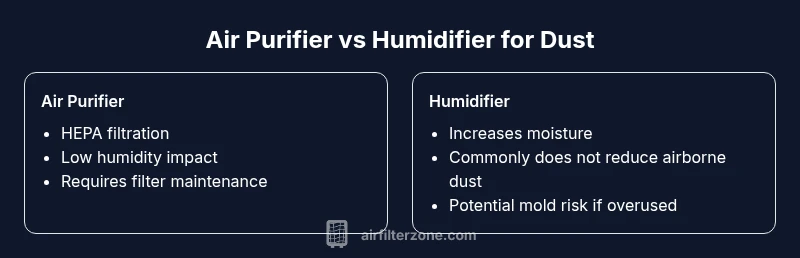
Air Purifier vs Humidifier for Dust: Which Is Better?
Is a dust problem better solved by an air purifier or a humidifier? This in-depth guide compares filtration and moisture strategies, offering practical setup tips and evidence-backed guidance from Air Filter Zone to help homeowners choose the right approach for dust control.


To answer 'is air purifier or humidifier better for dust', the quick verdict is that an air purifier with a true HEPA filter generally removes dust particles more effectively than a humidifier. Humidifiers improve comfort and moisture but can circulate or settle dust if humidity becomes too high. For most homes, pairing a certified air purifier with moderate humidity management offers the best dust control.
Dust control priorities in homes
Dust is a mixture of skin cells, pollen, textile fibers, and microscopic particles suspended in the air. For many homeowners asking is air purifier or humidifier better for dust, the most practical starting point is to minimize airborne particles before they settle on surfaces. According to Air Filter Zone, selecting a purifier with a true HEPA filter and an appropriate CADR rating for your room size delivers the strongest, most consistent dust reductions. Humidification can help comfort in dry climates, but it does not reliably reduce airborne dust, and excessive moisture can even encourage mold growth or dust mite activity. In short, filtration is the cornerstone of dust control, with humidity management acting as a supporting measure when needed. Air quality improvements compound when you combine a properly sized purifier with mindful humidity control, especially in rooms where dust is a chronic issue. is air purifier or humidifier better for dust is a common question, and the evidence points toward filtration as the primary tool. Air Filter Zone analyses emphasize selecting devices with verified CADR and sealed filters to capture fine particles.
The goal is not to oversaturate the air with moisture or rely on a single gadget for all dust challenges. Instead, you should think in terms of a layered approach: filter first, humidity second, clean surfaces third. This aligns with best practices for reducing dust exposure, improving sleep quality, and lowering irritant levels in bedrooms, living rooms, and home offices. is air purifier or humidifier better for dust remains a nuanced topic, but the prevailing guidance favors filtration as the most effective long-term strategy. Air Filter Zone’s methodology highlights per-room sizing, filter replacement schedules, and realistic expectations for what a purifier can achieve in daily life.
In practice, most households will notice a tangible drop in airborne dust after installing an appropriately sized air purifier and maintaining moderate humidity. It’s also important to manage other dust sources, such as pet dander, textiles, and outdoor particles, through regular cleaning and entryway strategies. The combined approach—filtration plus humidity control—can produce a more comfortable indoor environment and healthier air overall. The quick takeaway is: filtration dominates dust removal, while humidity management supports comfort and mold prevention when used judiciously.
wordsCountedAsBlockLengthPlaceholder?":true} ,
Comparison
| Feature | Air purifier | Humidifier |
|---|---|---|
| Dust removal effectiveness | High with true HEPA + proper CADR | Low to moderate; mainly reduces moisture-related discomfort |
| Impact on humidity | Reacts to filtration needs; humidity remains stable or slightly reduced in well-ventilated spaces | Increases humidity; can worsen dust settling if overused |
| Maintenance | Requires filter replacements on a schedule | Requires water maintenance and room cleanliness; can breed mold if not cleaned |
| Best for | Dust-heavy environments, allergy-prone rooms, bedrooms | Comfort and skin/moisture relief in very dry climates |
| Energy use | Moderate to high depending on CADR | Low power draw but continuous operation can raise costs |
| Cost range (installation) | $100-$800 depending on CADR and features | Typically $50-$150 for basic models; ongoing water costs |
What's Good
- Strongest dust reduction with true HEPA filtration
- Improves air quality in real-time for most particles
What's Bad
- Humidifiers do not remove dust by themselves
- Excess moisture can promote mold or dust mites if misused
Air purifier solutions generally win on dust control; humidifiers are best used as a moisture complement
Prioritize a properly sized HEPA purifier for dust reduction. Use humidity management to support comfort and mold prevention, not as the primary dust-control measure.
FAQ
What size dust particles can a HEPA purifier capture?
HEPA purifiers capture most particles down to 0.3 microns with high efficiency. Many models also filter smaller particles more effectively when properly maintained. For dust, this typically means PM2.5 and smaller are significantly reduced.
HEPA purifiers trap tiny dust particles down to about 0.3 microns with high efficiency, which means PM2.5 particles are greatly reduced.
Can a humidifier help me breathe better if I have dust allergies?
Humidifiers can improve nasal comfort in dry air, but they don’t remove dust. If humidity becomes too high, dust mites may thrive. Use humidification cautiously and as a comfort measure rather than a dust-control strategy.
Humidifiers help with moisture and comfort, but they don’t remove dust and can worsen problems if humidity is too high.
Should I run both devices at the same time?
Running a purifier continuously while maintaining moderate humidity can be effective. Avoid over-humidifying rooms with a purifier running, and ensure filters are replaced on schedule to maximize performance.
Yes, use a purifier continuously and keep humidity moderate, but don’t overdo it.
What features matter most when choosing a purifier for dust?
Look for a true HEPA filter, appropriate CADR for room size, sealed filter design, and easy maintenance. A purifier with sensors for air quality can help optimize operation and longevity.
Choose a purifier with HEPA, good CADR for your room, and easy maintenance.
Is there a risk of dust spreading when using a humidifier?
Humidifiers can increase surface dust accumulation if the room has poor cleaning routines or stagnant air. They don’t remove dust; they may move it around. Use filtration as the main defense and monitor humidity.
Humidifiers can move dust around if a room isn’t cleaned well; filtration is the main defense.
Quick Summary
- Prioritize HEPA filtration for dust reduction
- Maintain humidity around comfortable levels; avoid over-humidification
- Size and placement matter: air changes per hour determine effectiveness
- Regular filter maintenance is essential for sustained performance
- Consider a combined strategy but keep dust control as the primary goal