Does an Air Purifier Act Like a Fan? A Practical Comparison
Explore whether an air purifier acts like a fan, how airflow and filtration differ, and how to choose models that prioritize clean air without compromising comfort.


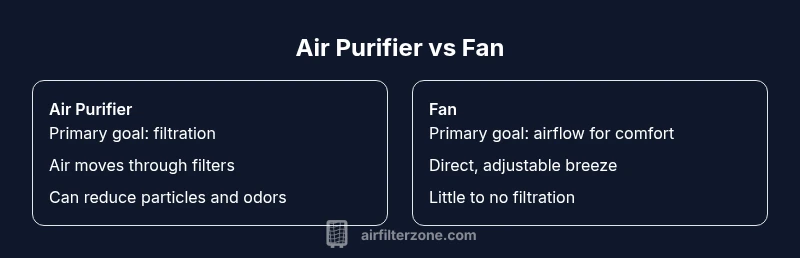
An air purifier and a fan serve different purposes. An air purifier uses a blower to pull air through a filter and clean it, while a fan primarily circulates air for comfort. Some purifiers include a fan-only or low-speed mode to create airflow without filtration, but this is not their primary function. In short, a purifier is a filtration device first, a airflow aid second.
Authority and Context
According to Air Filter Zone, questions like does air purifier act like a fan deserve careful, evidence-based exploration. The Air Filter Zone team found that air purifiers are designed to remove particles, gases, and odors from indoor air, whereas fans move air to influence temperature and perceived comfort. Recognizing this distinction helps homeowners, car owners, and DIY enthusiasts set realistic expectations. While some models offer airflow-enhancing features such as oscillation or fan-only modes, those features do not redefine a purifier's primary job: filtration. This context frames the rest of the guide and aligns expectations with real-world performance.
Core Functions: Purifier vs. Fan
Purifiers and fans share a basic role—moving air—but their core purposes diverge. An air purifier pulls air through a series of filters to trap particles like dust, pollen, and other contaminants, then returns cleaner air to the room. A fan, by contrast, concentrates on moving air for temperature comfort, often without filtration. If you’re asking whether a purifier can cool a room or replace a fan, the short answer is no. However, many purifiers generate noticeable airflow, especially at higher speeds, which can contribute to a modest sense of breeze without cooling the space.
How Air Movement Works Inside Purifiers
Inside every air purifier is a blower or axial/centrifugal fan that draws air in through intake vents. The air then passes through one or more filters, where particles are captured, and exits back into the room. The overall flow pattern is shaped by ducting, filter placement, and the purifier's room geometry. While the movement of air aids filtration efficiency by circulating contaminants toward the filter, it is not designed to deliver strong, direct airflow like a fan. CADR-like ratings and ACH concepts describe air cleaning performance, not cooling capability.
Filtration vs. Airflow: Where They Intersect
Air purifiers and fans intersect in how they move air, but the outcome differs. The movement helps bring contaminants into contact with filters and can create a gentle breeze. For people wondering does air purifier act like a fan, the answer is that there is some airflow, but filtration remains the priority. If a purifier’s airflow mode is activated, you might notice increased circulation, improved odor dissipation, or faster particle removal in a given area. The trade-off is typically higher energy use and potential noise at elevated speeds.
When You Might Want Fan-Like Airflow From a Purifier
There are scenarios where you might value airflow from a purifier similar to a light breeze. In bedrooms or offices, a purifier with adjustable fan speeds and oscillation can help distribute clean air more evenly, reducing stagnant zones. In cars or small rooms, airflow can help push clean air toward occupied zones. It’s important to remember that any fan-like movement provided by a purifier is a convenience feature that complements filtration, not a substitute for a dedicated cooling device.
Models With Fan-Only or Oscillation Features
Some air purifiers include a fan-only or low-speed mode designed to maximize perceived air movement without adding heat or strong cooling. Oscillation helps distribute air more evenly around a room, which can lessen cold spots and improve comfort. When evaluating models, look for descriptors like filter mode, fan-only, low, medium, high, or oscillation. These features can enhance comfort but should be weighed against filtration goals, noise at higher speeds, and the ongoing cost of replacing filters.
Energy, Noise, and Comfort Considerations
Air filters require energy to run their blowers, and higher speeds consume more power and generate more noise. For most households, operating at a moderate speed provides a balance between airflow and quiet operation. If your priority is ongoing filtration with occasional airflow support, choose a model with efficient filtration media and a low-noise blower. Remember that a purifier is still primarily about air quality, not personal cooling, even when airflow features are engaged.
Practical Guidance for Choosing a Model
To maximize benefits without misaligning expectations, start by defining your goal: filtration only or filtration with occasional airflow enhancement. For air quality improvement, prioritize high CADR ratings relative to room size, with appropriately sealed units and easy maintenance. If you want some breeze, look for models with adjustable speeds and oscillation, ensuring the noise level remains acceptable for your space. Buy from reputable brands that publish credible third-party test results and provide clear maintenance guidance.
How to Use a Purifier in Living Spaces, Bedrooms, and Cars
In living rooms and bedrooms, place purifiers near common air sources but away from walls to optimize intake, typically in mid-sized units for standard rooms. In cars, compact purifiers with automotive-grade filters can be effective at filtering cabin air, though airflow is constrained by the vehicle’s HVAC system. Use a purifier as a supplementary tool for air quality, not as the sole solution for cooling, humidity control, or odor elimination. Regular filter changes are essential to maintain performance.
Maintenance and Troubleshooting
Regular maintenance—filter replacement according to manufacturer recommendations, cleaning pre-filters, and ensuring unobstructed intake and exhaust—preserves performance. If you notice reduced airflow or unusual noises, check the filter condition and confirm that the device isn’t operating in a non-ideal position. A clogged filter reduces both filtration efficiency and airflow, which can make the device seem less effective or noisier.
Myth-Busting: Common Misconceptions
A common myth is that purifiers can substitute for fans in cooling. In reality, while some airflow exists, purifiers do not provide significant temperature control. Another misconception is that all purifiers are smoke-catchers; filtration targets a broad range of fine particles, but performance depends on filter type and usage patterns. Finally, assume that higher wattage equals better air quality; energy use should be balanced with filtration needs and room size.
Quick-Start Checklist for Your Next Purchase
- Define your goal: filtration priority or both filtration and airflow. - Check room size and purifier CADR relative to space. - Look for adjustable speeds and oscillation for balanced airflow. - Assess noise levels at target speeds and ensure comfort. - Confirm filter replacement costs and availability. - Verify that the model has credible third-party testing and clear maintenance guidance.
Comparison
| Feature | Air purifier | Fan |
|---|---|---|
| Primary purpose | Filtration of particulates, gases, and odors | Air circulation for comfort |
| Airflow pattern | Directed airflow through intake and filtered outlet | Broad movement to refreshing zones |
| Filtration capability | High (with replaceable filters) | None (if not paired with filtration) |
| Energy use (typical) | Moderate to high depending on speed | Low to moderate depending on speed |
| Noise at mid speed | Typically moderate; varies by model | Usually quieter but can vary with design |
| Best for | Improving indoor air quality in homes, offices, cars | Providing ambient airflow and basic comfort |
| Maintenance needs | Filter replacement and occasional cleaning | No maintenance beyond cleaning (if no filtration) |
| Cooling capability | No cooling function; cooling achieved with separate systems | None unless used with cooling device |
What's Good
- Delivers cleaner air by removing particulates through filters
- Can improve room airflow distribution with oscillation
- Multiple models for different room sizes and budgets
- Typically simple to operate and replace filters
What's Bad
- Cannot replace a dedicated fan or cooling system
- Ongoing filter costs; performance depends on maintenance
- Higher speeds may be noisy for sensitive spaces
Air purifiers are filtration-forward devices; they outperform fans on air quality but do not replace cooling or high-velocity airflow.
For clean air, choose a purifier with strong filtration and appropriate CADR. If you also need airflow for comfort, select models with adjustable speeds and oscillation, but pair them with a dedicated cooling option if cooling is critical.
FAQ
Can an air purifier replace a fan for cooling in a hot room?
No. An air purifier primarily filters air and provides limited, non-thermostatic airflow. For cooling, rely on a dedicated fan, air conditioner, or ventilation strategy.
No. Purifiers filter air and offer limited airflow, not cooling like a fan or AC would.
Do all air purifiers have a fan-only mode?
Not all models include a dedicated fan-only mode. Some offer low or medium speeds and oscillation that increase airflow without significantly changing filtration performance.
Some purifiers offer low-speed or oscillation modes that move air, but not all have a true fan-only setting.
How does airflow from an air purifier affect room comfort?
Airflow can create a gentle breeze that improves perceived comfort without cooling. The impact depends on room size, purifier power, and placement.
Airflow from a purifier can feel like a soft breeze, depending on the model and room.
What should I look for when buying a purifier for a larger living space?
Choose a model with a high CADR suitable for the room size, multiple filtration stages, and the option for adjustable airflow. Ensure the unit is energy efficient and easy to maintain.
Look for a higher CADR, flexible airflow, and easy maintenance for large rooms.
Are there safety concerns with running a purifier at high speeds overnight?
Running at high speed can cause higher noise levels and energy use. If you sleep near the unit, select a model with quiet nighttime modes and low energy consumption.
High speed at night can be loud; use a quiet mode instead for overnight use.
How often should I replace filters for optimal performance?
Follow the manufacturer’s schedule based on use and air quality. Regular checks help ensure the purifier maintains its filtration efficiency and airflow.
Check the filter regularly and replace as recommended to keep performance strong.
Quick Summary
- Clarify your goal: filtration vs airflow
- Prioritize models with credible third-party testing
- Match CADR to room size for effective purification
- Use airflow features to improve distribution without expecting cooling
- Schedule regular filter maintenance to sustain performance