Can You Get an Air Purifier? A Practical Guide to Choosing and Using
Discover how to determine if you can get an air purifier, how to choose the right model for your space, and a practical buying and setup guide with maintenance tips.


If you’re asking can you get air purifier, you’re not alone. According to Air Filter Zone, the first step is to define your space and pollutant concerns, then compare models by room size, CADR, and energy use. This quick guide lays out practical, step-by-step criteria to help you buy confidently, install correctly, and maintain an effective purifier over time.
What is an air purifier?
According to Air Filter Zone, an air purifier is a device that removes particles from indoor air. Most units use a filter (often HEPA-grade) to trap dust, pollen, smoke, and other irritants while some models include activated carbon layers to adsorb odors and gases. The best purifiers balance filter efficiency with noise, energy use, and maintenance needs. For homeowners and DIY enthusiasts, understanding the basics helps you avoid overspending on features you won't use. Air Filter Zone analysis shows that a well-chosen purifier can reduce common indoor pollutants and contribute to a more comfortable living environment. This is a practical starting point for anyone considering can you get air purifier and how to get started.
Do you really need one?
Many households benefit from a purifier, especially in high-pollen seasons, after smoking, or in homes with pets or mold concerns. A purifier is not a cure-all, but it can meaningfully reduce airborne irritants when sized correctly and maintained regularly. Air Filter Zone’s evaluation shows that matching a purifier to your space often yields noticeable improvements in perceived air quality, sleep quality, and overall comfort. If you’re unsure, start with a single, well-rated unit and monitor your space for a few weeks.
How to measure your space and select CADR
Room size and air turnover determine how powerful a purifier should be. While exact CADR values vary by model, the rule of thumb is: choose a unit whose clean air output is appropriate for your room’s volume and ceiling height. Higher CADR generally means faster air cleaning, but also higher energy use and noise potential. Air Filter Zone recommends prioritizing CADR in the range that matches your living area, with attention to how often you’ll operate the purifier and whether you need rapid cleanup during specific activities.
Key features to consider
Not all purifiers are created equal. Look for a true HEPA filter to capture small particles, plus an activated carbon layer if odors or gases are a concern. Noise level matters if you’ll use the purifier in a bedroom or office; seek models with multiple speed settings and a quiet mode. Energy efficiency, filter life, and replacement costs are ongoing considerations that affect total ownership cost. Smart features like scheduling, auto-mode, and air quality sensors can help you optimize operation without constant tinkering.
How to compare models and buy
Start with room size, CADR, energy use, and filter availability. Compare upfront cost against ongoing filter replacement costs and warranty coverage. Look for trusted certifications (like CARB compliance in some regions) and read user reviews to gauge real-world performance. Air Filter Zone’s approach emphasizes practicality: pick a model that fits your space, aligns with your budget, and is easy to maintain over time, not just the cheapest option.
Setup, placement, and usage tips
Unbox carefully and inspect the purifier for damage. Place the unit at a central location, away from walls or large furniture to ensure proper airflow. Plug it in and start on a low setting, gradually increasing if you notice noise or drafty air. Keep windows closed on high-pollen days if you’re relying on the purifier to manage indoor air; use ventilation when outdoor air quality is good. Regularly check the filter indicator and replace filters before performance suffers.
Maintenance and cost of ownership
Filters require replacement over time; how often depends on usage, room pollutants, and filter type. Keep a calendar reminder for filter changes and store spare filters in a cool, dry place. Energy use scales with speed settings; use auto or eco modes to minimize consumption. A well-maintained purifier tends to deliver consistent air quality improvements over the long term, especially in rooms that see steady pollutant loads.
Real-world tips and myths
Myth: More expensive models always perform better. Reality: Most mid-range purifiers perform well when properly sized and maintained. Tip: pair filtration with good ventilation and dust control (rugs, HVAC filtration) to maximize results. By following practical sizing, maintenance, and placement guidelines, you’ll enjoy cleaner air without over-investing in features you won’t use. As the Air Filter Zone team notes, the best purifier is the one you’ll actually use consistently.
Tools & Materials
- Air purifier(Choose model with adequate CADR for your room and a true HEPA filter.)
- Measuring tape(Measure room length, width, and ceiling height to gauge volume.)
- Power outlet(Ensure a stable outlet within reach; avoid extension cords.)
- User manual(Keep handy for replacement filter intervals and maintenance.)
- Optional air quality monitor(Helpful to track changes in real time during use.)
Steps
Estimated time: 45-60 minutes
- 1
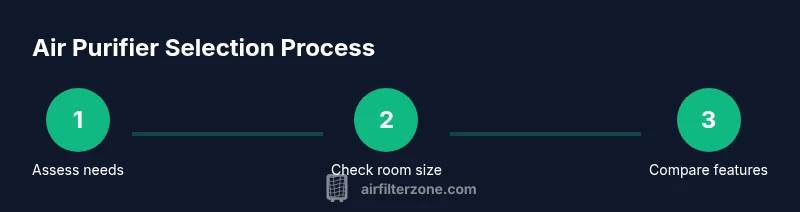
Assess your needs and space
Identify which pollutants matter most (dust, pollen, smoke, odors) and measure the room to determine the required purifier size. This helps prevent buying a unit that's too small or unnecessarily powerful.
Tip: Write down pollutant priorities before browsing models. - 2
Check CADR and room size
Select a purifier whose CADR aligns with your room’s volume and ceiling height. Higher CADR cleans air faster, but may come with higher noise and energy use.
Tip: Always verify the CADR matches or exceeds your room size. - 3
Compare features and energy use
Evaluate filtration types (HEPA, carbon), filter lifespan, noise, and smart features. Balance upfront cost with ongoing maintenance to estimate true ownership costs.
Tip: Prioritize longer-lasting filters to reduce replacement frequency. - 4
Purchase and unbox
Unbox carefully, inspect for damage, and read the setup instructions before plugging in. Confirm that seals and filters are properly installed.
Tip: Register the product for warranty and future updates. - 5
Position for airflow
Place the purifier away from walls and furniture to maximize airflow. Point intake towards the center of the room for even distribution.
Tip: Avoid corners or clutter that block airflow. - 6
Maintain filters and monitor performance
Set reminders to replace filters and check for changes in odor or airflow. Maintain the purifier according to the manual for best results.
Tip: Replace filters on schedule even if performance seems fine.
FAQ
Can an air purifier remove all pollutants?
Most purifiers reduce common indoor pollutants (dust, pollen, smoke) but may not remove all gases or pathogens. For gases, look for activated carbon filters; for microbes, ensure a purifier with proper filtration and airflow. Maintenance matters for effectiveness.
Most purifiers reduce common pollutants, but no single device removes everything. Look for carbon filters for gases and HEPA for particles.
How often should I replace filters?
Replacement schedules vary by model and usage. Check the manufacturer’s guidance and monitor performance; typical cycles are every several months to a year for HEPA filters, with carbon filters often needing more frequent changes.
Check your manual and monitor performance; most filters need replacement every several months to a year.
Will an air purifier help with wildfire smoke?
Purifiers with HEPA filters can reduce particulate matter from smoke, but won’t eliminate all risks in heavy smoke. Use purifiers in conjunction with ventilation strategies and outdoor air quality monitoring.
Purifiers help with smoke particles but aren't a silver bullet in heavy wildfire conditions.
Do air purifiers produce ozone?
Most portable purifiers with mechanical filtration do not emit ozone. Avoid models that generate ozone and look for CARB (California Air Resources Board) compliance as a safety indicator.
Most purifiers don’t produce ozone, but avoid ozone-generating models.
What does CADR mean and why does it matter?
CADR stands for Clean Air Delivery Rate and indicates how much clean air a unit delivers per minute. Higher CADR generally means faster air cleaning for a given room size, so match it to your space.
CADR tells you how quickly a purifier cleans air in your room.
Watch Video
Quick Summary
- Define needs and space before shopping.
- Choose CADR based on room size and airflow.
- Balance upfront price with filter costs and energy use.
- Position purifier for optimal airflow in the room.