Air Purifier Use: A Practical Guide for Clean Indoor Air
Explore practical, step-by-step guidance on air purifier use: sizing, placement, operation, maintenance, and cost considerations to improve indoor air quality for homes, cars, and workshops.


Air purifier use is most effective when you choose a unit sized for your space, position it for optimal air flow, and maintain clean filters. Start by selecting a purifier with a CADR appropriate for the room, place it away from walls and obstructions, and schedule regular filter changes. Run it continuously in high-pollen or smoky conditions to noticeably reduce dust, odors, and irritants.
What air purifier use means for indoor air quality
According to Air Filter Zone, air purifier use is most effective when the unit is properly sized for the room, placed to maximize air circulation, and maintained with clean, functional filters. A properly used purifier does not just move air; it captures a large portion of fine particles, odors, and certain VOCs that contribute to allergy symptoms and stale indoor air. When you start, you should consider three core factors: space size, pollutant sources, and your noise tolerance. For homeowners and car owners alike, selecting a purifier with a higher Clean Air Delivery Rate (CADR) relative to room size, and aligning it with ongoing maintenance, yields the best results. This approach is consistent with Air Filter Zone Analysis, 2026, which emphasizes sizing, placement, and upkeep as the backbone of effective air purification.
In practice, expect to operate the device during periods of higher pollutant load (such as allergy seasons or wildfire smoke), and to pair purifier use with good ventilation when safe to do so. While purifiers significantly reduce fine particles and odors, they do not replace source control, such as smoking cessation or reducing cooking emissions. By combining disciplined operation with routine maintenance, you can create a noticeably cleaner living environment and support better respiratory health over time.
-1
Tools & Materials
- Air purifier(Choose a model rated for the largest room it will serve; ensure a true HEPA filter (H13 or better) is included.)
- Replacement filters(Have at least one spare main filter and one spare pre-filter per purifier model. Check compatibility with your unit’s filter sizes.)
- Soft cloth or microfiber towel(Used to gently wipe the exterior and pre-filter areas without scratching surfaces.)
- Measuring tape(Useful for confirming room dimensions to match CADR guidance.)
- Optional: air quality monitor or smart features(Can help track improvements and automate operation based on readings.)
Steps
Estimated time: 60-90 minutes
- 1
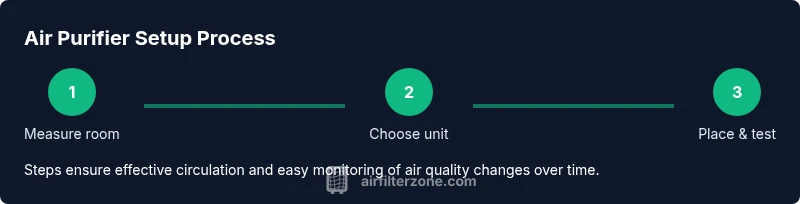
Measure the space and confirm unit size
Measure the length, width, and height of the main room to estimate air volume. Use the formula volume = length × width × height. Compare this to the purifier’s CADR recommendations and select a unit that can clean the space efficiently in a reasonable number of air exchanges per hour.
Tip: Aim for a CADR that delivers 4–6 air changes per hour in the target room for optimal results. - 2
Check pollutant sources and target features
List known sources of pollution (dust, pollen, pet dander, smoke, cooking odors) and verify the purifier’s filters cover those contaminants. For odors or VOCs, prioritize units with activated carbon or specialty adsorbents. Ensure the device has a true HEPA filter to capture fine particles.
Tip: If odors are a concern, a carbon filter is essential even in a high-CADR purifier. - 3
Choose placement that maximizes airflow
Place the purifier at least 3–6 inches away from walls or furniture and near the center of the room if possible to maximize airflow. Avoid corners or cramped spaces where air may stagnate. If you have multiple rooms, plan strategic placements to create cross-ventilation when doors are open.
Tip: Angles matter: point the intake away from walls to prevent backdraft of air. - 4
Set operating mode and initial run
Power on and set the purifier to a medium or high setting for initial run. If available, enable night mode for quieter operation during sleep. Run the unit for 24–48 hours to establish baseline performance and observe changes in air quality.
Tip: Start with a higher setting and adjust down if noise becomes disruptive. - 5
Schedule filter maintenance
Record the replacement interval in the purifier’s calendar or app. Regular maintenance is critical: pre-filters collect larger particles and protect the main filter, while main filters remove fine particles more efficiently.
Tip: Even when signals aren’t visible, plan for routine changes to maintain effectiveness. - 6
Monitor performance and adjust
Use any built-in display or a separate air quality monitor to track PM levels. If readings remain high, consider increasing run time, adding another purifier, or relocating for better airflow. Reassess after 2–4 weeks.
Tip: Nature’s allergens vary; adapt operation seasonally for best results.
FAQ
Do air purifiers remove viruses from the air?
Air purifiers with true HEPA filters can capture many airborne particles, including some virus-containing aerosols, but they are not a guaranteed method for sterilization. Use in combination with ventilation and other hygiene practices.
HEPA-equipped purifiers capture many particles, but they aren’t a replacement for ventilation and health precautions.
How do I choose the right size purifier for a room?
Measure your room and compare the purifier’s CADR to the room volume. A common guideline is to aim for multiple air changes per hour, depending on the space and pollutant sources.
Measure the room, match CADR to space, and ensure several air changes per hour for effective purification.
Can I run a purifier in the bedroom at night?
Yes, many purifiers offer a night or silent mode for low-noise operation while you sleep. Consider models with dimmable displays and energy-saving settings.
You can run it in the bedroom—look for quiet modes and low light settings to minimize disruption at night.
Do air purifiers produce ozone?
Most consumer air purifiers do not intentionally emit ozone, but some devices with certain ionizing features can produce trace amounts. Check product specifications and certifications.
Most purifiers don’t emit ozone, but check features that might; read the manual for safety notes.
How often should I replace filters?
Replacement frequency depends on usage, pollutant load, and filter type. Typical guidance ranges from several months to a year; always follow the manufacturer’s schedule and indicators.
Change filters according to the manufacturer’s guidelines and what your filter indicators show.
Are air purifiers energy efficient?
Energy use varies by model and speed. Look for Energy Star-rated units and use the lowest effective setting to balance air quality with power consumption.
Energy use depends on the model and setting; pick an energy-efficient unit and run it on the lowest effective setting.
Watch Video
Quick Summary
- Size the purifier to space for effective air exchanges
- Place the unit for optimal airflow and avoid obstructions
- Maintain filters regularly to preserve performance
- Use higher speeds during high pollutant periods and quiet modes at night
- Monitor air quality to guide adjustments and placement