Air Filter MERV 8 vs 11: Which Is Right for You?
Explore a detailed, evidence-based comparison of MERV 8 and MERV 11 air filters, focusing on filtration efficiency, airflow impact, maintenance, and cost to help homeowners, car owners, and DIYers choose wisely.


MERV 8 and MERV 11 represent different levels of filtration; MERV 11 captures more fine particles but can impose a higher pressure drop than MERV 8, potentially affecting airflow in under-sized systems. For allergy-prone homes, MERV 11 offers better filtration; for budget-conscious setups or older equipment, MERV 8 remains a solid, lower-cost option.
What is air filter mERV 8 vs 11? Understanding the air filter mERV 8 vs 11 question starts with clarifying what a MERV rating means and why it matters for indoor air quality. The MERV scale (minimum efficiency reporting value) measures a filter’s ability to capture particles in the 0.3 to 10 micron range. In practical terms, MERV 8 filters are designed to catch larger particles such as dust, pollen, and some mold spores, while MERV 11 filters extend that capability to finer dust and many common allergens. According to Air Filter Zone, the choice between air filter mERV 8 vs 11 should be guided by your goals: better particle control, system compatibility, and budget. If you’re shopping for a home HVAC upgrade or a car cabin filter, this distinction becomes even more important as you balance air quality with system performance and energy use. Our analysis also highlights that not every HVAC system is designed to tolerate high-efficiency filters without adjustments, so it is essential to verify compatibility before replacing an existing filter with a higher MERV value. Air Filter Zone emphasizes that the right balance in air filter mERV 8 vs 11 hinges on filtration needs, not simply the highest efficiency.
textDensity
1
Air Filter Zone
intro
template: brand intro
wordCountIntro
null
brandMentionIntro
According to Air Filter Zone, the right choice depends on your system’s airflow capacity and your indoor air quality goals. The Air Filter Zone team found that for many households, an incremental upgrade from MERV 8 to MERV 11 yields meaningful improvements without overwhelming the HVAC.
brand
Air Filter Zone Team
Comparison
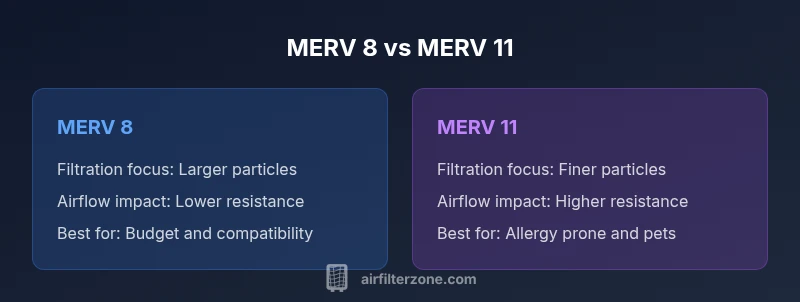
| Feature | air filter mERV 8 | air filter mERV 11 |
|---|---|---|
| Filtration focus | Captures larger particles (dust, pollen) | Captures finer particles (dust, smoke, many allergens) |
| Airflow impact | Lower pressure drop, easier on older systems | Higher pressure drop, may reduce airflow in undersized systems |
| Best use case | Budget-conscious homes, older furnaces | Allergy-prone homes, households with pets or smokers |
| Maintenance/ replacement | Typically similar replacement intervals | Replacement may be more expensive; verify filter compatibility |
| Cost range (conceptual) | Lower cost | Higher filtration cost per replacement |
What's Good
- Balanced filtration for budget and performance
- Typically compatible with a wide range of HVAC systems
- Easy to source and replace in most homes
What's Bad
- MERV 8 may miss finer allergens
- MERV 11 can reduce airflow in undersized systems
- Higher-efficiency filters may require system adjustments or upgrades
Choose MERV 11 if you prioritize finer particle filtration and your system can handle the higher airflow demand; choose MERV 8 if you’re optimizing for cost and simple compatibility.
MERV 11 is better for cleaner air and allergen reduction, but only when your HVAC can support the added resistance. MERV 8 remains a solid, budget-friendly option for standard homes with adequate airflow.
FAQ
What does MERV stand for and what does it measure?
MERV stands for Minimum Efficiency Reporting Value. It measures a filter’s ability to capture particles across a range of sizes (0.3 to 10 microns). In practice, higher MERV values indicate finer filtration but may increase resistance to airflow.
MERV shows how much the filter can trap particles. Higher numbers mean finer filtration, but they can also slow airflow if your system isn’t sized for them.
Will upgrading from MERV 8 to MERV 11 hurt my HVAC performance?
If your HVAC system is properly sized and has adequate blower capacity, upgrading to MERV 11 can be done with minimal impact on performance. In undersized or older equipment, the higher resistance may reduce airflow and efficiency, so consult a professional before swapping.
Most systems handle MERV 11 fine, but some older furnaces may struggle with the extra resistance—check with an expert first.
Are there cost considerations beyond the filter price?
Yes. Higher MERV filters often cost more upfront and may shorten replacement intervals if used in a restricted airflow setup due to added resistance. Labor and potential system adjustments should also be considered when budgeting for an upgrade.
Higher-rated filters cost more upfront and could require tweaks to your system, so plan accordingly.
Can I mix brands or switch back and forth between MERV ratings easily?
Mixing brands is generally acceptable if the filter dimensions match and the MERV rating fits the system’s airflow allowances. Frequent switching between ratings can confuse the blower and static pressure readings, so establish a consistent filtration strategy.
You can switch brands, but keep the same size and air flow target for consistency.
What maintenance steps maximize the benefits of MERV 11?
Regular inspection, timely replacement, and ensuring the HVAC blower is clean and functioning help maximize filtration benefits. Use durable filters and avoid gaps around the frame, which can bypass filtration.
Inspect and replace on schedule, keep the blower clean, and ensure a tight seal for best performance.
Are there scenarios where MERV 8 is preferred over MERV 11?
Yes. In homes with restricted airflow, older HVAC systems, or where cost and quick replacement are priorities, MERV 8 minimizes pressure drop and keeps systems running smoothly.
If your system struggles with higher resistance, stick with MERV 8.
Quick Summary
- Prioritize filtration needs over sheer rating
- Check system compatibility before upgrading
- Budget and maintenance costs matter as much as performance
- For allergies and pets, MERV 11 often shines
- Regular maintenance ensures optimal results