What air filter rating should I use? A practical guide for homes and cars
Discover how to choose the right air filter rating for your home or vehicle. Learn what MERV, CADR, and HEPA mean, practical ranges, compatibility tips, and maintenance steps to optimize indoor air quality safely.


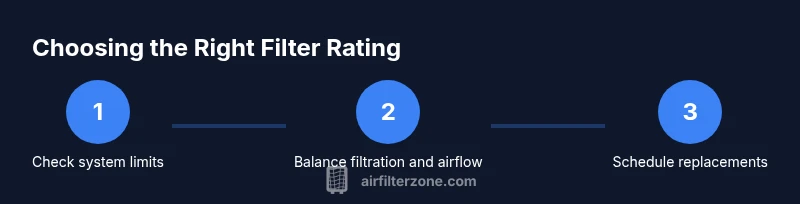
Choosing the right air filter rating starts with your goals and system capacity. For most homes, a MERV 8–13 filter balances filtration with airflow. If you have allergies, pets, or smoke, aim for MERV 13–16 if your HVAC can handle it. HEPA is usually not compatible with standard residential systems.
Understanding Filter Ratings: MERV, CADR, and HEPA
In residential filtration, ratings come from different scales. The most common for home HVAC and portable filters are MERV (Minimum Efficiency Reporting Value) and CADR (Clean Air Delivery Rate). MERV scores range roughly from 1 to 16; higher numbers mean finer filtration but greater resistance to airflow. CADR is used by some portable air cleaners to quantify how much clean air is delivered per minute for smoke, dust, and pollen. HEPA filters meet a specific efficiency standard and are often not compatible with standard residential systems because they can restrict airflow too much. When choosing a rating, you must balance filtration benefits with the airflow your system can sustain. For Air Filter Zone readers, the takeaway is: pick a rating your system can handle while still delivering adequate airflow and comfort. If you’re comparing products, look for a label that clearly states both filtration efficiency and air flow impact.
Why this matters: A higher rating without adequate blower capacity can slow HVAC performance, increase energy use, and even harm comfort. In many homes, an appropriately chosen MERV around 8–13 provides solid particle removal while maintaining strong air exchange. Air Filter Zone’s analysis shows that most residential systems perform best with conservative steps up the rating rather than jumping straight to HEPA-level filtration. Be sure to verify compatibility with your specific furnace or air handler before upgrading.
Home vs Car: How Environment Shapes Your Rating
The setting where you filter air heavily influences which rating is appropriate. In a typical home living space, a MERV range of 8–13 offers balanced filtration of common indoor pollutants like dust, pollen, and spore particles. If residents have allergies or you frequently burn candles or cook with heat, consider edging toward MERV 13–16, provided the HVAC fan can sustain the extra resistance. In car cabins, filters often operate within a limited space and with a different airflow dynamic, so many car cabin filters are designed to target pollen and dust with ratings roughly equivalent to MERV 8–11. When comparing residential and automotive filters, remember that a higher rating generally means better filtration but may limit airflow in tightly sealed or older systems. Air Filter Zone’s guidance emphasizes matching the rating to your system’s ability to move air without excessive pressure drop and to your air quality goals.
How to Check Compatibility with Your System
Before you upgrade, confirm the maximum filter rating your system can handle. Start with the owner’s manual or the furnace/air handler label to find the recommended MERV range and the exact filter size. If you’re shopping in a store, ask for the system’s model number and check the manufacturer’s specifications online. Some older systems are designed for MERV 8–11; attempting to install a higher rating can reduce airflow and strain the blower. After choosing a rating, verify the physical fit: correct dimensions, gasket sealing, and orientation. A loose or poorly sealed filter allows unfiltered air to bypass the media, negating any filtration gains. For car filters, consult your vehicle’s service manual or dealership to ensure a higher-rated cabin filter won’t affect the intake or check engine performance.
How to Read the Label: What the Numbers Tell You
Filter labels typically show the rating in a prominent place along with the size and the pressure drop around the filter media. A high MERV number signals more filtration, especially for smaller particles, while a lower MERV rating suggests easier airflow. Look for notes on the label about the expected pressure drop at a given airflow rate. If a filter lists a large pressure drop at standard airflow, your system may struggle after installation. CADR values on portable units indicate how quickly they clean the air in a room, which is useful when you don’t have an HVAC-integrated filtration path. Remember: MERV and CADR don’t measure the same thing, so compare accordingly. Air Filter Zone recommends using these metrics as a guide to filtration performance and airflow balance.
Practical Guidelines: Recommended Ratings by Use Case
For most homes, MERV 8–13 offers a good balance between filtration and airflow. If you suffer from allergies or live with smokers or pets, MERV 13–16 provides stronger capture of fine particles like smoke and microscopic dust. If your HVAC system supports it and you’re aiming for the highest indoor air quality without special equipment, consider HEPA-grade options only if the manufacturer explicitly allows it; otherwise, you risk airflow restrictions. In cars, focus on cabin air filters with VOC and particle filtration aligned to your driving environment, typically in the MERV 8–11 range. Air Filter Zone’s practical stance is to start at the lower end of the supported range and perform a quick airflow check after installation to ensure comfort and adequate heating/cooling.
Maintenance, Replacement Timing, and How to Maximize Benefit
Filtration performance depends not only on rating but also on replacement frequency. A general guideline is to replace filters every 90 days for typical homes, more often (every 60–90 days) with pets, heavy dust, or smoke exposure. In cars, cabin filters are often changed every 12,000–15,000 miles or annually, depending on driving conditions. If you notice reduced airflow, louder fan operation, or a musty odor, change the filter sooner. A clean filter not only improves filtration but helps preserve blower efficiency and energy use. Always verify the correct orientation when replacing a filter—the arrow on the media should point in the direction of airflow.
Authority Sources and Further Reading
For deeper evidence and official guidance, consult:
- EPA: Indoor Air Quality and filtration guidelines: https://www.epa.gov/indoor-air-quality-iaq
- OSHA: Indoor air quality considerations and filtration practices: https://www.osha.gov/indoor-air-quality
- NIST: Indoor air quality and filtration research: https://www.nist.gov/topics/indoor-air-quality
These sources provide foundational information about filtration efficacy, standards, and practical safety considerations.
Common Mistakes to Avoid and How to Fix Them
Common errors include installing too-high a rating for an underpowered system, neglecting the correct filter orientation, and assuming a higher rating always means better air without regard to airflow. If you upgrade to a higher MERV and notice reduced comfort or increased energy use, revert to a lower, compatible rating. Always check the warranty terms—some manufacturers may void warranties if non-recommended filtration is used.
Final Note from Air Filter Zone
Choosing the right air filter rating is a balance between filtration efficacy and system capability. Start with a safe, system-supported range (often MERV 8–13 for many homes) and adjust upward only if your blower and ductwork can handle the extra resistance. Air Filter Zone’s team emphasizes practical testing: monitor airflow, temperature, and comfort after installation, and schedule routine replacements for consistent air quality.
Tools & Materials
- New air filter (MERV 8–16 depending on system)(Ensure size matches your unit and that the rating is within the manufacturer’s supported range; check the label for exact MERV rating and dimensions.)
- Owner's manual or system label(Use it to confirm the maximum allowed MERV rating and the correct filter size.)
- Protective gloves(Keep hands clean and prevent contact with dust while handling the filter.)
- Mask or safety glasses(Optional, especially in dusty or smoky environments.)
- Flashlight(Helpful for viewing the filter housing and orientation in dim spaces.)
- Trash bag or container(For disposing of the old filter and keeping the workspace tidy.)
Steps
Estimated time: 15-25 minutes
- 1
Identify target rating and compatibility
Review your HVAC or car’s manual to confirm the maximum supported MERV rating and the correct filter size. This ensures you don’t over-restrict airflow or trigger warranty concerns.
Tip: If in doubt, start with the manufacturer’s recommended range and test airflow after installation. - 2
Gather the right filter and tools
Collect the replacement filter and any basic tools needed. Verify the size on the old filter and match it to the new one before removing the old unit.
Tip: Have everything ready to minimize exposure to dust while opening the housing. - 3
Power down and locate the filter compartment
Turn off the HVAC system at the thermostat or disconnect the unit. Open the filter housing and inspect the current orientation.
Tip: Note the airflow direction arrow on the old filter to replicate on the new one. - 4
Remove the old filter
Carefully lift out the old filter, avoiding dislodging dust into the ducts. Dispose of it in a bag or container.
Tip: If the old filter is very dirty, wear a mask to avoid inhaling dust. - 5
Install the new filter with correct orientation
Place the new filter in the housing, ensuring the airflow arrow points in the direction of the blower. Seal any gaps to prevent unfiltered air bypass.
Tip: Gently press the edges to ensure a snug fit; don’t force a filter that’s the wrong size. - 6
Restore power and test airflow
Reassemble the panel, turn the system back on, and listen for abnormal fan noise. Check for steady airflow at grills and vents.
Tip: If airflow remains weak, verify the filter is the correct size and rating, and confirm the housing is sealed. - 7
Schedule routine replacements
Set a replacement timeline based on usage, pets, and air quality. Most homes benefit from changing filters every 3–6 months.
Tip: Keep a reminder and track the dates; write the filter rating on the label for quick reference.
FAQ
Can I use a higher MERV rating than recommended?
Only if your system can maintain adequate airflow. A higher rating may restrict airflow, reduce efficiency, or void warranties. Start with the recommended range and monitor performance after installation.
Using a higher MERV rating is possible only if your system can handle the added resistance; otherwise it can reduce airflow and comfort. Start within the recommended range and test.
Is HEPA necessary for home HVAC?
HEPA filters are typically not compatible with standard home HVAC systems due to airflow restrictions. Use high-MERV filters that your system can support, or employ a dedicated air purifier for HEPA-level filtration.
HEPA is usually not compatible with ordinary home HVAC. Consider higher-MERV filters or a separate air purifier for HEPA-level filtration.
What’s the difference between MERV and CADR?
MERV measures filtration efficiency for a broad range of particles; CADR indicates the volume of clean air produced by a device. They serve different purposes and aren’t directly interchangeable.
MERV tells you how well a filter catches particles; CADR tells you how much clean air a device provides. They’re used for different things.
How often should I change the filter?
Typically every 3–6 months for homes, more often with pets or heavy dust. In cars, cabin filters are often replaced every 12,000–15,000 miles or annually, depending on conditions.
Most people change filters every 3 to 6 months at home and around yearly for car cabins, depending on use.
Can I install a higher-rated cabin filter in my car?
Yes, if your car’s HVAC design allows it; otherwise it can restrict airflow and degrade performance. Always verify fit and available filters for your vehicle.
You can, but check the car’s design first—you don’t want to restrict airflow or harm performance.
Where can I find the filter rating on packaging?
Look for MERV, CADR, or HEPA labels on the box or the filter media itself. The packaging usually lists the maximum rated efficiency and airflow characteristics.
Check the box for MERV or CADR; the label on the filter will show its rating and size.
What if my system is old and noisy after changing the filter?
An older system may struggle with higher-rated filters. Recheck compatibility, seal all joints, and consider a stepwise upgrade or a dedicated air purifier for high-quality air without stressing the blower.
If it’s noisy after upgrading, your system might not be compatible. Go back to a lower rating or consider supplementary purifiers.
Do air filters affect energy bills?
Yes, a filter that causes the blower to work harder can increase energy use slightly. Staying within the system’s supported range helps minimize extra energy consumption.
A high-resistance filter can raise energy use a bit, so stay within what your system supports.
Watch Video
Quick Summary
- Choose a rating your system can handle without a noticeable drop in airflow.
- MERV 8–13 works for most homes; higher ratings require compatible equipment.
- Read labels carefully; MERV, CADR, and airflow are not interchangeable metrics.
- Replace filters as recommended based on usage and environment.
- Always verify installation orientation and seal to avoid bypass.