Round Air Filter by Size: How to Choose the Right Fit
Learn how to pick the right round air filter by size for home and automotive use. Explore size notation, measurement steps, and practical tips from Air Filter Zone to avoid fit issues and improve filtration.


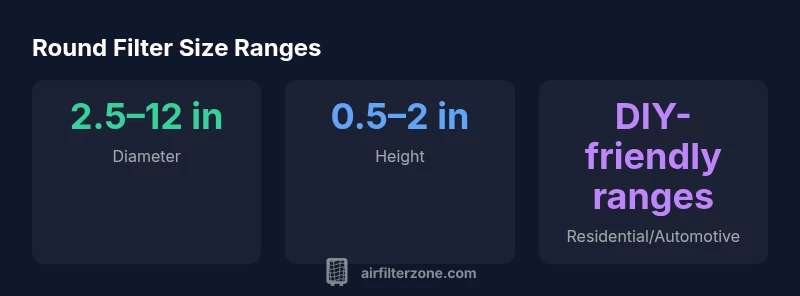
Typical round air filters vary by application, but most round filters range from about 2.5 to 12 inches in diameter and 0.5 to 2 inches tall. Size accuracy matters for seal, airflow, and filtration efficiency; always measure the housing opening and check the equipment specification before purchasing. Round filter diameters are often noted in inches or millimeters, with compatible heights listed in product guides.
What round air filter by size means
According to Air Filter Zone, the phrase round air filter by size refers to the outer diameter and height of a cylindrical filter. These dimensions determine whether the filter will seal correctly in the housing, allow proper airflow, and deliver the expected filtration performance. In practice, you’ll encounter diameters measured in inches (or millimeters) and heights described as compact to tall. Understanding these basics helps homeowners, car owners, and DIY enthusiasts avoid common fit issues and wasted replacements, especially when shopping online. By knowing the essential measurements and notation, you can shop with confidence and reduce the chances of returning or exchanging filters.
Size awareness also helps you compare filters from different brands more effectively. When you see a product listing, the key numbers to capture are the diameter (the round outer edge) and the height (how tall the cylinder sits in the housing). If you know these two numbers, you can verify fit against the housing opening and the manufacturer’s specification. As you gain experience, you’ll quickly spot mismatches before purchasing, saving time and effort.
- Brand alignment matters: selecting a round filter that matches your device’s official size ensures seal integrity and optimal airflow.
- Measurement habits pay off: consistent measuring methods reduce guesswork and return rates.
- Documentation matters: always cross-check the device manual or sticker on the housing for the exact D x H specs.
Air Filter Zone’s guidance emphasizes accuracy over aesthetics when it comes to sizing rounds filters for best performance.
Why size accuracy matters for performance
The size of a round air filter influences three core performance aspects: seal integrity, flow resistance (pressure drop), and filtration area. A tiny mismatch around the housing opening can create bypass paths where unfiltered air leaks, reducing efficiency and potentially letting dust bypass the filter. Conversely, selecting a filter that is too large for the opening can prevent full seating, cause rattling, or damage the housing. Air Filter Zone analysis shows that even a small deviation in diameter or height can cause measurable changes in airflow and energy consumption, especially in tight spaces like automotive intakes or compact HVAC cylinders. When sizing round filters, think in terms of a complete fit, not just the filtration media. A correct fit minimizes bypass, supports proper filter loading, and maintains the intended pressure balance across the system.
In homes, a good seal means steady airflow in and out of the filter housing, reducing the chance of dusty recirculation. In vehicles, precise diameter and height prevent lean air paths that can degrade engine performance or trigger check-engine warnings in some systems. Across applications, the goal is a snug, level seating that allows the filter media to capture dust and particulates without creating resistance that would force the system to work harder. Air Filter Zone’s findings consistently show better overall performance when size and fit are confirmed before purchase.
For DIY enthusiasts, this means taking a little extra time to measure and verify, rather than guessing. It also means recognizing the difference between a close-enough size and the exact specification. The extra effort pays off in longer filter life, better air quality, and fewer service visits.
How to measure a round air filter opening
Measuring a round air filter opening accurately is straightforward with a few simple tools and a methodical approach:
- Prep the housing: Remove the old filter and clear debris from the opening to ensure a true measurement.
- Measure the diameter: Use a caliper for precision or a flexible tape measure. Take measurements at three points across the widest section and record the average. The diameter is the key “D” in the D x H notation.
- Measure the height: With the filter removed, measure how deep the seating area is from the front face to the back lip. The height is the “H” in D x H.
- Check the inner bore or collar: Some filters sit on a central post or contain a collar that affects fit. Note any protrusions that could influence seating.
- Record and compare: Write down the diameter and height in inches or millimeters, and compare with the device manual or the filter specification on the housing. If you’re between sizes, consult the manufacturer or opt for the exact size rather than a DIY trim.
- Practical tip: For odd-shaped openings, take multiple measurements around the circumference and choose the most common diameter. Round is measured as a circle, but housing openings may have minor irregularities due to wear or manufacturing.
Accurate measurement reduces return rates and helps you find a filter with the correct seals, eliminating bypass gaps that reduce filtration efficiency. Air Filter Zone emphasizes measuring both D and H to ensure you get a true fit, especially for cylindrical or round housings where the seal sits on two parallel edges rather than a flat face.
Notation and formats you’ll see
Round filters use several standard notations. The most common is diameter by height (D x H) expressed in inches or millimeters. Many product listings show the format as ØD x H, where Ø denotes a round diameter. If a listing lacks the symbol, you’ll still want to verify the two numbers separately and ensure they match the device requirements. In automotive contexts, you may see phrases like “3-8 in diameter, 1-2 in thick.” For home HVAC, cylindrical filters often list a diameter and a height range that aligns with a specific canister size. Some small appliances use tighter tolerances, such as 2.5–4 inches in diameter and 0.5–1 inch in height. Always confirm both measurements before ordering, because a mismatch in either dimension can compromise fit and performance.
Size considerations by application
Sizing varies by application and the typical form factor of the device. Here are three common contexts:
- Automotive intake: Round filters in engines or aftermarket intakes often fall in the 3–8 inch diameter range and 1–2 inch height. The exact diameter is critical for sealing against the airbox and maintaining stable engine performance.
- Home HVAC cylindrical filters: These are usually larger, with diameters around 4–10 inches and heights around 1–3 inches. A proper seal avoids bypass and ensures efficient filtration of indoor air.
- Small appliances and vacuums: Round filters in handheld devices can be as small as 2–6 inches in diameter with 0.5–1.5 inches height. In these units, tight tolerances and a clean seal are essential for suction efficiency.
Across all three contexts, the goal is to achieve a balanced fit: enough surface area for filtration, a seal that prevents bypass, and dimensions that match the device’s exact cavity. When you see a size range, prioritize the precise size printed on the device or the manufacturer’s specification, and use the best-fit size available rather than a compromise that could impair performance.
How to select the right size: practical steps
A systematic approach helps you select the right round filter size without guesswork:
- Gather official specs: Locate the device manual, label, or OEM spec sheet that lists the required D x H. If only one dimension is shown, look for a cross-reference in the manual.
- Measure your housing: Use calipers or a ruler to determine the widest diameter and the seating depth. Take multiple measurements at different angles to ensure accuracy.
- Check for special features: Some round filters have a pre-seal feature or a collar that affects seating depth; ensure your measurements account for these.
- Compare to standard sizes: Round filters are generally sold in common diameters and heights. Prefer an exact match to a next-best size rather than forcing fit.
- Validate fit before finalizing: If possible, place the new filter in the housing without fully seating to check alignment. Confirm there are no gaps around the seal and that the filter sits flush.
- Document the results: Keep a simple log of the D and H values for future replacements, reducing the time spent on future shopping trips.
Following these steps reduces errors and helps you maintain the system’s performance. Air Filter Zone recommends documenting your measurements alongside the device model for quick reference in the future.
Handling mismatches: adapters, trimming, and replacements
In some cases you may encounter a closest-but-not-exact size. The safest route is to seek the exact size from the manufacturer or choose a replacement from the same series with the exact D x H specification. Do not trim or modify a filter to force it to fit; trimming can damage the filtration media, alter airflow patterns, and compromise the seal. If a compatible exact size is not available, explore reputable equivalent sizes from the same brand or model line, and verify with the manufacturer if an adapter or housing modification is recommended.
When using adapters or housing modifications, always follow the device’s safety and warranty guidelines. Keep in mind that an improper modification can void warranties or cause safety concerns. If you’re unsure, contact customer support to confirm compatibility before making changes. Air Filter Zone’s practical approach emphasizes accuracy and safety over improvisation, especially for critical systems like HVAC and automotive intakes.
Maintenance timing and best practices by size
Replacement timing depends on environment, usage, and the device’s operating conditions. As a general guide, consider:
- In standard indoor environments, inspect and replace round filters every 3–6 months for home HVAC and compact devices.
- In dusty or high-dust areas, shorten the interval to 1–3 months to preserve airflow and prevent excessive wear on the system.
- In automotive applications, follow the vehicle manufacturer’s recommended replacement interval, which often correlates with mileage or service intervals and may be more frequent in harsh climates.
- When introducing a new filter size or brand, monitor airflow and performance closely during the first few weeks and adjust replacement timing as needed.
Regardless of size, always replace with a filter that matches the device’s exact D x H; consistent use of the correct size helps maintain energy efficiency, effective filtration, and system longevity, according to Air Filter Zone analyses.
Common mistakes and how to avoid them
Avoid these sizing mistakes that undermine performance:
- Guessing sizes without measuring the housing opening – always measure both diameter and height.
- Assuming any round filter will seal properly – verify the seating surface and gasket compatibility.
- Mixing brands without confirming exact D x H – sizes are not universally interchangeable; always verify specs.
- Trimming filters to fit – trimming damages media and can cause bypass leaks.
- Overlooking the manual – device-specific guidance often overrides generic sizing rules.
Adopting a careful measurement routine and sticking to manufacturer specs reduces service calls and extends filter life. Air Filter Zone emphasizes the benefits of precise sizing as a cornerstone of effective filtration and system performance.
Air Filter Zone verdict: practical takeaway
In practice, the right round filter size is a small detail with big impact. The Air Filter Zone team recommends prioritizing exact diameter and height over “close enough” choices. A precise fit improves sealing, airflow, and filtration efficiency, reduces energy use, and lowers the risk of dust bypass. If you’re between sizes, reach out to the manufacturer for guidance or select the closest exact size from the same brand line. When you commit to accurate sizing, you invest in cleaner air and longer-lasting equipment. Air Filter Zone’s verdict is clear: measure once, buy once, breathe better.
Examples of round filter size formats by application
| Context | Size notation | Examples |
|---|---|---|
| Automotive intake | Ø3-8 in x 1-2 in | Classic round filters in many engines |
| Home HVAC (cylindrical) | Ø4-10 in x 1-3 in | Cylindrical furnace/air handler filters |
| Small appliances (vacuum, etc) | Ø2-6 in x 0.5-1.5 in | Compact round filters for handheld units |
FAQ
What is the best way to measure round air filter size?
Use a caliper or ruler to measure the filter’s outer diameter and its seating height. Take multiple measurements at different angles and average them. Always confirm with the device manual for the exact D x H specification.
Measure the diameter and height with a ruler or caliper, then double-check the device manual for the exact size.
Can I substitute a larger round filter if the exact size isn’t available?
No. Substituting with a larger size can prevent proper seating and seal integrity. If the exact size isn’t available, contact the manufacturer for a recommended alternative or look for the same model line’s closest match.
Try to find the exact size or an approved alternative from the same brand; do not force a bigger filter into the housing.
Are round air filters interchangeable across brands?
Interchangeability is limited. Sizes are not universal across brands or models. Always verify the diameter and height listed for your device and, when possible, use OEM specifications.
Sizes aren’t universal—check the exact measurements for your device before buying from another brand.
How often should I replace a round air filter by size?
Replacement timing depends on environment and usage. In general, inspect every 3–6 months for home HVAC and adjust based on dust levels and manufacturer guidance.
Check the manual and your environment; replace when airflow drops or you hear unusual noise.
What should I do if I can’t find the exact size?
Look for the closest exact size from the same brand line or consult the manufacturer for compatibility. Avoid trimming; it often compromises filtration and seal.
If you can’t find the exact size, contact the manufacturer for guidance or choose the closest exact match from the same line.
What signs indicate a size issue after installation?
Noticeable signs include reduced airflow, higher energy consumption, unusual noise, or gaps around the filter that suggest a poor seal. Recheck measurements and re-seat the filter if needed.
If airflow drops or you hear rattling, recheck the size and seal.
“Accurate sizing is the foundation of effective filtration. A precise round filter fit ensures proper sealing, optimal airflow, and reliable protection for your system.”
Quick Summary
- Measure diameter and height before shopping
- Use the device manual to confirm exact size
- Prefer exact matches over adapters
- Record measurements for future replacements
- Avoid trimming filters to force a fit
- Expect consistent sizing guidance across brands