How to Filter Air with Dyson: A Practical Guide
Learn how to filter indoor air with Dyson purifiers. This step-by-step guide covers model selection, setup, operation, maintenance, and best practices for cleaner air at home.


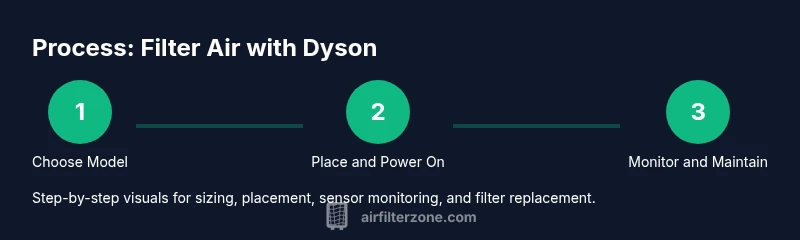
You can filter indoor air effectively with Dyson purifiers that use true HEPA filtration plus activated carbon. Run the device in Auto mode to let built-in sensors adjust fan speed, and monitor air quality via the Dyson Link app or device indicators. Start by selecting a model sized for your room, place it away from walls, and replace filters when prompted for best results.
Why Dyson for air filtration
If you're wondering how to filter air with Dyson, you're choosing a brand with a strong focus on filtration and ease of use. According to Air Filter Zone, Dyson purifiers combine true HEPA filtration with activated carbon to capture both microscopic particles and odors. These units are designed for everyday living spaces and work well in rooms of moderate size when placed correctly. In this section, we'll explore how Dyson filtration works, what to expect, and how to choose a model that fits your room. Dyson's design emphasizes simple operation, minimal maintenance, and smart sensing to help homeowners, car owners, and DIY enthusiasts achieve cleaner air with less guesswork.
- Placement matters: keep the purifier at least a few inches away from walls and furniture to prevent obstructed airflow.
- Use the right filter: ensure your unit has a sealed HEPA filter and an activated carbon layer for odors and gases.
- Expect gradual improvements: most people notice reduced dust and visible air freshness after a few days of regular use.
How Dyson filtration works
Dyson purifiers rely on a combination of filtration stages and intelligent sensors. The core is a true HEPA filter that captures a broad spectrum of particles, including dust, pollen, and pet dander, while an activated carbon filter targets odors and some volatile organic compounds. The devices often include air quality sensors that measure particle concentration and volatile compounds in real time. When the sensor detects poorer air quality, the purifier automatically increases the fan speed; when air quality improves, it eases back to a quieter setting. This balance helps homeowners maintain cleaner air without manual tinkering, which is especially helpful for households with children, allergy-prone individuals, or heavy traffic nearby. If you’re seeking to understand the mechanics so you can select the right model, this section breaks down the filtration stages and why each matters for daily use.
Planning the setup: room size, placement, and power
Choosing the right Dyson purifier starts with room size. A model intended for a large living area may overwhelm a small bedroom, while a compact unit may struggle in a large family space. Consider ceiling height, windows, and typical occupancy when sizing. Placement should avoid direct drafts from vents and keep at least one foot of clearance from obstacles. Power considerations matter too: use a stable outlet and consider scheduling if your unit supports it. If you want to filter air efficiently in a shared living space, place the purifier where air circulates best, not behind large furniture or in a corner where air pockets form.
Step-by-step: getting started with your Dyson purifier
Maintenance, filter care, and when to replace
Enhancing air quality with habits and environment
Common mistakes to avoid and quick wins for better air
Tools & Materials
- Dyson purifier with HEPA filtration(Make sure it includes a sealed True HEPA filter and an activated carbon filter.)
- Replacement filters(Check compatibility with your model and have spares on hand.)
- Remote or Dyson Link app(Useful for monitoring air quality and scheduling maintenance reminders.)
- Power outlet with room for airflow(Position away from water and in a location with stable power.)
- Measuring tape or room size calculator(Helpful for sizing and placement guidance.)
Steps
Estimated time: 40-60 minutes
- 1
Assess room size and pick the right model
Measure the primary living area or bedroom to determine the purifier size needed. Use the manufacturer's guidance to match the unit to room square footage and ceiling height. If in doubt, opt for a model with a higher recommended room size than your space.
Tip: A larger model may perform better over time with variable air quality, but ensure it fits the room and is physically unobtrusive. - 2
Unbox and inspect the filter system
Remove the purifier and check that the HEPA and carbon components are present and undamaged. Inspect for any packaging residues and ensure the seal is intact around the filter cartridge.
Tip: If you detect damage, contact the manufacturer or retailer before use to avoid compromised filtration. - 3
Install or replace the filter
Follow the model-specific instructions to install the filter. Align tabs, twist or snap into place, and ensure the unit seals correctly. Give the purifier a brief test run to confirm airflow.
Tip: Reset any filter indicator if your unit has one after installation. - 4
Choose an optimal location
Place the purifier in a central location with at least a few inches of clearance on all sides. Avoid corners where airflow can stagnate. Keep it away from direct heat sources and moisture.
Tip: If possible, position near the main source of pollutants (e.g., near the kitchen or pet areas) to maximize capture efficiency. - 5
Power on and set the mode
Plug in the unit and switch it on. Start in Auto mode if available so sensors drive the speed. If you prefer a consistent level, choose a fixed fan speed that balances air quality improvements with noise levels.
Tip: Enable any night or sleep mode for quiet operation during rest hours. - 6
Monitor air quality and adjust
Use the built-in indicators or the Dyson Link app to monitor PM2.5 or other sensors. If air quality worsens due to cooking or cleaning activities, temporarily increase the fan speed or adjust location for better capture.
Tip: Set reminders to check filters and clean the intake area monthly. - 7
Schedule maintenance and filter replacement
Follow the manufacturer’s guidance or the indicator lights to replace filters. Keep spare filters on hand and store them in a clean, dry area. Reset indicators after replacement.
Tip: Document the date of replacement to track maintenance cycles. - 8
Integrate with daily routines
Incorporate door and window management, dusting schedules, and cooking ventilation into your routine to maximize the purifier’s impact. Combine filtration with good housekeeping for best results.
Tip: Regular cleaning of the intake grill prevents performance degradation.
FAQ
Can Dyson purifiers remove odors effectively?
Yes, Dyson purifiers with activated carbon filters help reduce odors along with particles. The effectiveness depends on odor source and room conditions. Regular replacement of the carbon filter maintains odor control.
Yes. Dyson purifiers with carbon filters help reduce odors, but replace the carbon filter as recommended for best results.
How often should I replace the filter?
Follow the device’s indicator or manufacturer guidelines. Replacement frequency varies with usage, room size, and pollutant load. Proactive replacement maintains filtration efficiency.
Follow the indicator or guidelines; replace when prompted to keep filtration efficient.
Do I need to run it 24/7?
Running continuously helps maintain steady air quality, but you can schedule or adjust based on occupancy and activities. Auto mode adapts to changing conditions without manual work.
Running it continuously helps, but you can program it to match your daily routine.
Will a Dyson purifier improve air quality in a large open plan?
For large spaces, choose a model rated for higher room size or use multiple units. In open plans, strategic placement ensures airflow reaches all zones.
In big spaces, you may need a larger model or multiple units for even coverage.
Can I use Dyson purifiers in cars or other small spaces?
Some compact Dyson purifiers are designed for small spaces, but verify the model’s intended use and power requirements before deployment in vehicles.
Check your model’s guidelines before using it in a car.
Are Dyson purifiers energy-efficient?
Dyson purifiers are designed to balance air quality improvements with energy use. Use auto or night modes to reduce unnecessary energy consumption.
They’re designed to be energy-conscious, especially in Auto or Sleep modes.
Watch Video
Quick Summary
- Choose a Dyson model sized for your room.
- Place the purifier where air circulates freely.
- Monitor air quality and replace filters when indicated.
- Use Auto mode to optimize filtration without manual tweaks.
- Regular cleaning supports consistent performance.