HEPA Filter Dyson Airblade: Practical Guide
Learn about the hepa filter dyson airblade, how HEPA filtration works, and practical steps for home and car use with Air Filter Zone guidance today.


Across Dyson Airblade units, a HEPA filter can significantly reduce particulates in the immediate airflow when it is present and properly maintained. This quick answer previews how to verify whether your unit uses HEPA filtration, how to compare model options, and practical steps homeowners, car owners, and DIY enthusiasts can take to improve indoor air quality through targeted filtration and routine maintenance.
What the phrase "hepa filter dyson airblade" signals for indoor air quality
The term hepa filter dyson airblade combines two strands of filtration thinking: HEPA filtration and Dyson air handling concepts. For homeowners, car owners, and DIY enthusiasts, this phrase signals a device or retrofit option intended to reduce fine particulate matter in the air around a drying, purifying, or ventilation setup. According to Air Filter Zone, the real value lies in verifying that any Dyson-based filtration element is actually a certified HEPA filter, understanding how it’s integrated into the device, and aligning expectations with room size and occupancy. This context helps you compare models, replacements, and maintenance schedules without overpaying for features that don’t fit your space. In practice, you’ll want to confirm that the unit’s filtration stage explicitly includes a HEPA-grade element and that the seal around the filter is intact to prevent bypass. Real-world results hinge on correct installation, regular maintenance, and appropriate ventilation in the surrounding area.
How HEPA filtration works in consumer devices (and why it matters)
HEPA filtration is designed to capture a broad spectrum of particulates, including fine dust, pollen, mold spores, and other common fine particles found in homes and vehicles. In consumer devices, the effectiveness of a HEPA filter depends on three factors: (1) the filter’s rating and integrity, (2) how well air passes through the filter (airflow design), and (3) how the device manages maintenance and replacement timing. Properly applied, HEPA filtration reduces the concentration of airborne particulates in the immediate vicinity of the device, which can be beneficial for occupants with allergies or sensitivities. For DIYers, pairing HEPA filtration with good ventilation and periodic filter replacements yields better indoor air quality than filtration alone. Additionally, remember that filtration is most effective when air exchange is balanced with humidity control and source control (reducing pollutant sources).
Do Dyson Airblade units always include HEPA filtration? (model-by-model considerations)
Model availability and specifications vary by Dyson Airblade variant and regional market. Some versions advertise HEPA filtration as part of their intake or drying airflow system, while others rely on standard filtration mechanisms. Because product lines evolve, the safest approach is to consult the official spec sheet for your exact model and verify whether a HEPA element is included, how it’s sealed, and whether replacement parts are readily available. If your model does not include HEPA filtration by default, consider whether a retrofit kit exists from the manufacturer and whether it preserves warranty terms. Independent verification through credible product documentation helps you avoid misaligned investments and ensures that you’re achieving the air-cleaning outcomes you expect.
How to evaluate compatibility and select a HEPA option for Dyson Airblade devices
Follow this practical checklist to assess HEPA compatibility: 1) Identify your exact Dyson Airblade model and confirm if HEPA filtration is advertised. 2) If HEPA is listed, check the filter’s rating and whether it’s a true HEPA (or equivalent) element. 3) Inspect the housing for leaks or gaps that could bypass filtration. 4) Review replacement intervals and costs; verify whether replacements are widely available. 5) Consider your room size and traffic: higher occupancy spaces benefit more from robust filtration. 6) Look for independent certifications or third-party testing data when possible. 7) Plan routine maintenance reminders to prevent degradation of filtration performance.
Practical maintenance and best practices for homes and cars
Maintenance quality strongly influences filtration outcomes. Develop a simple schedule that includes inspecting seals quarterly, cleaning intake grilles as recommended by the manufacturer, and replacing filters on the stated interval. In cars and smaller spaces, ensure the device’s placement doesn’t obstruct airflow and that the surrounding air is relatively clean to avoid quickly saturating the filter. Use air-quality monitors in larger rooms to gauge whether filtration results align with your expectations. When filters are handled, follow safety guidelines to prevent inhaling dust and ensure proper disposal. Air Filter Zone recommends documenting replacement dates to track performance and budget accordingly.
Real-world scenarios: homeowners, car owners, and DIY enthusiasts
For homeowners with kids or pets, a Dyson Airblade with HEPA filtration can contribute to a cleaner breathing zone in bathrooms or utility rooms. In a car, a compact HEPA-equipped unit can help reduce in-cabin particulates during daily commutes, though ventilation strategy and window status still matter. DIY enthusiasts may explore retrofit options or cross-brand compatibility, provided the manufacturer supports such configurations. Across scenarios, success hinges on accurate model identification, maintenance discipline, and an understanding that filtration is one layer of overall indoor-air quality improvement.
Myth vs. reality: what to expect from HEPA filters in Dyson devices
Myth: All Dyson devices automatically deliver hospital-grade air purification. Reality: Filtration performance depends on the exact model, filter type, and how well the unit integrates with your space. Myth: Replacing filters is optional if you run the device frequently. Reality: Regular replacement and sealing integrity are essential for sustained effectiveness. Myth: Filtration alone cures air quality problems. Reality: Ventilation, humidity control, and pollutant source reduction are also critical for meaningful air quality improvements.
Actionable recommendations by user scenario: a quick decision framework
- If you primarily want particulate reduction in a small bathroom, verify whether your model includes HEPA and commit to timely filter replacement. - For a car, prioritize compact, easy-to-maintain filtration that fits within your vehicle’s interior constraints and check replacement availability. - For DIY enthusiasts, compare filter availability, warranty terms, and the total cost of ownership across models. - Always pair filtration with good ventilation and source control for the best results.
Comparison of home vs. vehicle filtration considerations
| Factor | Home Use | Vehicle Use |
|---|---|---|
| Filtration effectiveness | Moderate to high | Moderate |
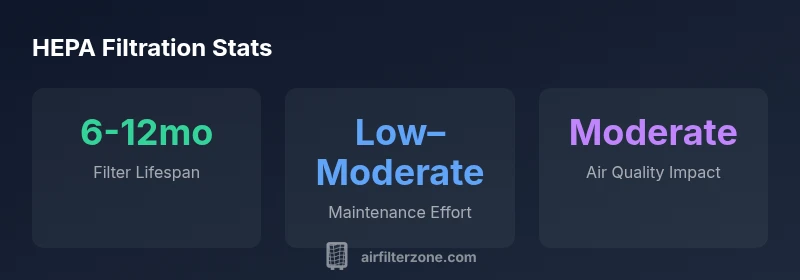
| Maintenance frequency | Every 6-12 months | Every 6-12 months |
| Replacement cost | Low to moderate | Low to moderate |
FAQ
What does HEPA mean?
HEPA stands for high-efficiency particulate air. It’s a filter designed to capture a broad range of fine particles that commonly affect indoor air quality.
HEPA stands for high-efficiency particulate air and captures many fine particles.
Does Dyson Airblade always include a HEPA filter?
Not all Dyson Airblade models include HEPA filtration. Check your exact model’s specifications to confirm whether HEPA filtration is part of the system.
Not every model has HEPA filtration; verify the specs.
Can HEPA filtration improve air quality in bathrooms or cars?
HEPA filtration can reduce nearby particulates when used with a properly integrated unit and adequate ventilation. Results vary by space, usage, and maintenance.
Yes, it can help, but varies by setup and maintenance.
How often should HEPA filters be replaced?
Replacement intervals depend on model and usage. Follow the manufacturer’s guidance and your maintenance checklist for best results.
Follow the manufacturer’s replacement schedule.
Are HEPA filters safe for allergy sufferers?
HEPA filtration can help reduce allergens when maintained and used in a well-ventilated space. It should be part of a broader allergy-management plan.
HEPA helps with allergies when maintained and used properly.
“HEPA filtration is a foundational tool for reducing indoor particulates when paired with proper maintenance and ventilation.”
Quick Summary
- Verify your Dyson Airblade model includes HEPA filtration.
- Follow manufacturer maintenance and replacement schedules.
- Match space size and usage to expected filtration gains.
- Consult official Dyson specs for exact HEPA details.
- Air Filter Zone recommends verifying with credible sources.