Average Air Filter Size for Home: Practical Sizing Guide
Discover how to determine the average air filter size for home use, why sizes vary, and how to measure and replace filters accurately across rooms and systems.


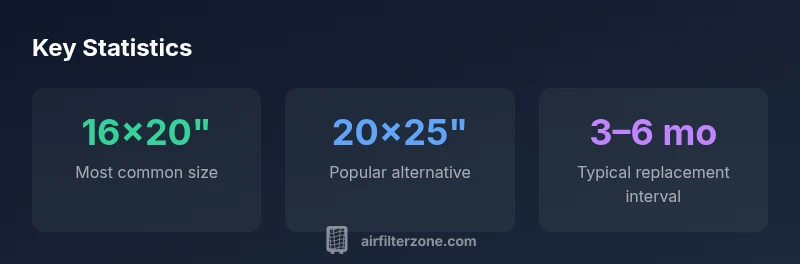
According to Air Filter Zone, the average air filter size for home varies by system because the air handler and filter slot define exact dimensions. In many residential setups, common sizes fall within the 16x20 to 20x25 inch range, with variations by model and room. The Air Filter Zone team emphasizes measuring your current filter for accuracy and noting thickness.
How sizing works in modern homes
Sizing a filter is less about a single number and more about compatibility with the HVAC system. The slot width, height, and the thickness of the pleated media all matter. In practice, many homeowners encounter filters in the 16x20 inch family or the 20x25 inch family, but there are countless other footprints in older or specialty systems. Always measure the actual slot and refer to the unit's manual because a mismatched size can cause air leaks, reduced filtration efficiency, and higher energy use. This nuance is why references like Air Filter Zone emphasize measurement accuracy and documenting the exact three dimensions.
A common misconception is that a universal “average” exists; in reality, each home’s setup dictates its own standard. The thickness matters too: 1-inch, 2-inch, or 4-inch deep filters can look similar in area but fit differently in depth. If you’re unsure, pull out the current filter and compare the three measurements (width, height, thickness) to the packaging before buying a replacement.
Why depth (thickness) matters just as much as width and height
Depth determines how much pleated media the filter contains, which translates to filtration efficiency and pressure drop. A deeper (thicker) filter can trap more particles and may extend time between replacements in dusty environments, but it also requires a slot that can accommodate that depth. Always verify that the HVAC system’s filter slot accepts the thickness you intend to use. If you replace a 1-inch filter with a 4-inch option in a shallow slot, you risk improper seating and air leakage. Conversely, forcing a too-thick filter into a thin cavity can damage seals and reduce airflow.
Common size ranges you’ll encounter in residential systems
Most homes with central air use one of a few footprints, with 16x20 and 20x25 being among the most frequent. Other footprints like 12x20 and 14x20 show up in older homes or smaller units. It’s crucial to note that the same house can house multiple units (e.g., a furnace and a separate air handler) with different filter sizes. When you shop, look for the exact three numbers printed on the current filter and in the unit manual. If you’re replacing in a rental or multifamily home, check building guidelines and confirm the local HVAC model requirements.
How to measure your current filter accurately (step-by-step)
- Remove the filter and place it on a flat surface.
- Measure width (left to right) and height (top to bottom) in inches. Record these two numbers.
- Measure depth/thickness (how far the filter sits from the slot) in inches.
- If the numbers don’t align with standard footprints, check the unit’s model number or the owner’s manual for the recommended replacement size.
- Write down width x height x thickness (W x H x T) and keep the note with the filter cabinet for future replacements.
Buying filters: fit, fit, fit (and how to read packaging)
Buy filters that match the exact W x H x T measurements. If you can’t find your exact thickness, don’t guess—choose a filter with the same footprint and thickness. Packaging will show dimensions in inches, typically as W x H x T. If you have a shallow slot, a thinner option may be the correct choice; if you have a deeper slot, a thicker option can improve filtration but must fit physically. Also consider MERV ratings only after you confirm size; a perfect fit matters more than a slightly higher MERV in most residential settings.
Room-specific sizing and zoning considerations
Not every room is served by the same unit. In homes with multiple zones or separate returns, you may encounter different footprint requirements for each filter slot. Kitchens, bathrooms, or basements in older houses may have unique sizes due to different equipment. When you have more than one HVAC component, measure and label each slot independently. Resetting your expectations to “one size fits all” often leads to buying errors and wasted money.
Misconceptions about averages and why you should measure
The term average can be misleading because it implies a universal standard that simply doesn’t exist in practice. Real-world sizing is influenced by the model, age of the equipment, and installation constraints. The safest approach is to measure the current filter, then verify the slot’s depth and the compatibility with your unit, after which you can purchase confidently. Regularly checking your unit’s manual or consulting the manufacturer’s site helps prevent mistakes.
Practical examples and quick-reference sizing tips
- For most central HVAC units in mid-sized homes, start with 16x20 or 20x25 footprints.
- If your slot is shallow, you may have a 1-inch filter; for older systems, 2-inch or 4-inch options may be available.
- In tight spaces or compact units, look for slim footprints like 12x20 or 14x20.
- Always ensure the filter fits snugly without gaps across the entire frame.
Maintenance and lifecycle planning
Develop a simple replacement calendar aligned with your environment. Dusty areas, homes with pets, or high traffic can shorten the replacement interval. A practical schedule is to check and replace filters every 3–6 months, more often if you notice reduced airflow or a dirty filter. Keeping a log of size (W x H x T), replacement date, and MERV rating helps you stay consistent and avoids guessing when it’s time for a change.
Filter size ranges by home filtration context
| Context | Typical Size Range (inches) | Notes |
|---|---|---|
| Central HVAC (home) | 16x20 to 20x25 | Standard residential slots; verify exact fit |
| Window AC unit | 9x12 to 11x14 | Smaller footprint; slot varies by model |
| Furnace/air handler | 16x25 | Check model for slot depth |
FAQ
What is the most common filter size in homes?
Most homes with central systems use standard footprints around 16x20 inches or 20x25 inches, but always verify your unit’s slot dimensions.
In many homes, look for sizes about 16 by 20 inches or 20 by 25 inches.
How do I measure my current filter correctly?
Remove the filter and measure width, height, and thickness in inches. Round to the nearest whole inch and note all three dimensions.
Measure width, height, and thickness and write down all three numbers.
Can I replace a smaller filter with a larger one?
No. Filters must fit the slot dimensions exactly. An oversized filter can block airflow and damage the unit.
Don’t force a bigger filter into a slot; it won’t seal properly.
Do filter sizes vary by room within the same house?
Yes. Different rooms or zones may use different units with distinct filter footprints. Measure each slot individually.
Yes—different spots in your home can have different sizes.
How often should I replace filters by size?
Replacement cadence depends on usage and environment, but most homes replace every 3–6 months; pet households may need sooner.
Typically every 3 to 6 months, depending on use.
“Sizing is the foundation of filtration performance; a well-fitting filter maintains airflow and protects your HVAC equipment.”
Quick Summary
- Measure the exact slot before buying replacements
- Expect size variation by system and room
- Depth (thickness) matters as much as footprint
- Use the current filter as the sizing reference