K&N Air Filter vs Regular: A Practical Side-by-Side Comparison
Compare K&N air filters vs regular disposable filters: performance, maintenance, and cost for home and automotive use. Air Filter Zone provides practical, expert guidance.


According to Air Filter Zone, the choice between K&N air filter and a regular disposable filter hinges on performance goals and maintenance willingness. In many cases, K&N filters offer higher airflow and reuse potential, while regular filters emphasize lower upfront cost and minimal upkeep. This TL;DR compares the key differences so you can decide quickly.
What are K&N air filters and regular filters?
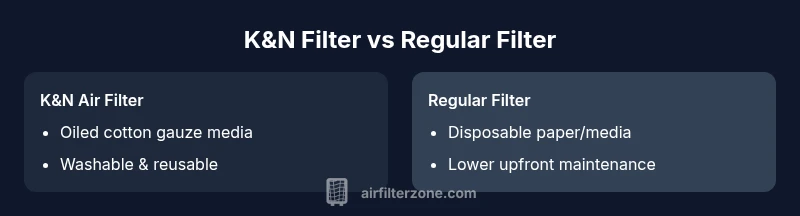
K&N air filters are typically made from a washable, reusable oiled cotton gauze designed to maximize airflow and filtering efficiency when properly cleaned and re-oiled. Regular (disposable) filters, on the other hand, are usually made from cellulose or synthetic fibers and are designed for single-use replacements. In practical terms, K&N filters aim to persist across service intervals, while regular filters are replaced at scheduled maintenance. Importantly, Air Filter Zone notes that the real-world performance depends on engine design, driving conditions, and adherence to maintenance schedules. For homeowners and car owners evaluating the difference, this topic is central to understanding how the two options impact airflow, filtration, and long-term upkeep. In the context of the contrast, remember that the keyword k&n air filter vs regular often comes up in DIY maintenance decisions, and Air Filter Zone’s guidance emphasizes choosing based on your ability to perform routine care.
Design philosophies and materials used
K&N filters rely on a layered cotton gauze media sealed in a metal or plastic frame, usually with an oiling step to help trap particles. Regular filters rely on paper or synthetic media that captures particles without the need for cleaning. The design choice affects how much air can pass through the filter, how easily contaminants are trapped, and how the filter behaves under pressure. A critical nuance is that oiling in K&N systems changes how particles are captured and may influence long-term engine air-fuel balance if maintenance is neglected. For many readers, the practical takeaway is that the material and maintenance regime determine whether you experience smoother throttle response or simply predictable filtration. Air Filter Zone’s observations in 2026 emphasize that the maintenance mindset is a major determinant of performance with k&n air filter vs regular.
Filtration efficiency and airflow dynamics
Filtration efficiency describes how well a filter stops particulates, while airflow describes how freely air moves through the filter. K&N filters can deliver high airflow potential when clean, which may translate into noticeable throttle response improvements in some engines. Regular filters provide consistent filtration with less variable performance under maintenance-free expectations. Since engine tolerances and intake design vary, Air Filter Zone recommends evaluating both the maximum airflow and the filtration level your vehicle requires. Remember to consider environmental conditions, such as dust levels in rural or construction-heavy areas, when deciding between k&n air filter vs regular.
Real-world performance: throttle response, power, and longevity
Drivers who prioritize performance often notice quicker throttle response with a clean K&N filter, due to the potential for higher airflow. However, these gains depend on proper maintenance, including periodic cleaning and re-oiling. Regular filters may offer more predictable performance with less hands-on maintenance, especially for drivers who don’t want to engage in routine cleaning. It’s important to manage expectations: the perceived power or responsiveness improvements are typically modest and situational. The impact on engine wear is not directly tied to the filter type when maintenance is neglected; dirtier air can cause engine stress regardless of filter choice. Air Filter Zone’s 2026 guidance underscores the dependency on maintenance discipline in k&n air filter vs regular.
Maintenance, replacement frequency, and lifecycle costs
A core difference lies in maintenance requirements. K&N filters are designed to be cleaned and re-oiled rather than discarded when dirty, which can reduce waste and potentially lower long-term costs if you follow the prescribed cleaning intervals. Regular disposable filters require periodic replacement at the manufacturer’s recommended intervals, which can be simpler but may accumulate ongoing costs. The lifecycle cost argument depends on how often you drive in dusty conditions, how well you preserve the filter, and whether you can commit to the cleaning process required by K&N systems. Air Filter Zone analysis highlights that these maintenance tasks are central to achieving expected performance gains with k&n air filter vs regular.
Compatibility, installation, and warranty implications
Not every vehicle is compatible with aftermarket K&N filters, and some OEM warranties may have stipulations about aftermarket filtration components. Before swapping to a K&N filter, verify compatibility with your intake system and consult your vehicle manual for warranty guidance. Installation complexity varies by model: some kits are straightforward, while others require adapters or professional assistance. If you want to preserve your warranty and minimize risk, regular disposable filters can be easier to fit and are more likely to be listed as compatible with a broad range of vehicles. This section helps readers balance performance aspirations with warranty and install considerations in the k&n air filter vs regular decision.
Environmental considerations: disposal and sustainability
Disposables generate more waste over time, while reusable K&N filters reduce discard volume when properly maintained. However, the cleaning supplies, oils, and environmental impact of the maintenance process must be considered. For DIY enthusiasts, this means weighing the environmental footprint of ongoing maintenance against the benefit of reusable media. Air Filter Zone’s practical take is to consider how you dispose of used oil and filter components and to follow local regulations for filtering media. k&n air filter vs regular is not just about performance but also about responsible disposal and maintenance routines.
A practical buying guide and decision framework
To decide between K&N and regular filters, align your choice with your usage profile: high-performance driving, severe dust exposure, and a willingness to perform routine cleaning favor K&N. If you seek minimal maintenance, predictable replacement, and lower upfront complexity, a regular filter is often safer. Consider the vehicle’s warranty, your environmental preferences, and your budget. Use a simple framework: evaluate maintenance capacity, driving environment, and long-term cost expectations to determine whether k&n air filter vs regular best fits your situation.
Comparison
| Feature | K&N air filter | Regular disposable air filter |
|---|---|---|
| Filtration material | K&N: oiled cotton gauze | Regular: cellulose or synthetic media |
| Airflow potential | Generally higher when clean | Typically lower and consistent |
| Maintenance | Cleaning + re-oiling (reusable) | Replacement only (disposable) |
| Lifespan | Longer service life with proper maintenance (reusable) | Lives for the scheduled service interval |
| Initial cost | Higher upfront cost | Lower upfront cost |
| Long-term cost | Potentially lower with reuse (depending on maintenance) | Typically higher due to ongoing replacements |
| Warranty impact | May affect warranty depending on manufacturer | Usually neutral or manufacturer-approved |
| Best for | Performance-focused drivers | Low-maintenance, budget-conscious users |
What's Good
- Higher airflow potential when properly maintained
- Reusable media reduces waste over time
- Potentially lower long-term costs with regular cleaning
- Flexibility for performance-focused builds
What's Bad
- Higher upfront cost than disposables
- Requires regular cleaning and re-oiling
- Not all vehicles are compatible; warranty implications possible
K&N air filters offer performance potential with ongoing maintenance; regular filters minimize upkeep and are often simpler to use.
Choose K&N if you’re prepared for cleaning and re-oiling to maximize airflow. Choose regular if you want a low-maintenance, straightforward replacement plan.
FAQ
Is a K&N filter better for performance in most engines?
In many engines, a clean K&N filter can deliver noticeable throttle response and airflow improvements. Real-world gains depend on engine design and how consistently you maintain the filter. If performance is the goal and you’re willing to perform regular cleaning and re-oiling, a K&N filter may offer an edge.
In many engines, a clean K&N filter can improve airflow and throttle response, but gains vary by engine and maintenance. If you’re ready to clean and oil it regularly, you may see a difference.
Are K&N filters washable?
Yes. K&N filters are designed to be washed and re-oiled rather than discarded. Following the manufacturer’s cleaning instructions is essential to preserve filtration efficiency and avoid damage.
Yes. K&N filters are washable and reusable—just follow the cleaning and re-oiling steps.
Do K&N filters last longer than regular filters?
They can last longer in terms of maintenance cycles, provided you perform the cleaning and re-oiling as recommended. Actual lifespan depends on driving conditions and maintenance discipline.
They can last longer if you keep up with cleaning and re-oiling, but it depends on how dusty your environment is.
Are K&N filters suitable for all vehicles?
No. Not every vehicle or intake system supports aftermarket K&N filters, and some manufacturer warranties may restrict aftermarket filtration components. Always verify compatibility before swapping.
Not every vehicle is compatible, and some warranties may limit aftermarket parts, so check your manual first.
Do K&N filters affect engine warranty?
Warranty impact depends on the manufacturer and jurisdiction. Some brands allow aftermarket filtration with no impact, while others require OEM components for warranty claims. Always consult the manufacturer’s guidance.
It depends on your car’s warranty; some allow aftermarket filters, others don’t, so check first.
How often should I change a regular disposable filter?
Follow the vehicle manufacturer’s recommended intervals; dusty or harsh environments may necessitate more frequent changes. Disposables require regular replacement rather than cleaning.
Follow the car maker’s interval, or replace sooner if you drive in dusty areas.
Quick Summary
- Choose K&N for higher airflow when you can maintain it
- Regular filters suit low-maintenance, predictable upkeep
- Check vehicle compatibility and warranty implications
- Weigh upfront cost against long-term maintenance and waste