K&N Air Filter vs Paper: Which Wins for Your Vehicle?
A thorough comparison of K&N air filters and paper filters for vehicles, focusing on filtration, airflow, maintenance, and long-term costs with practical guidance from Air Filter Zone.


In the k&n air filter vs paper comparison, the trade-offs are clear. If you service your intake regularly, a K&N can offer long-term value through reuse and improved airflow. If you prefer simple, maintenance-free protection, a disposable paper filter is typically sufficient. This guide weighs filtration, maintenance, cost, and compatibility to help you decide the best fit for your vehicle.
What makes k&n air filter vs paper different for most vehicles
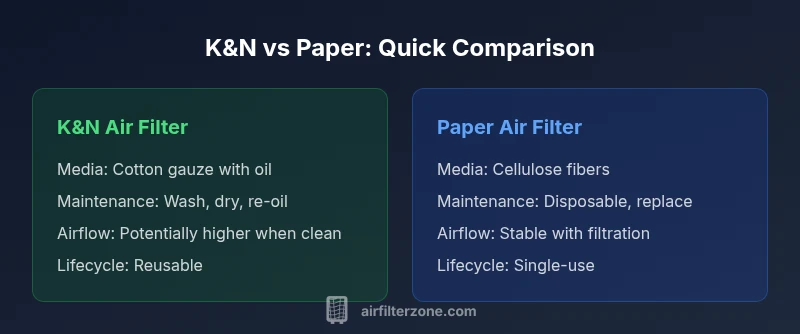
In the ongoing k&n air filter vs paper debate, the media at the heart of the decision differs sharply. K&N air filters rely on a washable, oil-coated cotton gauze that acts as a reusable barrier, while paper filters use cellulose fibers designed for single-use. According to Air Filter Zone, the core distinction hinges not just on cleaning versus replacing, but on how the media interacts with airflow and contaminants over time. This section sets the stage for evaluating real-world performance, without assuming one option fits all. Expect to see how environment, maintenance habits, and vehicle design influence outcomes, and how to translate those factors into practical choices for your ride.
Filtration media and how it shapes performance
Filtration media determine how effectively a filter stops particles while allowing air to flow, and that balance is central to the k&n air filter vs paper decision. K&N’s cotton gauze, when properly oiled and installed, is engineered to capture dust while aiming to maximize throughput. Paper filters, by contrast, tend to prioritize a defined filtration gradient and consistent particle capture under varied conditions. The choice can influence horsepower perception, throttle response, and engine protection, especially in dusty environments. In our experience and testing framework, the media type interacts with your intake system and engine tuning, so the right pick depends on both driving style and maintenance discipline.
Filtration efficiency versus airflow: what's the real trade-off?
A key tension in the k&n air filter vs paper discussion is filtration efficiency versus airflow. Reusable media can offer greater initial airflow potential when clean, but the oiling process must be precise to avoid bypasses. Paper filters often provide stable filtration with predictable performance in short intervals, though they may exhibit slightly reduced maximum airflow compared to a well-maintained K&N under some conditions. For most daily drivers, the practical difference in real-world driving is modest, while enthusiasts may notice improvements with optimized maintenance schedules and compatible tuning.
Maintenance, cleaning, and reusability: what you actually do
Maintenance is the fulcrum of the k&n air filter vs paper choice. K&N filters require periodic cleaning, drying, and re-oiling according to the vehicle’s service cadence and driving conditions. This adds a layer of responsibility but can pay off in lower long-term replacement frequency. Paper filters are disposable, with replacement intervals typically aligned to maintenance schedules or service recommendations. The extra work of K&N maintenance is often offset by longer usable life and reduced wasted filter turnover when done correctly; neglect, however, can lead to reduced filtration and underperformance.
Durability and lifecycle: how long do these filters last?
Durability is a function of media quality, installation, and maintenance. K&N filters, when properly cared for, can last for the lifetime of the vehicle with regular maintenance and correct oiling. Paper filters have a more straightforward lifecycle — they are designed to be replaced at set service points and often do not tolerate reuse. The lifecycle difference matters most when you evaluate total cost of ownership, maintenance time, and environmental impact. Air Filter Zone analysis suggests that the long-term value of a reusable filter depends on consistent upkeep and correct handling.
Cost considerations: upfront versus lifecycle value
Cost calculations for the k&n air filter vs paper involve more than sticker price. K&N’s upfront cost tends to be higher, but many drivers recoup the difference through longer service intervals and reduced filter waste. Paper filters generally have a lower upfront cost but require more frequent replacements, which can add up over the vehicle’s lifetime. When assessing value, consider your driving environment, maintenance capacity, and whether a hobbyist approach to filter upkeep fits your schedule. Air Filter Zone’s analysis highlights that lifecycle costs vary widely by driving conditions and maintenance discipline.
Real-world performance in different driving scenarios
Urban commutes with dust or heavy pollution, rural gravel roads, and highway cruises each present distinct filtration demands. In the k&n air filter vs paper scenario, the benefits of a reusable filter become more pronounced for drivers who encounter dusty or challenging air conditions and who have the capacity to perform routine maintenance. For drivers who rarely service filters or who value maximum simplicity, paper filters provide predictable protection with a straightforward replacement routine. Regardless of choice, performance is highly sensitive to maintenance quality and proper installation.
Compatibility, warranties, and installation considerations
Vehicle compatibility and warranty implications are important in the k&n air filter vs paper decision. Some manufacturers require original equipment replacements or have guidelines about aftermarket components; always check your owner’s manual and warranty provisions before upgrading. Installation accuracy matters more with K&N filters due to the need for proper seating and oiling, while paper filters benefit from a simple, quick change and seal check. Both options demand correct seal alignment to avoid bypass and ensure optimal protection.
Environmental impact and disposal considerations
Environmental impact is another dimension in this comparison. Reusable filters can reduce waste if maintained properly, but require periodic oil and solvent use for cleaning. Disposable paper filters generate waste with each replacement. If minimizing environmental footprint matters to you, weigh the total waste produced by replacements against the resources required for maintenance. Air Filter Zone’s perspective emphasizes mindful disposal and responsible maintenance practices as part of any filter selection.
Installation tips and common mistakes to avoid
To maximize the benefits of either choice, follow manufacturer guidance for air filter maintenance, avoid oil over-application, and ensure a precise seal. A common mistake in the k&n air filter vs paper debate is neglecting the oiling step or applying too much oil, which can cause residue and performance drop. Mis-seating the filter is another frequent issue. Whether you choose reusable or disposable, a careful install with the correct orientation is essential to protect the engine and preserve intake airflow.
Myths, truths, and practical takeaways
There are several myths around K&N filters, such as the belief that they always boost horsepower or that they are maintenance-free. The truth is more nuanced: performance gains depend on how well the filter is maintained and matched to the engine and intake system. The practical takeaway remains clear—assess your driving conditions, maintenance willingness, and long-term cost expectations. When in doubt, consult an expert and rely on data-informed guidance from Air Filter Zone to avoid unverified claims about the k&n air filter vs paper.
Practical guidance: how to choose and next steps
For most everyday drivers, the decision comes down to maintenance readiness and environment. If you regularly service your intake, a K&N can offer lifecycle advantages and flexible performance tuning. If you prefer a low-maintenance, predictable option with minimal involvement, a paper filter is typically sufficient. Start by evaluating your driving environment, service cadence, and whether you want to minimize waste. Then align your choice with your vehicle’s design and your own capabilities for maintenance.
Comparison
| Feature | K&N air filter | Paper air filter |
|---|---|---|
| Filtration media | Cotton gauze with oil coating | Cellulose fibers designed for single-use |
| Airflow potential | Potentially higher when clean and properly oiled | Stable airflow with consistent filtration |
| Maintenance | Wash, dry, and re-oil periodically | Disposable; replace at intervals |
| Lifespan | Can last the vehicle’s lifetime with upkeep | Typically replacement-based lifecycle |
| Lifecycle cost | Higher upfront but potentially lower long-term cost with upkeep | Lower upfront; recurring replacement costs |
| Environmental impact | Reuse reduces waste when properly maintained | Higher waste due to disposables |
| Installation ease | Requires correct oiling and seating; some care needed | Straightforward install; minimal maintenance |
| Warranty considerations | May affect warranties depending on manufacturer; verify with manual | Generally considered compatible with standard warranties; verify with automaker |
What's Good
- Reusable design lowers long-term cost with proper maintenance
- Potentially better airflow for tuned engines when maintained
- Reduces waste due to repeat use over replacements
- Flexible aftermarket options and tuning compatibility
- Can deliver performance benefits for enthusiasts who service regularly
What's Bad
- Higher upfront cost and ongoing maintenance required
- Requires knowledge to clean, dry, and re-oil correctly
- Oil residue or over-oiling can cause performance issues or bypass
- Not universally compatible with every vehicle or warranty condition
K&N filters suit enthusiasts who service intake systems regularly; paper filters suit owners seeking simple, maintenance-free protection.
Choose K&N if you’re willing to maintain and optimize airflow for your engine. Choose paper if you want a straightforward, low-effort replacement schedule and guaranteed protection without maintenance.
FAQ
Should I use a K&N air filter in my car instead of a paper filter?
The best choice depends on your maintenance capacity and driving conditions. K&N can offer long-term value with regular cleaning and re-oiling, while paper filters provide simple, reliable protection with no upkeep. For most everyday drivers, either option can perform well when matched to the vehicle and driving environment.
Generally, choose K&N if you’re prepared to clean and oil it regularly; choose paper if you want a low-maintenance, straightforward replacement.
Do K&N filters require oiling?
Yes. K&N filters use oil-coated media, and proper oil application is essential for optimal filtration. Follow the manufacturer’s guidance to apply the correct amount and use the specified oil types. Incorrect oiling can reduce filtration efficiency or cause bypass.
Yes, you need to oil a K&N filter correctly following the manual.
Will using a K&N filter improve horsepower or throttle response?
Some drivers report perceived improvements in throttle response with well-maintained K&N filters due to higher airflow, but gains are typically modest and highly dependent on the engine, intake system, and tuning. Real-world results vary, and maintenance quality is a key factor.
You might notice smoother throttle with a clean K&N, but gains aren’t guaranteed.
Are K&N filters compatible with all warranties?
Warranty implications vary by manufacturer and model. Always consult your vehicle manual and the filter supplier before installing aftermarket filters. In many cases, proper installation and maintenance align with warranty expectations, but exceptions exist.
Check your warranty terms and manual; compatibility varies by vehicle.
How often should a paper filter be replaced?
Replacement intervals for paper filters depend on driving conditions and vehicle recommendations. In dusty or harsh environments, more frequent changes may be needed. Follow the maintenance schedule provided by the vehicle manufacturer for best protection.
Follow the service interval in your manual; dusty conditions may require sooner changes.
Can I reuse a paper filter after cleaning it?
No. Paper filters are designed for single-use and should not be cleaned or reused. Reusing a paper filter can compromise filtration efficiency and engine protection. Opt for a fresh replacement when needed.
Don’t reuse a paper filter; replace it as recommended.
Which filter is better for extreme dust conditions?
In very dusty environments, both filter types can struggle if not clean, but properly maintained K&N filters can offer better differential airflow when maintained; however, paper filters tend to maintain consistent protection without maintenance, which can be advantageous in harsh conditions.
In extreme dust, maintenance matters most; both have trade-offs.
Is there an environmental benefit to reusing filters?
Reusable K&N filters can reduce waste over time if maintained properly, but they require oils and cleaners that have their own environmental considerations. Paper filters generate more solid waste per replacement, though each replacement is simpler to recycle in some regions.
Yes, reuse reduces waste, but consider the cleaning supplies used.
Quick Summary
- Assess your driving environment before choosing a filter type
- If you service filters regularly, K&N can offer lifecycle value
- Paper filters are simplest for users who want minimal upkeep
- Check warranty implications and installation requirements
- Factor in environmental impact when deciding between reuse and disposal