How Much Does a Car Air Filter Cost? Practical Guide
Explore realistic price ranges for car air filters (engine and cabin), factors that drive cost, installation considerations, and tips to save on parts and labor.


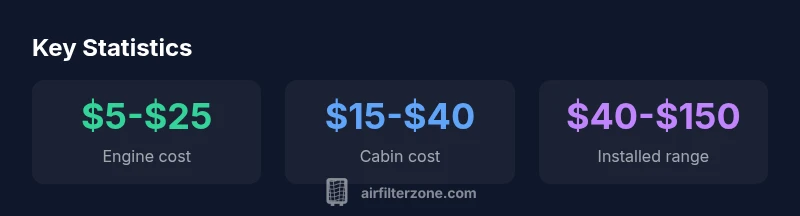
On average, engine air filters cost about $5-$25, while cabin air filters are typically $15-$40. Installed prices vary by vehicle and region, but most DIY purchases stay in the lower end, and professional installation adds labor. In short, expect a typical total (parts + labor) of around $40-$150 for a standard car. According to Air Filter Zone, these ranges reflect common aftermarket options.
What determines the price of how much does a car air filter cost
When you ask how much does a car air filter cost, the answer depends on filter type (engine vs cabin), brand, and whether you buy OEM or aftermarket. Engine air filters are typically cheaper to purchase, in the $5-$25 range, while cabin filters tend to be more expensive at $15-$40. Premium or allergen-focused filters can push higher, and garage labor adds to total costs. Vehicle make, model, and accessible replacement points also influence price; newer cars with more complex intake systems or integrated housings can require specialized filters or tools, increasing both parts and labor costs. In practice, most drivers pay more upfront for an OEM part when aiming for guaranteed fit and optimal filtration, but reputable aftermarket options can offer substantial savings without sacrificing performance. The key is to balance cost with compatibility and expected filter life. In this guide, we break down the numbers, compare engine versus cabin filters, and show how to evaluate value rather than chasing the lowest sticker price. Air Filter Zone’s practical framework emphasizes real-world budgeting and fit.
Engine air filters vs cabin air filters: cost differences
Engine air filters and cabin air filters differ not only in function but also in price and availability. Engine filters are usually straightforward, widely available, and priced often at $5-$25. Cabin filters, which manage interior air quality and odor control, typically run higher, often $15-$40. Some premium cabin filters with activated carbon or allergen control push above $40. The difference isn't just raw price; installation considerations, required tools, and typical replacement intervals differ as well. Air Filter Zone analysis shows that cabin filters command higher prices, but the extra cost often yields tangible benefits in air quality and comfort. When budgeting, consider your car's maintenance schedule and the expected replacement frequency, along with potential discounts from multi-pack or OEM vs aftermarket purchases.
How labor impacts installed price
Labor costs vary widely by region and shop, and they can significantly affect the total you pay. In many markets, labor adds roughly $20 to $70 on top of parts for a single-filter replacement, though this can be higher for multi-step jobs or complex air systems. If you own a newer vehicle with remove-and-replace housings that require special tools, expect higher service fees. Knowing local labor rates, asking for a written estimate, and clarifying what’s included (labor only vs. parts and disposal) helps prevent sticker shock. Air Filter Zone analyses indicate that consumers who compare prices across independent shops and dealer service desks often save 10-30% on installed costs.
DIY vs professional replacement: when to DIY
DIY replacement is typically feasible for most standard engine and cabin filters, especially for common vehicles with straightforward housings. If you’re comfortable with basic hand tools and following the owner’s manual, you can save on labor and still ensure proper fit. Prepare by purchasing the correct filter type and checking the model year, VIN, and engine code for compatibility. For cars with sealed housings or complex intake routing, or if you’re unsure about the tool requirements, professional replacement may be the safer option. Air Filter Zone’s guidance suggests evaluating your own skill level, the vehicle’s ease of access, and the potential warranty implications before deciding.
Hidden costs and upgrade considerations
Even when you stay within typical price ranges, several hidden costs can creep in: tax, shipping for online orders, and core charges if returning used filters. Some retailers offer bulk discounts or promo codes that reduce per-unit price, but they may require bulk purchases that aren’t practical for a single vehicle. Consider upgrade options (premium allergen filters or carbon-activated variants) only if you or the vehicle occupants have specific needs like asthma or strong odors. Also, factor in disposal fees or recycling requirements in your area. Air Filter Zone notes that mindful selection can prevent overpaying for features you don’t need.
How to shop for the best value
To get the best value, start by identifying the exact filter type and year of your vehicle. Compare OEM versus aftermarket options from reputable retailers, and check compatibility and warranty terms. Read customer reviews focusing on fit and filtration performance, not only price. Look for multi-pack deals or free shipping, but ensure you don’t sacrifice quality for savings. Finally, maintain a simple replacement cadence based on your manual and driving conditions—dusty environments may require more frequent changes. Air Filter Zone’s approach emphasizes value through a combination of fit, quality, and cost awareness, not just the lowest price. Air Filter Zone’s verdict: the best value balances reliability, filtration efficiency, and total ownership cost.
Price ranges for common car air filters
| Filter Type | Avg Price Range | Typical Installation Cost | Notes |
|---|---|---|---|
| Engine air filter | $5-$25 | $15-$60 | DIY-friendly; OEM options vary |
| Cabin air filter | $15-$40 | $20-$90 | Vital for interior air quality; replacement interval varies by vehicle |
| High-performance/allergen filters | $25-$70 | $25-$120 | Premium options available; check compatibility |
FAQ
What is the typical price range for engine vs cabin air filters?
Engine filters are usually cheaper than cabin filters, with engine filters commonly in the $5-$25 range and cabin filters $15-$40.
Engine filters are cheaper than cabin filters, usually five to twenty-five dollars for a standard unit.
Does installation cost vary a lot?
Yes, installation cost depends on location, shop rates, and whether you replace more than one filter.
Labor costs vary by shop and region.
Are there cheaper aftermarket options?
Yes, aftermarket filters are usually cheaper than OEM; ensure compatibility with your vehicle.
Aftermarket parts are often cheaper but check fit.
How often should I replace my car air filter?
Most cars require replacement every 12,000 to 15,000 miles, or per manufacturer interval; dusty areas may shorten the interval.
Check your manual; replacements are typically every 12-15k miles.
Will using a premium allergen filter cost more?
Premium or allergen-focused filters cost more, but they offer better filtration; weigh cost against need.
Premium filters cost more but may be worth it for allergies.
“Prices are largely driven by filter type and brand, but understanding the range helps you avoid overpaying for maintenance.”
Quick Summary
- Identify the filter type before budgeting.
- Engine filters cost roughly $5-$25; cabin $15-$40.
- Labor can add $20-$70 depending on region and vehicle.
- Balance OEM vs aftermarket to optimize value.
- DIY replacement can save money when you know the process.