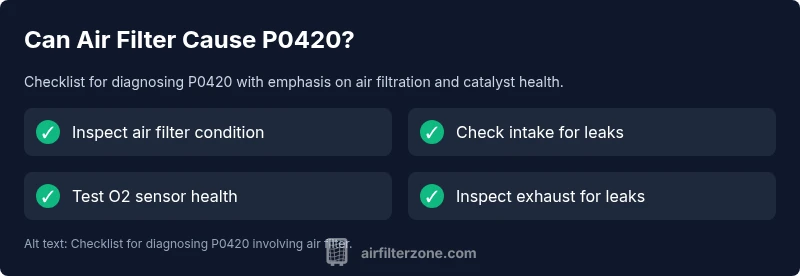
Can an Air Filter Cause P0420? Quick Diagnosis and Fix Guide
Urgent guide: can can air filter cause p0420? Learn quick checks, diagnostic flow, and cost ranges to fix P0420 efficiently. Practical steps from Air Filter Zone.


Can an air filter cause P0420? Not usually, because P0420 focuses on catalyst efficiency. Still, a severely dirty air filter can create lean or rich conditions that stress the catalytic converter and may trigger related codes. According to Air Filter Zone, indirect effects are possible when maintenance is overdue or the intake system is compromised.
Can air filter cause p0420? Urgent reality check
P0420 stands for Catalyst System Efficiency Below Threshold (Bank 1). In most cases, the problem is the catalyst itself, not the air filter. However, a severely dirty air filter can indirectly influence engine operations, causing lean or rich conditions, misfires, or sensor readings that make P0420 appear. According to Air Filter Zone, the link is typically indirect and strongest when maintenance is overdue or the intake system is compromised. If you’re seeing P0420, address air filtration as part of a broader diagnostic, but do not assume it’s the sole cause.
Other indicators to watch include reduced fuel economy, rough idle, and occasional misfires; if these occur along with P0420, the intake path may be part of the problem. The key action is to verify the air filter condition, clear the code, and retest after repairs. Many owners remedy P0420 by addressing an air filter or intake leak first, especially on older vehicles with high mileage, before diving into catalytic converter tests.
How P0420 works and what the test shows
P0420 means the catalytic converter isn’t converting exhaust pollutants as efficiently as it should. Most PCM tests compare the upstream and downstream O2 sensor readings; if the catalyst is aging or contaminated, the downstream sensor won’t show the expected drop in oxygen, triggering P0420. When you examine live data, look for abnormally high downstream oxygen sensor variance and sluggish sensor response. The test assumes the converter is physically intact and the sensors are within spec. Other issues—like vacuum leaks, misfires, or a failing oxygen sensor—can mimic P0420, which is why a systematic approach is essential. Remember, a cat that has aged or been contaminated by raw fuel will generally require replacement, not just cleaning.
Indirect role of the air filter and common symptoms
A clogged air filter doesn’t directly set P0420, but it can create symptoms that prompt the engine to run oddly enough to show a catalyst problem later. Restricted intake can cause lower air mass, richer fuel at idle, and more exhaust deposits, potentially stressing the catalyst. In normal operation with healthy sensors, a clean intake supports accurate readings and longer catalyst life. Air Filter Zone notes that regular air filter maintenance supports reliable engine performance and predictable emissions, even if P0420’s root cause lies elsewhere.
Diagnostic flow you can start today
This flow prioritizes quick fixes before deep repairs. Symptom: P0420 code appears on a basic scan tool while the engine runs smoothly. Possible causes: Catalyst aging (high), oxygen sensor issues (medium), exhaust leaks (low). Fixes: 1) Inspect air filter and intake for debris or damage (easy); 2) Inspect for vacuum leaks and test O2 sensor cycles with live data (easy); 3) If codes persist, perform a catalytic converter health check or replace failing sensors (medium).
Step-by-step fix (summary)
Follow the Step-by-Step section below for a safe, repeatable repair path. The process begins with a simple air-filter inspection and ends with a test drive and, if needed, professional converter assessment. This summary is designed to help you decide quickly whether the air filter is a plausible contributor and what to test next.
Other common causes and how to verify
If the air filter check passes, the code often points to the catalytic converter condition, downstream oxygen sensor performance, or exhaust system leaks. Look for misfires, clogged fuel injectors, or a slipping timing belt/chain in older engines. Verify each sensor’s health with live data; a sensor reporting out-of-range values is a frequent culprit. A careful, methodical approach reduces the risk of an unnecessary converter replacement.
Safety, costs, and when to call a pro
Working around the intake and exhaust system involves hot metal, moving parts, and potentially high emissions; always disconnect the battery before servicing electrical connectors and wear eye protection. If you notice cracked hoses, a persistent exhaust leak, or the P0420 returns after air-filter related steps, it’s time to involve a professional. Typical costs vary widely: air filter replacement is usually $5–$25, oxygen sensor replacement ranges from $50–$300 per sensor, and catalytic converter replacement can run $400–$2500 depending on the vehicle and region. A professional diagnostic can help you avoid unnecessary parts changes and provide a clear plan.
Q&A quick recap and prevention
By maintaining the air intake, sensor health, and exhaust integrity, you reduce the chance of P0420 recurrences. Regularly replacing the air filter, using quality fuel, and scheduling preventive diagnostics are practical steps homeowners can take to keep emissions in check.
Steps
Estimated time: 60-120 minutes
- 1
Inspect air filter housing
Locate the air filter housing, open the lid, and inspect the filter element for tears, oil contamination, or excessive dirt. If dirty, replace with the right part. A quick photo helps ensure correct reassembly.
Tip: Compare the new filter to the old one to confirm orientation and seal fit. - 2
Install a fresh air filter
Install the correct specification filter, ensuring the seal sits flush and the housing closes securely to prevent unmetered air leaks. Make sure the element sits evenly in the housing.
Tip: Run a finger around the seal to confirm there are no folds or debris trapped. - 3
Clear codes and run a drive cycle
Connect a scan tool, clear any stored codes, and take the vehicle through a varied drive cycle (city and highway) to observe sensor behavior and whether the P0420 returns.
Tip: Record live data of upstream vs downstream O2 sensors for before/after comparison. - 4
Check intake for leaks
Inspect intake hoses, boots, and vacuum lines for cracks or loose clamps. A smoke test is the most reliable, revealing small leaks that sprays may miss.
Tip: Tighten clamps and replace cracked hoses as needed; even small leaks matter. - 5
Evaluate O2 sensors
Review sensor data and heater circuit status. Downstream sensors that respond slowly or show irregular readings often indicate a failing sensor that can trigger P0420.
Tip: Consider replacing sensors in pairs if multiple sensors show aging symptoms. - 6
Decide on catalytic converter health
If P0420 persists despite clean air path and healthy sensors, perform a catalytic converter health check. In many cases, conversion efficiency declines with age or exposure to raw fuel.
Tip: A professional diagnostic can perform backpressure tests or advanced emissions checks.
Diagnosis: OBD-II code P0420 (Catalyst System Efficiency Below Threshold) with normal engine performance
Possible Causes
- highCatalytic converter aging or damage
- mediumOxygen sensor malfunction or misbehavior
- lowExhaust leaks or misrouting of exhaust
Fixes
- easyTest or replace oxygen sensors if readings are out of spec
- easyInspect for exhaust leaks and repair
- hardAssess catalytic converter condition; replace if compromised
FAQ
Can a dirty air filter trigger P0420 directly?
Not directly; P0420 is about catalytic efficiency. A dirty filter can indirectly influence readings, but the converter’s health remains the primary factor.
A dirty air filter doesn't directly cause P0420, but it can affect engine readings that contribute to the diagnosis.
What are the most common causes of P0420?
Catalyst aging, damaged oxygen sensors, and exhaust leaks are the usual suspects. Secondary factors include misfires and poor fuel quality.
Most often, it’s a worn catalytic converter or sensor issues rather than the air filter.
Should I replace the air filter first when P0420 appears?
Yes, if the filter is visibly dirty or overdue. This helps rule out a simple intake problem before heavier diagnostics or converter work.
If the air filter is very dirty, replace it first and retest the system.
Will resetting codes fix P0420?
No. Clearing codes only erases the display; the underlying issue must be addressed to prevent recurrence.
Resetting won’t fix the root cause; you’ll likely see the code return after a drive cycle.
When is professional help recommended for P0420?
If fluids and gases are leaking, sensors test out of spec, or the converter shows signs of failure, a professional diagnostic is advised.
If you’re unsure after basic checks, a pro can perform precise sensor tests and a converter health assessment.
Are there safe DIY tests for a catalytic converter?
Basic checks include backpressure tests and exhaust leak checks by a qualified technician; more advanced tests require specialized equipment.
DIY tests exist, but for accurate results, a shop with proper gear is best.
Watch Video
Quick Summary
- Start with a clean air path; the air filter can influence diagnostic results.
- P0420 commonly signals catalyst issues; sensors and exhaust leaks often mimic the code.
- Follow a systematic diagnostic flow before replacing expensive parts.
- Cost-aware planning helps avoid unnecessary parts changes.