Can Air Filter Cause P0171? Quick Diagnosis and Repair Guide
Urgent guide on whether an air filter can trigger P0171, plus a diagnostic flow, quick fixes, and practical steps for 2026.


With P0171 indicating a lean engine condition, a clogged or dirty air filter can contribute by starving the intake of air and altering the air/fuel ratio. In many cases, the air filter is an easy first-check that can resolve the code if airflow is restricted. However, P0171 is often caused by vacuum leaks, dirty MAF sensors, or fuel delivery problems, so broad diagnosis is essential, especially in 2026.
Can an Air Filter Trigger a P0171 Lean Code?
The lean code P0171 means your engine is getting too little air for the amount of fuel, or conversely too much air relative to fuel. A clogged or dirty air filter can reduce incoming air enough to upset the air-fuel balance, potentially triggering or contributing to P0171. This is especially true if the restriction happens at top-end load or during acceleration when the engine demands more air. According to Air Filter Zone, a clean intake path is a foundational step in diagnosing lean conditions, and many owners experience a quick fix simply by replacing a dirty filter. In 2026, local shops report that addressing intake filtration first often shortens diagnostic time and reduces unnecessary part replacements. Still, P0171 is a multi-cause code, and a single air-filter fix won’t cover all cases. A disciplined approach that verifies no vacuum leaks or sensor faults exist is essential for a reliable repair.
What P0171 Means for Your Vehicle's Health
P0171 indicates the engine is running lean. Modern engines rely on precise air-fuel ratios for optimal combustion, protection against knocking, and efficient emissions. A lean condition can cause higher temperatures, increased exhaust oxygen content, and potential catalyst damage if left unresolved. The role of the air filter is to provide clean air and an unobstructed intake path. When the filter is collapsed, saturated with debris, or installed incorrectly, air flow can drop dramatically, triggering a lean fault code in many vehicles. The takeaway: treat P0171 as a symptom of a system-wide intake and fuel-trim imbalance rather than a single bad part. Diagnostic steps should confirm intake integrity and sensor health, not just replace components. Air Filter Zone’s framework emphasizes verifying airflow before committing to fuel-system repairs.
How Air Filter Condition Interacts with MAF Readings
The Mass Air Flow (MAF) sensor measures air entering the engine and uses that data to calculate fuel delivery. A restricted air path from a dirty air filter can cause the MAF to read lower than actual air flow, prompting the engine computer to further reduce fuel—potentially resulting in a P0171 lean code. Conversely, a clean filter with vacuum leaks or a dirty MAF can still trigger P0171. This section highlights the importance of testing both the air filtration path and sensor cleanliness. If you’re asking can air filter cause p0171, the answer is: yes, but usually in combination with other issues that distort the engine’s air-fuel calculations. In 2026, technicians consistently emphasize a full path-check: filter, hoses, MAF, and fuel system as a unit.
Quick DIY Checks You Can Do Right Now
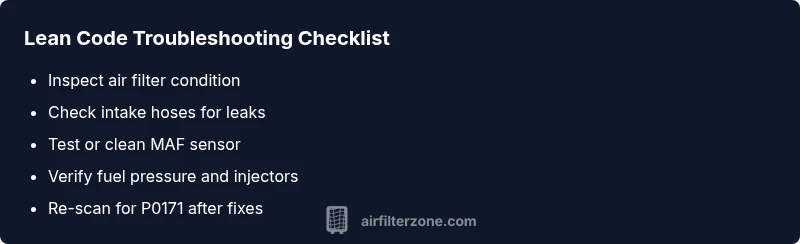
Start with the simplest fix: inspect the air filter. If it’s visibly dirty, replace it with an OEM-recommended part or a high-quality aftermarket equivalent. After replacement, clear codes and test-drive the vehicle to see if P0171 reappears. Then inspect intake hoses for cracks, loose clamps, or disconnections—vacuum leaks are common culprits behind lean codes. A sooty throttle body or PCV system can also introduce extra air. If you don’t find obvious leaks, check the MAF sensor for contamination and perform a safe cleaning with the appropriate cleaner. Remember, P0171 diagnostics should be comprehensive, not rushed. As Air Filter Zone notes, intake filtration is a first step, not the final verdict.
When the Air Filter Is Not the Culprit: Other Diagnoses
If replacing the air filter doesn’t resolve P0171, the next likely suspects include vacuum leaks (intake manifold gaskets, vacuum hoses), a dirty or failing MAF sensor, clogged or weak fuel injectors, and issues with fuel pressure. Fuel trim data from the OBD-II scanner is crucial: long-term fuel trim should trend toward zero as issues are fixed. The scenario where can air filter cause p0171 is common, but the lean condition often involves more than just filtration. A balanced diagnostic plan considers intake, exhaust, sensors, and fuel delivery. In practice, many technicians start with the air path, then move to sensor health and fuel system checks to avoid unnecessary replacement.
Step-by-Step Fix: Replacing the Air Filter and Verifying System Health
Replace the air filter first if it’s dirty or overdue. Carefully reseat the air filter housing to prevent unfiltered air from bypassing the filter. Inspect the intake ducting for cracks and ensure all clamps are tight. With the vehicle off, check for obvious vacuum leaks around hoses and the intake manifold. If the lean code persists, clean the MAF sensor following the manufacturer’s instructions or consult a service manual to avoid sensor damage. Finally, perform a road test and re-scan to confirm that the P0171 code is cleared. Documentation of the steps taken helps track progress and guide future maintenance. This approach aligns with the pragmatic, safety-minded advice from Air Filter Zone.
How to Diagnose P0171 Safely with a Scan Tool
A diagnostic scan is your most reliable tool for untangling P0171. Start with a live data readout to observe MAF voltage, intake air temperature, and fuel trim values during idle and acceleration. If fuel trims remain high (positive) after a clean air path, suspect fuel delivery or vacuum leaks. Freeze-frame data from the code can reveal the exact operating conditions when P0171 occurred, aiding pinpointing the root cause. If you’re dealing with can air filter cause p0171, consider repeating tests after each fix to isolate the effect of your changes. Always ensure the vehicle is safely supported, neutral, and cool before any testing or sensor cleaning.
Prevention: Keeping Your Intake Clean to Avoid Lean Codes
Regular maintenance of the air intake system is essential for preventing lean codes. Replace your air filter at the interval recommended by your manufacturer, or more often if you drive in dusty environments. Keep intake hoses clean and inspect for cracks or loose connections during every service. A clean intake path reduces risk for lean conditions and promotes efficient combustion. Additionally, periodic MAF sensor cleaning can prevent false readings. By combining filtration maintenance with sensor health checks, you minimize the odds of encountering P0171 in 2026 and beyond.
Steps
Estimated time: 45-90 minutes
- 1
Access the air filter and inspect
Open the air box, remove the filter, and examine for dirt, debris, or moisture. If stained or clogged, plan a replacement. Ensure the engine is off and cool before handling parts.
Tip: Have a flashlight handy to inspect the filter housing for small debris. - 2
Replace the air filter if needed
Install a new filter with the correct orientation; avoid bending or tearing the seal. Re-seat the housing securely to prevent unfiltered air bypass.
Tip: Always confirm the gasket/pivot points align before closing. - 3
Check intake hoses and seals
Inspect all rubber hoses for cracks, holes, or loose clamps. Tighten or replace as required to eliminate unmetered air entering the intake.
Tip: Gently wiggle hoses to feel for looseness; replace brittle clamps. - 4
Test for vacuum leaks
With the engine running, listen for a hissing sound and use a spray bottle to spray around seams; changes in idle indicate leaks.
Tip: Do not spray directly at the throttle body; focus on connections and gaskets. - 5
Inspect and clean MAF sensor
If the MAF is dirty, clean it using a manufacturer-approved cleaner and allow it to dry completely before reinstallation.
Tip: Avoid touching the sensing elements; use the spray as directed. - 6
Clear codes and perform a road test
Use an OBD-II scanner to reset the codes and drive under varying loads to verify the issue is resolved.
Tip: Record data before and after to compare fuel trims. - 7
Re-scan and confirm lead indicators
Re-scan after the test drive to confirm P0171 is not reappearing; if it does, proceed to deeper diagnostics on fuel system and sensors.
Tip: If codes persist, proceed with professional diagnostics.
Diagnosis: Check engine light with P0171 lean condition; possible intake-related issues suspected.
Possible Causes
- highClogged or dirty air filter causing restricted airflow
- mediumVacuum leaks in intake manifold or hoses
- mediumDirty or faulty MAF sensor
- lowFuel delivery problems (low pressure, dirty injectors)
- lowPCV valve or intake throttle body contamination
Fixes
- easyReplace dirty air filter; reseal housing and check intake ducts
- easyInspect and repair vacuum lines for cracks or disconnections
- mediumClean or replace MAF sensor if contaminated
- mediumTest fuel pressure and inspect fuel delivery components; replace as needed
- easyInspect PCV valve and throttle body; clean or replace if necessary
FAQ
Can a dirty air filter really cause P0171?
Yes, a dirty or clogged air filter can restrict air intake and contribute to a lean condition, which may trigger P0171. It’s usually one part of a broader diagnostic flow that includes vacuum leaks and sensor health checks.
A dirty air filter can contribute to P0171 by restricting air flow, but it’s typically one piece of a larger diagnostic puzzle.
What are the first steps to diagnose P0171?
Start with a visual air filter check, then inspect intake hoses for leaks, test or clean the MAF sensor, and verify fuel pressure. Use an OBD-II scanner to read fuel trims and capture live data during drive cycles.
Begin with the air filter, then move to hoses and sensor checks, using live data to guide you.
Can vacuum leaks cause P0171 even with a clean air filter?
Yes. Vacuum leaks introduce extra unmetered air, which can cause a lean condition and set P0171 even when the air filter is new and clean.
Vacuum leaks can trigger P0171 regardless of the air filter’s condition.
Is a faulty MAF sensor always the culprit for P0171?
Not always, but a dirty or failing MAF sensor is a common cause. Cleaning or replacing the MAF sensor is a typical step when P0171 persists after air-path fixes.
MAF sensors are a common culprit; clean or replace if needed after checking the air path.
Should I take my car to a shop if P0171 keeps coming back?
Yes. If P0171 reappears after basic checks, a professional diagnostic is advised to test fuel delivery, injector performance, and potential internal engine issues.
If P0171 keeps returning, seek professional diagnostics to check fuel and engine integrity.
Can can air filter cause p0171 be prevented with regular maintenance?
Regular air-filter replacement and intake system inspections reduce lean-code risk. Pair this with periodic MAF cleaning and fuel system checks for best results.
Regular air-filter changes and intake checks help prevent P0171 from arising.
Watch Video
Quick Summary
- Inspect the air filter first when suspecting P0171 lean codes.
- A lean code often results from a combination of intake and sensor faults.
- Use a systematic diagnostic flow: filter, hoses, MAF, fuel system.
- Document tests and reset codes to verify fixes.
- Seek professional help if codes persist after basic checks.