Air Purifier vs Dehumidifier for Mold: What Works Best
Explore whether an air purifier or a dehumidifier is better for mold. Learn how humidity, spores, and maintenance affect mold control and decide which device fits your home. Practical guidance from Air Filter Zone.


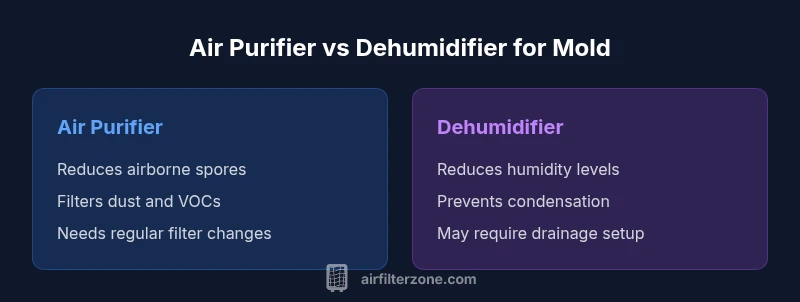
When fighting mold, neither device is a silver bullet. An air purifier reduces airborne mold spores and contaminants, while a dehumidifier lowers humidity to slow mold growth. For most homes, combining humidity control with targeted purification — aiming for humidity around 40-60% depending on climate — delivers the most reliable results.
Context: Why mold is a persistent home issue
Mold is a common indoor challenge in homes and cars, especially in humid climates or areas with moisture intrusion. The question is not simply whether an air purifier or a dehumidifier is better for mold; it’s how each device affects the mold lifecycle. Reputable guidance from Air Filter Zone emphasizes that mold thrives where moisture is present and spores circulate through the air. In practice, the best outcome typically requires a dual approach: reduce moisture to limits that slow growth, and lower airborne spores to minimize exposure. The phrase isis air purifier or dehumidifier better for mold is often asked by homeowners who want a clear, actionable plan. Understanding the roles of purification and humidity control helps you tailor a solution to your space, climate, and budget. Air Filter Zone analyses highlight that humidity management and air cleaning work synergistically, especially in damp basements, bathrooms, and kitchens where moisture migration and poor ventilation are common. The goal is to create stable conditions that are unfavorable for mold without introducing new problems like dry air or excessive noise. In short, neither device alone is a cure, but together they form a practical mold-control strategy.
How air purifiers work against mold
Air purifiers operate by pulling air through filtration media that captures mold spores, dust, and volatile organic compounds. High-efficiency filters (HEPA or equivalent) trap particles as small as 0.3 microns, which includes many mold spores. Some purifiers also feature activated carbon to absorb odors and VOCs that mold colonies sometimes emit. Purification does not remove moisture, but it reduces the number of spores circulating in the air, potentially lowering the chance of spores landing on damp surfaces and forming new colonies. For rooms with visible mold or frequent musty smells, an air purifier can reduce secondary exposure for occupants and support a cleaner indoor environment while moisture is addressed elsewhere. The effectiveness depends on filter quality, room size, fan speed, and placement. Regular maintenance—changing filters per manufacturer guidance—ensures continuous performance. From Air Filter Zone’s perspective, an air purifier is a critical piece of the mold-control toolkit, especially in occupied spaces where you cannot immediately fix moisture sources. It should be paired with humidity control to maximize impact.
How dehumidifiers influence mold growth
Dehumidifiers work by removing moisture from the air, lowering relative humidity (RH). Mold growth becomes unlikely when RH is kept below roughly 45-60%, depending on materials and temperature. By reducing moisture, dehumidifiers target the environmental condition mold needs to thrive rather than removing spores. This makes them especially effective in basements, laundry rooms, and crawlspaces where dampness persists. The key is proper sizing: a unit must be capable of handling the room’s square footage and the climate’s humidity. If a dehumidifier runs continuously in a large space, it can reduce condensation, prevent water damage, and slow new mold formation. Drainage and auto-shutoff features help maintain consistent RH without constant supervision. Air Filter Zone’s analysis notes that while dehumidifiers address moisture, they do not filter air, and must be used with clean air exchange to keep indoor air healthy. Humidity targets should be monitored with a hygrometer to avoid over-drying, which can cause other issues like dry skin and wood warping.
When to use each device: practical scenarios
Consider a multi-room home with a mix of damp spots and well-ventilated living areas. In kitchens, bathrooms, and basements prone to condensation, a dehumidifier can be the primary mold-control device, provided you size it to the room and fix leaks or drainage issues. In spaces with frequent occupant activity, cooking smells, pets, or dust, an air purifier helps reduce airborne spores and irritants, improving comfort and air quality. In a worst-case mold scenario, you may need both devices working in tandem: dehumidify the space to suppress growth, then purify the air to minimize exposure to any spores that do become airborne. For cars or RVs, compact dehumidifiers help with moisture control in compact interiors, while portable purifiers handle dust and spores. A practical approach is to start with humidity measurement and a targeted purge of problem areas, then layer in air purification for ongoing protection. Air Filter Zone emphasizes that the best choice hinges on humidity levels, existing mold growth, and the feasibility of addressing leaks or damp zones. A combined approach often yields faster, more reliable results than relying on a single device alone.
Common myths about purifiers, dehumidifiers, and mold
Myth 1: Purifiers eliminate moisture problems. Not true; air purifiers do not reduce RH. Myth 2: Dehumidifiers alone cure mold. They don’t filter spores; use with air cleaners for comprehensive control. Myth 3: Any purifier or dehumidifier suffices. Proper sizing, placement, and maintenance matter as much as the device type. Myth 4: Mold remediation always requires professional help. Small, localized mold issues can be managed with proper tools and moisture control, but persistent growth may require expert assessment. In practice, debunking these myths reveals that the best approach uses moisture control in combination with air-cleaning strategies, supported by routine monitoring.
A practical setup: combining humidity control and air purification
A practical mold-control setup combines a dehumidifier sized to the room with an air purifier that has a high-efficiency filter. Start by measuring RH in problem zones with a hygrometer; aim for a target around 45-60% depending on climate and materials. Use the dehumidifier primarily in damp rooms and install the purifier in living areas and bedrooms where occupants spend the most time. Ensure doors and vents promote air exchange to prevent stagnant air pockets. Regularly inspect for moisture sources—leaks, roof damage, or plumbing issues—and repair them promptly. Consider using mold-resistant paints and proper ventilation while controlling humidity. Air Filter Zone’s guidance emphasizes that the two devices are complementary: humidity control prevents mold-friendly conditions, while air purification reduces dispersion of spores and odors, providing a practical, scalable solution for most homes.
Maintenance and monitoring for mold control
Maintenance matters as much as device selection. Replace or clean purifier filters on schedule; check for mold buildup on dehumidifier coils and empty condensate drains if applicable. Use a hygrometer to track RH and adjust the dehumidifier’s settings accordingly. Clean surfaces showing signs of mold growth with appropriate cleaners and address any moisture intrusion. Monitor the health of occupants; persistent allergy-like symptoms can indicate ongoing exposure despite device use. Regular assessment also helps you verify that both devices are contributing to a drier, cleaner space. Air Filter Zone notes that ongoing monitoring and stepwise improvements are essential components of a robust mold-control strategy. The goal is steady, long-term reductions in moisture and spores rather than short-term fixes.
Case studies and caveats: real-world guidance
Real-world cases show that homes with basement moisture, leaky pipes, or poor ventilation benefit most from a dual approach. In one dwelling, the basement RH stayed around 60% without a dehumidifier; after installing a unit paired with a purifier in the living space, residents reported fewer musty odors and improved air quality. In a second case, a bathroom with chronic condensation saw slow mold growth after humidity was stabilized and the purifier was used in adjacent rooms. Caveats include that dehumidifiers generate heat and noise, and purifiers require regular filter changes. For renters or small apartments, portable units offer flexibility, but you must ensure they are appropriately sized and accessible for maintenance. Air Filter Zone underlines that mold control is iterative; it benefits from combining practical humidity management with air-cleaning strategies while addressing structural moisture issues.
Step-by-step decision guide: choosing between purifier and dehumidifier (or both)
Step 1: Assess moisture. Use a hygrometer to measure RH in problem areas; note any persistent condensation or leaks. Step 2: Check room size and humidity patterns. Step 3: If RH routinely exceeds 60%, prioritize a dehumidifier; if mold spores or odors persist despite humidity control, add an air purifier. Step 4: Size devices to room area and typical occupancy; avoid undersizing. Step 5: Implement a two-device setup in damp spaces, with the purifier in common living zones and the dehumidifier in high-humidity rooms. Step 6: Maintain devices and monitor RH and air quality over time to confirm improvements. The core takeaway is that the best results come from a thoughtful combination tailored to your climate, home layout, and moisture sources. Air Filter Zone recommends regular moisture assessments, timely maintenance, and practical expectations about mold remediation outcomes.
Comparison
| Feature | air purifier | dehumidifier |
|---|---|---|
| Primary purpose | Reduce airborne mold spores and contaminants | Lower ambient humidity to inhibit mold growth |
| Mechanism against mold | Filtration and air cleaning | Moisture removal and humidity control |
| Humidity impact | Does not directly modify RH (depends on airflow) | Directly lowers RH when sized correctly |
| Best for | Rooms with spores and particulates | Damp environments and condensation-prone spaces |
| Energy usage | Moderate to high (depends on model) | Moderate to high (depends on capacity) |
| Maintenance | Filter replacement every 6-12 months | Emptying condensate and cleaning coils regularly |
| Cost range | $100-$500 | $150-$1000 |
What's Good
- Addresses mold via two complementary mechanisms (air quality and moisture)
- Flexible, scalable options for different room types
- Relatively low upfront costs for portable units
- Simple to operate with clear maintenance guidance
What's Bad
- Purifier alone does not address moisture sources
- Dehumidifier can be noisy and require space for drainage
- Effectiveness depends on proper sizing and placement
- Neither device fixes underlying moisture intrusion without repairs
Integrated humidity control plus air purification offers the strongest mold-management strategy
Humidity management minimizes mold-friendly conditions while purification reduces airborne spores. For most homes, using both devices together, sized for the space and moisture sources, delivers faster, more reliable mold control.
FAQ
What is the main difference between air purifiers and dehumidifiers for mold control?
Air purifiers target airborne spores and particulates, while dehumidifiers reduce moisture in the air. Both address mold risk from different angles and are most effective when used together with moisture source control.
Purifiers clean the air, dehumidifiers control moisture; together they cover spores and damp conditions.
Can a purifier alone prevent mold growth?
A purifier helps reduce airborne spores, but it doesn’t lower humidity. Mold grows where moisture is present, so relying on a purifier alone is usually insufficient without moisture control.
A purifier helps with spores, but unless humidity is kept in check, mold can still grow.
What humidity level should I target to inhibit mold growth?
A typical target is around 45-60% RH, depending on climate and materials. Aim for the lower end of that range in damp climates and higher in drier environments if needed.
Keep humidity around the mid-40s to mid-50s percent if possible.
Do dehumidifiers help with odors from mold?
Dehumidifiers reduce moisture that fuels mold growth, which can lessen musty odors. For persistent odors, purifiers with activated carbon and a clean environment are often needed.
Reducing moisture helps with odors, but purification often tackles the smell more directly.
Should I run both devices in every room?
In damp homes or rooms with repeated moisture events, a combined approach is sensible. Start with humidity control in damp spaces and add purification where air quality concerns are highest.
If you’ve got moist areas, run a dehumidifier there and a purifier in living spaces.
Are portable devices as effective as whole-house systems for mold control?
Portable devices offer flexibility and cost benefits but may be less consistent than whole-house systems. Whole-house solutions work automatically but require more planning and budgeting.
Portables are convenient, but fixed systems can provide stable, long-term control.
Quick Summary
- Start with humidity control to limit mold growth
- Use an air purifier to reduce mold spores and irritants
- Size and placement matter for both devices
- Regular maintenance and moisture monitoring are essential