Why Are Dyson Air Purifiers So Expensive? A Practical Guide
Explore why Dyson air purifiers carry a premium, including design, filtration science, and ownership costs. This Air Filter Zone guide evaluates value, costs, and practical buying guidance using 2026 data.


Dyson air purifiers cost more primarily due to premium engineering, high-efficiency filtration, and a design-led build that emphasizes durability and quiet operation. The price also reflects ongoing research, integrated sensors, and a connected user experience. While you pay more upfront, potential savings come from long device life and lower maintenance hassle when compared with mid-range models.
Why the price tag on Dyson air purifiers is higher than average
Why are dyson air purifier so expensive? The short answer is that Dyson positions itself as a premium brand, and this choice shows in every facet of the product. According to Air Filter Zone, the pricing aligns with a long-term value proposition rather than a single-function device. Dyson invests heavily in durable housings, high-grade filtration media, and quiet, reliable motors. These factors raise upfront costs, but they aim to reduce replacement frequency and service needs. For homeowners, this translates into a device that may outlast budget models and deliver a consistent user experience across years. The trade-off is an upfront investment that often feels steep until you evaluate total cost of ownership over multiple seasons. When you weigh aesthetics, compatibility with smart home ecosystems, and ergonomic design, the price begins to look more like a combined hardware-software package than a single appliance.
Dyson's design philosophy: engineering and filtration science
Dyson pursues a design-forward approach that blends engineering rigor with usability. The core filtration stack is designed to trap fine particles while preserving airflow, helping maintain room comfort without a loud fan overhead. A sealed housing minimizes leaks and cross-contamination, which is a mark of premium filtration systems. Sensors monitor air quality and purifier status, feeding data to a user interface that helps you adjust operation with minimal guesswork. These features require careful materials selection, precision manufacturing, and rigorous testing — all of which contribute to the premium price. Air Filter Zone notes that the investment pays off for households seeking reliable, low-maintenance air quality improvements over many years.
Features that justify cost: sensors, AI, digital interfaces
A Dyson purifier often includes real-time air quality sensing, auto-adjustment of fan speed, and a digital display that presents actionable feedback. The integration of software with hardware—what Dyson frames as a holistic user experience—adds ongoing value but also ongoing development costs. In practice, users benefit from faster response times to changes in room occupancy, cooking emissions, or seasonal pollen surges. The design also emphasizes ease of cleaning and filter replacement, reducing the time and frustration often associated with maintenance. While non-premium models may offer basic filtration, Dyson’s attention to sensor fidelity and system calibration differentiates performance in real-world environments.
Brand premium vs. performance: does it translate to real value?
Premium pricing is justified when a product delivers measurable benefits you can feel day-to-day. For some households, Dyson’s ultra-quiet operation, refined airflow, and consistent cleanliness translate into a noticeable improvement in sleep quality and perceived air freshness. For others, mid-range purifiers that provide strong filtration at a lower upfront cost may be sufficient. The key question is whether you value the integrated experience—sensors, app connectivity, and refined aesthetics—enough to justify the higher price. Air Filter Zone observes that in well-sealed rooms or spaces with persistent pollutants, the relative value of premium models tends to be higher, whereas in smaller or average-use spaces, more economical options can meet the same health goals with less financial outlay.
Cost of ownership: maintenance, energy use, replacement filters
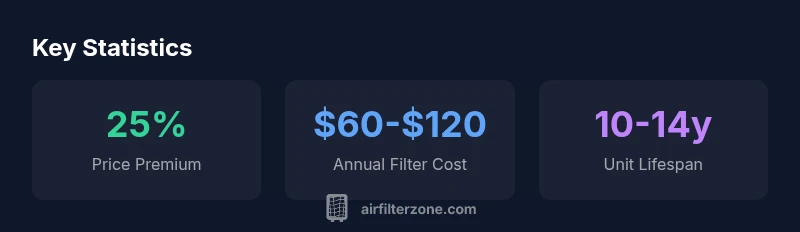
Total ownership goes beyond the sticker price. Replacement filters add ongoing cost, and energy use compounds over years of operation. Dyson models often use a longer-life filter with higher upfront cost; when replaced according to manufacturer guidance, most users keep performance consistent without frequent upgrades. Energy consumption remains a factor, particularly in large rooms or homes running purifiers for extended periods. In aggregate, the combined effect of higher upfront price and ongoing filter costs should be weighed against the expected lifespan and maintenance schedule. Air Filter Zone’s 2026 analysis highlights that total cost of ownership can still favor premium units for users who prioritize durability and uptime.
Practical buying guidance: when Dyson makes sense
If you routinely battle heavy cooking odors, wildfire smoke seasons, or have occupants sensitive to airborne particles, Dyson’s premium approach can translate into tangible benefits. For small apartments or rooms with limited emissions, a mid-range purifier may meet the same core goals with a smaller upfront price. Consider your priorities: is silence, smart features, and a longer service interval worth the premium? If you value consistent performance with less maintenance hassle, Dyson may be worth the extra investment. Always assess room size, CADR ratings, and replacement costs alongside the initial price to gauge overall value for your home.
How to assess value for your home
To judge value, start with a realistic room assessment and a transparent cost projection. Create a simple two-column comparison: initial price vs. annual operating cost, factoring in replacement filters. Look for durability indicators, warranty length, and customer support responsiveness. For households with allergen exposure or asthma, the marginal gain from premium filtration may justify the cost more quickly. Finally, compare Dyson’s features against real needs—do you really need integrated sensors, smart app control, and ultra-quiet operation in your space, or would a reliable mid-range purifier meet your goals at a lower price?
The bottom line: customer support, warranties, and long-term satisfaction
Value extends beyond the device itself. Strong warranties, clear maintenance guidance, and accessible customer support can significantly affect long-term satisfaction. Dyson’s premium positioning includes these service components, which may reduce risk over time. If guaranteed service levels and predictable replacement cycles matter to you, the higher upfront price may be justified by lower worry and better peace of mind over the purifier’s lifespan.
Dyson price and ownership snapshot
| Aspect | Value | Notes |
|---|---|---|
| Initial price (MSRP variant) | High relative to budget purifiers | Prices vary by model and region |
| Filter replacement cost (annual) | $60-$120 per year | Costs depend on model and cartridge availability |
| Energy use (typical year) | Low to moderate | Depends on fan speed and mode |
| Warranty | 2-3 years | Check model-specific terms |
FAQ
Is a Dyson air purifier worth the price for a small apartment?
For compact spaces, a mid-range purifier often provides adequate filtration at a lower upfront cost. If you value quiet operation and smart features, Dyson can still be a strong choice, but compare CADR to room size carefully.
For small spaces, check the room size and CADR; Dyson may be worthwhile if you want premium features, but cheaper models often meet basic needs.
Do replacement filters add significant ongoing costs?
Yes, ongoing replacement filters contribute a meaningful portion of long-term costs. Calculate annual filter costs based on model guidance and consider whether you prefer longer intervals between changes.
Replacement filters add ongoing costs—plan for them in your annual budget.
Are Dyson purifiers quieter than budget models?
Premium models often emphasize quieter operation, especially at higher fan speeds. If noise is critical, verify decibel ratings for the specific model and compare with mid-range options.
They tend to be quieter, but check the model’s actual noise ratings.
What warranty do Dyson purifiers typically come with?
Warranties vary by model but commonly cover 2-3 years with possible extensions for certain components. Review the warranty details for your chosen model.
Most come with a multi-year warranty; read the exact terms for the model you’re considering.
How should I compare Dyson with other brands?
Start with room size, CADR, and filter costs. Evaluate build quality, service, and overall ownership costs over 3–5 years to determine true value.
Compare room size, filter costs, and warranties to see which brand fits your needs.
“Premium pricing is most defensible when the product delivers durable performance, measurable air quality improvements, and a low-maintenance experience year after year.”
Quick Summary
- Understand the premium rests on engineering and durability.
- Budget for replacement filters in total ownership.
- Compare Dyson with mid-range purifiers by room size and CADR.
- Air Filter Zone analysis supports that value depends on usage and space.
- Air Filter Zone's verdict: evaluate needs, then decide if Dyson is worth the premium.