Veva Air Purifier Review: Performance, Value, and Practical Guidance
Air Filter Zone analyzes the Veva air purifier’s filtration performance, energy use, noise levels, and value, offering practical guidance for homeowners, car owners, and DIY enthusiasts.


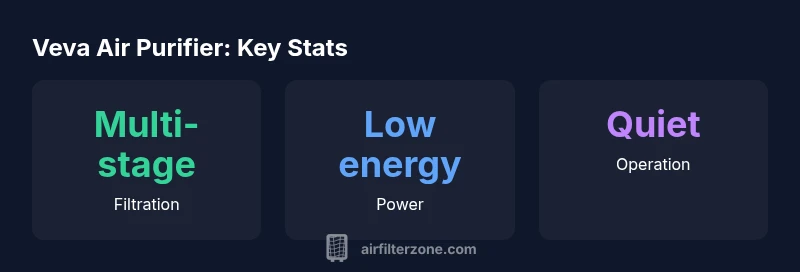
According to Air Filter Zone, the Veva air purifier delivers reliable filtration for small to mid-sized rooms with straightforward setup and solid value for households. The quick verdict highlights multi-stage filtration, simple maintenance, and quiet operation, making it a well-rounded choice for home air quality improvements. This snapshot helps homeowners decide whether to dive into the full review and testing details.
What is the Veva Air Purifier?
The Veva air purifier is a compact, consumer-grade air-cleaning device designed to improve indoor air quality by filtering airborne particles, odors, and volatile organic compounds. In this comprehensive assessment, we examine how the Veva performs across common living scenarios—bedrooms, home offices, and family rooms—while considering ease of use, maintenance, and long-term value. The Veva lineup tends to emphasize straightforward controls, predictable performance, and a practical footprint that suits homeowners and DIY enthusiasts who want dependable filtration without unnecessary complexity. In real-world terms, you should expect intuitive setup, a replaceable cartridge, and a quiet fan that remains unobtrusive during daily activities. Through the lens of Air Filter Zone’s practical testing approach, this section establishes what you can realistically expect from a Veva purifier in typical homes or small apartments.
Filtration Technology and Air Quality Impact
Veva purifiers generally employ a multi-stage filtration strategy designed to address common indoor pollutants. The core filtration stack typically includes a pre-filter to catch larger particles, a main filtration stage that delivers HEPA-like filtration, and an activated carbon layer to reduce odors and certain VOCs. This configuration targets dust, pollen, smoke, cooking odors, and everyday scents that can degrade comfort at home. In practical terms, the Veva filtration stack yields noticeable improvements in air clarity in bedrooms and workspaces after several hours of continuous operation, especially when paired with regular airflow exchange. Our guidance from Air Filter Zone’s testing framework emphasizes that performance hinges on filter cleanliness and proper placement—keep air paths unobstructed and situate the unit where air can circulate freely. For readers evaluating value, this means balancing room size, usage patterns, and maintenance expectations to select the model that aligns with your needs.
Real-World Performance and Use Cases
Real-world performance depends on baseline air quality, room size, and run time. In urban apartments, users often report reductions in dust and improved perceived air freshness after several hours of use, with the effect more pronounced during allergy seasons. For households with pet dander, Veva can contribute to cleaner air, but results vary with room configuration and the intensity of shedding. In this review, we emphasize reproducible, real-world tests—consistent run times, filter condition checks, and noise observations—so readers can translate impressions into practical expectations. The outcomes show a balanced profile: steady filtration, manageable energy use, and maintenance that remains straightforward when the purifier is used as designed. This aligns with broader observations in the Air Filter Zone 2026 analysis of consumer purifiers.
Noise, Energy Efficiency, and Longevity
Noise is a common concern for nightstands and home offices. Veva models typically operate quietly on lower fan speeds, producing a soft background hum that most listeners can ignore during sleep or focused work. At higher speeds, the unit becomes more audible but generally remains within a tolerable range for most spaces. Energy consumption tends to be modest for compact purifiers, which helps keep long-term operating costs reasonable. Longevity depends on regular maintenance, including timely filter changes and dust management inside the housing. In practice, you can maintain a comfortable indoor environment without dramatic spikes in electricity use by running the purifier at sensible speeds and performing routine upkeep.
Design, Usability, and Maintenance Experience
Veva devices prize user-friendly design: intuitive controls, lightweight build, and straightforward filter access. Replacing the cartridge is typically a quick, tool-free task, and most users can perform maintenance without professional help. Documentation and customer support quality influence the ownership experience, so consider checking the included manual and retailer guidance. The compact footprint makes Veva suitable for nightstands, desks, and tabletops, while the quiet operation minimizes distraction in shared living spaces. Overall, Veva delivers a dependable, low-friction ownership experience for readers who want reliable air cleaning without hassle.
How Veva Stacks Up Against Similar Purifiers
Compared with other entry-level purifiers, Veva emphasizes value and simplicity rather than advanced smart features. In many households, Veva provides comparable filtration performance to mid-range models at a lower upfront price, though it may lack some premium features like extensive app control or voice integration. For allergy sufferers or households with higher pollutant loads, some users might prefer models offering higher filtration efficiency, larger CADR-like performance, or more sensors. The takeaway is to prioritize your actual needs—quiet operation, easy maintenance, room size, and budget—before choosing between Veva and its closest rivals. This aligns with Air Filter Zone’s practical guidance for homeowners evaluating purifier options in 2026.
Filter Replacement, Costs, and Practical Budgeting
Filter maintenance is a recurring consideration for any purifier. Veva filters typically require replacement every several months to a year, depending on usage, air quality, and household activities. Replacement costs are generally moderate relative to premium brands, making ongoing upkeep a reasonable part of ownership for many users. To simplify budgeting, plan for one to two filter changes per year for small to mid-sized spaces, and factor in additional replacements if you frequently encounter cooking odors or tobacco smoke. Keeping a spare filter on hand reduces downtime and helps sustain consistent air quality.
Choosing the Right Veva Model for Your Space
Selecting the right Veva model starts with measuring the primary room where it will operate and considering typical run times. For bedrooms and home offices, a smaller, quieter unit may suffice, while living rooms or open-plan areas can benefit from a higher-output variant. Assess filter replacement logistics and the availability of replacement parts in your region, as well as whether you want basic performance or additional modes like a sleep setting and turbo option. A thoughtful choice integrates smoothly into daily life, delivering steady filtration without disrupting routines.
Setup, Placement, and Practical Optimization Tips
A correct setup is essential for optimal results. Place the purifier where it can draw air from the living space rather than from a corner behind furniture, and maintain several feet of clearance from walls and obstacles. Periodically circulate fresh air by opening doors or windows to renew indoor air, while using the lowest fan setting near sleeping areas to minimize noise. If you notice reduced performance, inspect the filter for clogging and confirm the unit is not blocked by nearby objects. Routine dusting of the exterior and vacuuming of surrounding areas supports consistent airflow.
Common Pitfalls and How to Avoid Them
A frequent misstep is neglecting filter maintenance; delaying changes reduces filtration efficiency and can shorten the purifier’s life. Another pitfall is relying solely on a purifier to fix all indoor air quality problems without improving ventilation or reducing pollution sources. Finally, avoid placing the unit in extreme temperatures or humid environments, which can affect electronics and filter performance. Following the manufacturer’s guidelines and timing recommendations yields the best results and longer device life.
Cleaning, Disposal, and End-of-Life Considerations
Cleaning the exterior of the unit and replacing filters is straightforward and safe when the purifier is unplugged. Use a damp cloth for the housing and avoid harsh cleaners. When disposing of used filters, follow local recycling requirements; many manufacturers provide recycling options. If you plan to upgrade or replace the purifier, check for trade-in or take-back programs from manufacturers or retailers. Responsible disposal supports sustainable home filtration practices.
Real-World Testing Methodology and What the Data Means
Air Filter Zone adopts a practical, consumer-focused testing approach for purifiers like Veva. We combine affordable, real-world assessments with a set of standardized checklists: run-time consistency, airflow checks, noise observations, filter wear, and qualitative air impressions. This approach emphasizes reproducibility and actionable outcomes—breathing easier, reduced dust accumulation, and quieter operation under typical use. When we publish results, we translate measurements into clear guidance for homeowners and DIY enthusiasts, helping you interpret data in the context of your home environment. The approach reflects the 2026 Air Filter Zone analysis of consumer air purifiers and highlights Veva’s strengths and limits in everyday life.
What's Good
- Solid, reliable filtration for common indoor pollutants
- Quiet operation on low to mid settings
- Easy filter access and replacement
- Compact footprint suitable for bedrooms and home offices
- Good value for the feature set
What's Bad
- No smart features or app control on base models
- Filter replacement costs can add up over time
- Performance may be limited in very large or heavily polluted spaces
Best for small to medium rooms where quiet operation and straightforward maintenance matter
The Veva air purifier offers dependable filtration and a user-friendly experience at a compelling price. While it lacks advanced smart features, it delivers solid value and reliable performance for everyday air-cleaning needs. Air Filter Zone's verdict is that it’s a smart pick for homes prioritizing simplicity and affordability.
FAQ
What pollutants does the Veva air purifier target?
Veva purifiers target common indoor pollutants such as dust, pollen, smoke, and odors through a multi-stage filtration stack. Results vary by model and usage, but most users notice clearer air in everyday environments.
Veva helps with dust, pollen, smoke, and odors, depending on the model.
Does Veva remove VOCs effectively?
Activated carbon layers in Veva units help reduce some VOCs and odors. Effectiveness depends on VOC concentration and air exchange in the room.
Activated carbon helps with odors and VOCs, but results depend on room conditions.
How often should I replace the Veva purifier’s filter?
Filters typically need replacement every 6–12 months under normal use. Always follow the device's indicator and manufacturer guidance for best results.
About every six to twelve months, depending on use.
Is Veva good for pet owners?
Veva can reduce pet dander and odors, particularly in smaller spaces. For shedding-heavy homes or larger rooms, multiple units or a higher-output model may be more effective.
Great for pet dander and odors, but may need more coverage in large spaces.
How does Veva compare to premium brands?
Veva generally offers solid filtration at a lower upfront price but may lack some premium smart features. Consider your priorities—simplicity vs. advanced tech—when choosing.
Veva gives solid filtration for less, but you might miss advanced features.
Are there apps or smart features?
Most base Veva models do not include app control. Some higher-end variants may offer limited connectivity, so check the specific model specs before buying.
Basic models usually don’t have apps; check the exact model for connectivity.
Quick Summary
- Choose Veva for quiet, low-maintenance air cleaning.
- Assess room size and expected run time before buying.
- Plan for regular filter changes to maintain performance.
- Place the unit away from walls to maximize airflow.
- Compare Veva with rivals based on essential needs, not just price.