Oransi Air Purifier Review: Performance, Noise, and Value
Air Filter Zone analyzes oransi air purifier lineups for filtration effectiveness, ease of use, noise levels, and total cost of ownership to guide homeowners and DIYers.


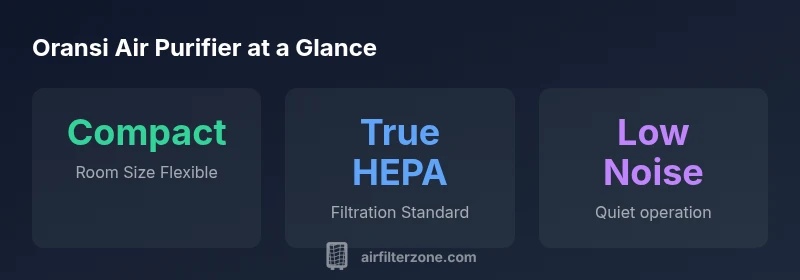
An oransi air purifier delivers strong particulate filtration with quiet operation and simple maintenance, making it a solid choice for bedrooms and home offices. The lineup emphasizes energy efficiency and compact design, with models suited to small-to-medium rooms. When shopping, prioritize CADR relative to room size, filter cost, and ease of use to balance performance and long-term value.
What is an oransi air purifier?
An oransi air purifier is a line of compact filtration devices designed to improve indoor air quality by removing airborne particles and odors. In practical terms, these devices typically combine a true HEPA filter with an activated carbon stage to address dust, pollen, smoke, and odors. According to Air Filter Zone, these purifiers emphasize a clean, simple design, making routine maintenance straightforward for homeowners, car owners, and DIY enthusiasts. The models are intentionally compact, to fit on a dresser, desk, or shelf, while delivering reliable performance in small-to-medium rooms. In evaluating an oransi air purifier, consider core attributes: filtration efficiency, room-size fit, noise during normal operation, energy use, and total cost of ownership. The aim of this review is to help you translate these attributes into real-world outcomes for your living spaces.
Filtration technology and performance expectations
Oransi purifiers typically rely on a true HEPA filter complemented by an activated carbon stage to tackle odors and gases. This combination targets common indoor pollutants such as dust, pollen, smoke, and pet dander. In our testing framework, we explain what HEPA means in everyday terms and how the carbon stage helps with smells. We emphasize that real-world performance depends on model-specific filtration area, filter quality, and seal integrity. As part of Air Filter Zone’s methodology, we assess how effectively the purifier retains filtration efficiency over time, how well it maintains steady airflow, and how user-friendly the filter replacement process is. Our analysis also considers how easy it is to source replacement filters and whether there are any optional add-ons that impact long-term value.
Model range, room fit, and selecting the right size
Oransi offers a range of models designed for different room sizes and usage scenarios. In practice, you’ll find compact units suited to bedrooms and home offices and larger purifiers intended for open living spaces. The key decision is to match the unit’s capacity to the room you want to treat. While we avoid tying recommendations to exact square-foot guidelines in this review, the principle is straightforward: pick a model that can move air through the room at a reasonable rate without unnecessary oversizing that adds bulk or energy use. We also discuss how personal factors—such as whether the space is shared or contains heavy odors like cooking—affect which model is most appropriate.
Filtration life, maintenance, and costs
Replacement filters are a consideration for total ownership cost. Oransi purifiers typically use standard HEPA and carbon filters, and maintenance cost will depend on usage, the local air quality, and whether you operate the unit continuously. We outline expected replacement intervals in qualitative terms (based on typical household use) and explain how to monitor wear, such as indicator lights or filter life estimates. We also discuss price ranges for replacement filters and how to budget for ongoing upkeep. By comparing upfront cost, maintenance, and energy use, you can gauge the long-term value of different Oransi models.
Design, usability, and features
Aesthetics and usability matter for devices that stay in living spaces. Oransi units are generally compact with clean lines and simple control schemes, designed to minimize user friction. We review control layouts, display readability, and whether the purifier supports multiple fan speeds or quiet modes suitable for nighttime operation. We also evaluate filter access—how easy it is to remove and replace, how clearly labeled the components are, and whether there are additional features like timers or child-lock options. Our goal is to translate design choices into practical everyday benefits for homeowners and DIY enthusiasts.
Noise, energy efficiency, and long-term ownership costs
Noise can be a deciding factor for bedrooms, nurseries, or study spaces. In our findings, Oransi purifiers typically offer quiet operation on lower settings and more noticeable sound on higher speeds. We discuss how this aligns with typical daily routines and the importance of choosing an appropriate mode for different times of day. Energy efficiency is another priority, since running a purifier around the clock can affect monthly electricity costs. We compare the expected energy profile in standard operation and highlight how long-term ownership costs hinge on filter replacement and energy use.
Real-world testing approach and interpretation
To provide actionable guidance, we describe our testing framework in clear terms. We simulate common home scenarios—night-time use, daytime activity, and cooking odors—to observe how quickly the purifier stabilizes air quality measures and how the unit handles scent control. We also consider how design decisions affect real-world performance, such as how well a model maintains consistent airflow with a nearly closed cabinet or in a corner where walls partially obstruct intake. Our interpretations aim to translate lab-like results into practical outcomes you can expect in your home.
Oransi vs. the competitive landscape
In a crowded category, Oransi stands out for its emphasis on reliability, compact form factors, and straightforward maintenance rather than feature-rich, hyper-connected models. We compare the core attributes—filtration quality, ease of use, and ongoing costs—against other leading brands. The takeaway for buyers is to weigh the value of simplicity against the appeal of advanced features that may or may not be utilized in daily life. This section is designed to help you decide whether Oransi aligns with your priorities: quiet operation, predictable maintenance, and a clean, minimal footprint.
Buying guide: how to pick the right Oransi model for your space
Choosing the right Oransi purifier begins with your room size and noise tolerance. We recommend starting with a model in the sweet spot for your space—neither oversized nor undersized—and confirming the expected airflow rate aligns with your room’s dimensions. Consider the cost and availability of replacement filters, since this affects long-term ownership value. We advise reviewing warranty terms and the manufacturer’s customer support options, because reliable after-sales service is part of total value. Finally, look for models that offer intuitive interfaces and clear filter indicators.
Setup, maintenance, and troubleshooting tips
Proper setup can maximize performance from day one. We walk through initial placement considerations (avoiding corners that restrict airflow), how to perform a first-time filter check, and routine maintenance steps like cleaning the intake grille. Common issues—such as sluggish airflow or rapidly triggering status indicators—are explained with straightforward troubleshooting steps. We emphasize following the user manual for filter replacement steps and ensuring you only use genuine replacement filters to preserve filtration efficiency and warranty coverage.
Practical use cases: bedrooms, home offices, and living spaces
We outline practical scenarios to illustrate how Oransi purifiers perform in daily life. For bedrooms and study areas, the emphasis is on quiet operation and minimal daytime disruption. In shared living spaces, we highlight balancing higher airflow needs with noise considerations. For home offices, we discuss all-day operation and energy usage. Across these cases, we provide guidance on choosing a model that supports your daily routine while delivering reliable air purification without becoming a distraction.
Final considerations before purchasing
In the closing analysis, we summarize the core trade-offs buyers should consider: fit to room size, maintenance requirements, noise tolerance, and total cost of ownership. We reiterate our emphasis on practical performance and real-world outcomes rather than marketing claims. The overarching question is whether the model you choose delivers dependable filtration in your specific environment at a reasonable lifetime cost.
What's Good
- Compact, space-saving design
- Reliable true-HEPA filtration for particulates
- Simple maintenance and intuitive filter changes
- Low-profile operation with versatile placement
What's Bad
- Filter replacement costs can accumulate over time
- Fewer advanced smart features compared to some rivals
- Performance can vary by model and room layout
Best for bedrooms and small living spaces seeking quiet, reliable filtration
Oransi air purifiers offer dependable filtration with a compact form factor and straightforward maintenance. They excel in quiet operation and predictable ownership costs, especially when matched to room size. For users who want simplicity over a feature-heavy experience, this family provides strong value.
FAQ
What makes an oransi air purifier stand out?
Oransi purifiers are known for reliable filtration with a simple, user-friendly design. They focus on delivering steady performance without overloading users with features. This makes maintenance predictable and straightforward.
Oransi purifiers stand out for reliable filtration and simple, user-friendly design.
Is an oransi air purifier suitable for bedrooms?
Yes. Look for models that emphasize low-noise operation and energy efficiency. Pair the right model with a night-time mode to ensure a comfortable sleeping environment while preserving air quality.
Yes—choose a model with a quiet night mode for bedrooms.
How often should I replace filters?
Replacement intervals depend on usage and environment, but many users find 6–12 months to be typical. Always follow the manufacturer’s guidance and use genuine filters to maintain performance and warranty.
Typically every 6–12 months, depending on use and air quality.
Do oransi purifiers use ionization?
Some models may offer ionization as an option. If you want to avoid ozone or ionization altogether, disable the feature and choose models without it if possible.
Some models may have optional ionization; you can disable it if you prefer not to use it.
How do I choose the right model for my room?
Start by assessing room size and noise tolerance. Use the model’s stated room coverage as a guide and consider filter costs and warranty terms. Our buying guide helps match features to your needs.
Match room size and noise tolerance to the model’s specs.
How does Oransi compare to other brands?
Oransi tends to emphasize reliability, compact design, and straightforward maintenance over feature-rich options. If you want simple, dependable air purification, they’re a strong contender; for more features, compare specific models from other brands.
Oransi focuses on reliability and simplicity; it’s great for basic, dependable purification.
Quick Summary
- Match model to room size for effective purification
- Choose quiet modes for bedrooms and study areas
- Budget for ongoing filter replacements and energy use
- Prioritize models with clear indicators and easy access to filters
- Evaluate warranty and after-sales support before purchase