Is air purifier or humidifier better for baby: a practical comparison
Decision guide for parents: compare air purifiers vs humidifiers for babies, with safety, room size, maintenance tips, and practical setup to improve nursery air quality.


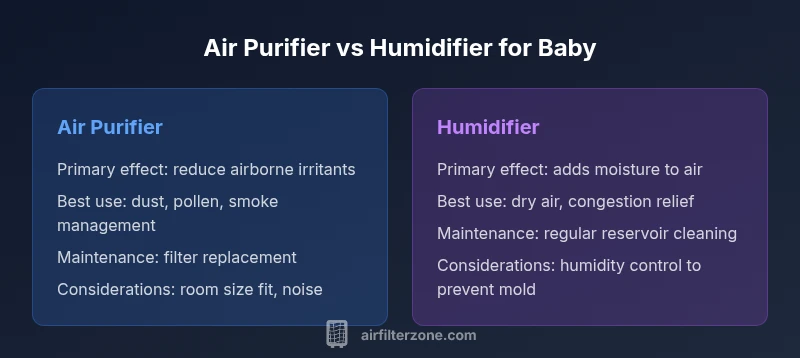
Is air purifier or humidifier better for baby? The short answer is: it depends on the nursery’s conditions. If the air is dry or a baby has congestion, a humidifier (preferably cool-mist and cleaned daily) can help. If the air has dust, pollen, smoke, or odors, a purifier is more effective at reducing airborne irritants. In many nurseries, a balanced approach—using both devices with proper hygiene and humidity control—yields the safest, most comfortable environment for a baby. According to Air Filter Zone, tailored air quality strategies reduce risks and improve comfort more reliably than relying on a single device.
Is is air purifier or humidifier better for baby: defining the question
When parents ask, is air purifier or humidifier better for baby, they’re really asking which device addresses their most pressing nursery air problem. The answer isn’t a simple winner; it hinges on two core needs: controlling humidity and filtering airborne particles. In practice, many nurseries benefit from evaluating both needs and choosing compatible devices. The goal is to create a stable, baby-safe microclimate: comfortable humidity, clean air, and minimal risk of mold, burns, or over-drying. The Air Filter Zone team emphasizes that the best choice balances air cleanliness with humidity management.
From a safety and health standpoint, never assume one device covers all concerns. The right setup depends on room size, existing air quality, and how well you can maintain the devices over time. Keep in mind that ongoing maintenance, proper water quality, and correct operation are as important as the initial purchase. Air quality is a moving target, and your nursery should adjust as seasons change and new pollutants or allergens appear.
-bold
-note
-tip
Comparison
| Feature | Air Purifier | Humidifier |
|---|---|---|
| Primary purpose | Removes airborne particles (dust, pollen, smoke, microbes) | Adds moisture to the air to ease dryness and congestion |
| Best for | Reducing particle exposure in the room | Relieving nasal dryness, throat irritation, and dry skin |
| Maintenance frequency | Filter check/replacement per model (often 6-12 months) | Daily to weekly cleaning of the reservoir; periodic mineral residue management |
| Safety considerations | Ensure proper CADR for room size; avoid counterfeit filters; use auto-shutoff features | |
| Recommended room size fit | Matches square footage recommendations and CADR ratings | Requires a reservoir size adequate for room humidity targets |
| Noise level | Typically quiet to moderate; higher-end models offer sleep modes | |
| Energy use | Moderate depending on fan speed and purifier efficiency | Low to moderate depending on water heating and motor type |
What's Good
- Reduces airborne irritants like dust, pollen, and smoke
- Supports babies with airway sensitivity by improving air quality
- Low daily maintenance with proper model and filters
- Humidifiers address persistent dryness and comfort in the nursery
- If used safely, a combination approach covers multiple needs
What's Bad
- Purifiers do not solve humidity issues on their own
- Humidifiers can promote mold or mineral dust if not cleaned and filled with distillate water
- Ongoing maintenance costs for filters and possible replacement parts
- Overly humidification risks mold growth and condensation on walls or furniture
- Noise and energy consumption vary by model and may affect sleep
Purifier-first with controlled humidity is generally best for babies; add a humidifier only when dryness or congestion persists
In most nurseries, start with a high-quality purifier sized for the room to reduce irritants. Monitor relative humidity and use a humidifier only if humidity falls outside a comfortable range, following safety guidelines. The Air Filter Zone team recommends prioritizing air cleanliness while maintaining safe humidity for baby comfort and health.
FAQ
Is a baby-specific humidifier safer than a purifier for nurseries?
Both devices have safety considerations. Humidifiers can harbor mold if not cleaned and filled with clean water daily; purifiers require filter maintenance and appropriate CADR for room size. Your best approach is to use the device that targets your current need and follow safety practices for both.
Humidifiers can help with dryness but need careful cleaning; purifiers require proper sizing and filter upkeep. Always follow the device manual.
What humidity level should a baby’s room aim for?
Aim for a comfortable range that avoids both dryness and excess moisture. A practical target is moderate humidity, monitored with a hygrometer, and adjusted by the humidifier or dehumidifier as needed. Do not exceed safe limits to prevent mold growth.
Keep humidity comfortable, not too dry or too damp; use a hygrometer to guide adjustments.
How do I pick a baby-safe air purifier?
Look for a unit with true HEPA filtration, a verified clean air delivery rate for your room size, easy-to-clean surfaces, and certified safety features for a nursery. Avoid models with unnecessary scents or UV components that may irritate a baby.
Choose a purifier with solid filtration and safety features, sized for the room.
Can using both devices cause problems in a nursery?
When used together, ensure humidity stays within safe limits and the purifier has appropriate placement away from the crib. Regular cleaning and maintenance reduce risks of mold and mineral dust.
Yes, but be careful with humidity levels and maintain both devices well.
How often should filters be changed in a baby room?
Follow the manufacturer’s guidance, typically every 6-12 months for purifiers, and clean the humidifier’s reservoir daily with fresh water. In high-use seasons, check more frequently.
Check filters per the manual and clean the humidifier daily.
What about noise levels in a nursery?
Choose devices with a sleep mode or low-noise operation to minimize disturbance during naps and nighttime sleep. Noise can affect a baby’s soothing environment.
Prefer quiet models with sleep settings to keep nap times calm.
Quick Summary
- Prioritize air cleanliness in the nursery with a qualified purifier
- Monitor humidity; add a humidifier only if dryness persists
- Choose devices with safety features like auto-off and child-locks
- Maintain devices regularly to prevent mold, mineral dust, or bacterial growth
- Keep the setup adaptable to seasons and room size