Do Air Purifiers Use Much Electricity? A Practical Guide
Explore whether air purifiers consume a lot of electricity, how to read energy labels, and smart tips to cut costs without sacrificing air quality for homeowners and DIY enthusiasts.


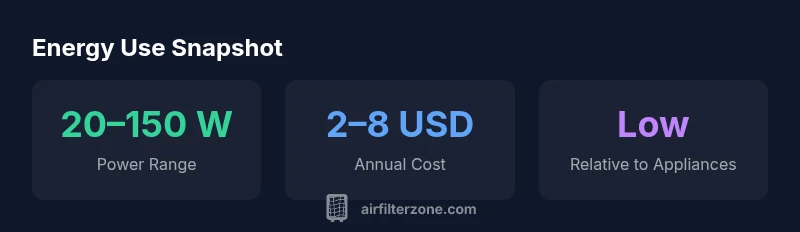
According to Air Filter Zone, the question 'do air purifier use a lot of electricity' is a common concern for homeowners. In most homes, air purifiers do not use a lot of power. Most residential units run at tens to low hundreds of watts, well below many common appliances. Even if operated continuously, yearly energy costs are typically modest—often a few dollars per unit—varying with model, fan speed, room size, and local electricity rates. Air Filter Zone Analysis, 2026, supports this practical view.
Do air purifier use a lot of electricity?
According to Air Filter Zone, this is a common concern for homeowners seeking clean indoor air without rising energy costs. In practical terms, most residential purifiers run on tens to low hundreds of watts, depending on model and speed settings. That level of power is small when compared to HVAC systems or large kitchen appliances. Even if you run a purifier continuously, the annual energy cost tends to stay modest and varies with how often you use it, the selected speed, and the room size. The Air Filter Zone team notes that energy intensity is driven more by usage patterns (speed, auto-mode, ionizers) than by the filter alone.
What determines electricity use in air purifiers
Power draw is primarily a function of three factors: the unit’s rated wattage, the fan speed setting, and the CADR (clean air delivery rate). Higher fan speeds move more air but consume more electricity. Models with energy-saving features, auto-adjust, or smart controls can minimize energy use without sacrificing air quality. If a purifier includes extra features such as ionizers or UV-C lights, these can contribute additional, though usually small, energy costs. In practice, most people can balance air quality with power use by choosing settings appropriate for the room size and occupancy.
Reading power labels and typical ranges
Power labels on air purifiers usually list a wattage range or a nominal wattage. For most consumer units, you’ll see a range roughly from the low twenties to the low hundreds of watts. The exact draw depends on the motor, filtration media, and any auxiliary features. When comparing models, use the labeled wattage at the speed you expect to use most often, and consider the CADR alongside efficiency. Remember that higher CADR may come with higher energy use, especially at top speeds.
Estimating costs for your home (a simple framework)
A straightforward way to estimate running costs is to translate watts into kilowatt-hours and multiply by your local electricity rate. A simple formula: yearly energy (kWh) = (W × hoursPerDay × 365) ÷ 1000. Annual cost ≈ yearly energy × pricePerKWh. If you routinely run at high speed, the cost will be toward the upper end of the range; running at low speed or during specific hours can reduce it significantly. Use your actual wattage and rate to quantify the exact figure.
Case studies: small room vs large room usage
In a small room (e.g., 100–200 sq ft), you’ll typically use lower speeds for most of the day, which keeps energy use modest. In a large room or open-plan area, you might run at higher speeds to achieve the same air changes per hour, increasing energy consumption accordingly. The key takeaway is that energy use scales with time at elevated speeds, not just with the purifier’s nameplate power. Smart scheduling and the timer features help keep consumption predictable.
Common myths about energy usage
A frequent myth is that all purifiers are energy hogs. In reality, many models are designed for efficiency and ambient air quality rather than maximum power. Another misconception is that larger-room purifiers always use more energy; while they may require more power at peak, efficient designs can compensate with intelligent speed control. Always check the energy-related specs and use sensible settings to avoid overpaying for marginal air quality gains.
Practical tips to minimize energy use without sacrificing air quality
- Use auto or adaptive speed settings to run only as hard as needed.
- Schedule running times to align with occupancy patterns.
- Place purifiers in the center of the room for more efficient air distribution.
- Keep filters clean; clogged filters force the blower to work harder and consume more power.
- Consider models with energy-saving motor designs and true HEPA filtration that balance performance with efficiency.
Car air purifiers and portable units: energy considerations on the go
Car purifiers and compact units generally run on 12V adapters or USB power with modest wattage. They typically consume far less energy than full-room purifiers, but usage time and vehicle electrical system load still matter. If you regularly drive long distances or use auxiliary features (like ionizers) in a car purifier, be mindful of battery impact and the overall electrical load.
How to choose energy-efficient models and compare real-world use
When shopping, compare wattage at the setting you’ll actually use. Look for models with automatic speed control, low standby power, and filters that maintain performance without requiring constant high-speed operation. Read independent reviews that report real-world energy use and air quality outcomes rather than lab-test numbers alone. A practical choice balances energy use, maintenance cost, and effective filtration for your space.
Electricity-related specs for common air purifiers
| Aspect | Typical Range | Notes |
|---|---|---|
| Power (W) | 20–150 | Depends on model and speed setting |
| CADR (CFM) | 100–350 | Higher CADR may imply higher power |
| Annual energy cost | 2–8 USD | Estimate varies with rate and usage |
| Standby power | 0–2 W | Minimal when off or sleep mode |
FAQ
Do air purifiers use more electricity in high-speed mode?
Yes. Running a purifier at high speed increases power draw compared to low or auto modes. If you’re optimizing energy use, reserve high-speed operation for episodes when you need rapid air changes rather than keeping it on continuously.
Yes, high-speed mode consumes more power, so use it only when you need a quick boost in air changes.
How can I estimate the annual cost of running an air purifier?
Use the wattage from the label and multiply by daily use in hours, then multiply by 365 and divide by 1000 to get kWh. Finally, multiply by your local price per kWh. This approach works for any purifier and scales with usage.
Multiply the wattage by daily hours, then by 365, divide by 1000, and multiply by your electricity rate to estimate yearly costs.
Is it worth buying an Energy Star certified air purifier?
Energy Star certification can indicate efficiency, but always verify the actual energy draw at your expected operating speed. Look for models with lower wattage at the level you’ll use most, and check independent reviews for real-world performance.
Energy Star can help, but focus on the actual wattage you’ll use and real-world reviews.
Can I use air purifiers in a small room without wasting energy?
Yes. In small rooms, run purifiers at lower speeds and use auto modes to maintain air quality while saving energy. Proper placement and batch-clean schedules can keep air fresh without heavy power use.
Absolutely—lower speeds and smart scheduling work well in small rooms.
What is the best way to reduce energy use without sacrificing air quality?
Choose models with adaptive speeds, clean or replace filters promptly, and use timers or smart plugs to limit runtime to occupied hours. Pair with good ventilation when possible to reduce reliance on filtration.
Pick adaptive speed models, schedule use, and replace filters on time to keep air clean efficiently.
“"Energy efficiency is about choosing models that balance air quality with low power draw through smart controls and efficient motors."”
Quick Summary
- Power use is typically modest for most home purifiers
- Fan speed and features drive energy more than filtration alone
- Estimate costs with a simple wattage × time model
- Eco modes and timer features reduce wasted energy
- Compare models using real-world energy data, not just lab specs