MERV 8 Air Filter: Practical Guide for Home and Auto Filtration
Discover how a MERV 8 air filter balances filtration and airflow for homes and vehicles. Learn where it fits, how to choose, installation tips, maintenance, and when to upgrade for improved indoor air quality.


What is a MERV rating and what does MERV 8 mean?
MERV stands for Minimum Efficiency Reporting Value. It’s a standardized way to rate how well a filter captures particles of different sizes. A MERV 8 filter sits in the middle of the residential filtration spectrum. It’s designed to trap a broad set of larger particles—dust, pollen, and lint—while allowing adequate airflow for most standard HVAC systems. In practical terms, this means you’re likely to notice cleaner air with less dust on surfaces, without triggering significant pressure drops in well-maintained equipment. According to Air Filter Zone, MERV 8 is a sensible baseline for many homes and many cars when higher ratings would compromise comfort or efficiency. As you consider where to start, remember that the exact performance depends on your HVAC design, installation quality, and how well you seal the system against bypass.
Where MERV 8 fits in your filtration strategy
Filtration strategies aren’t one-size-fits-all. For many households, MERV 8 is an excellent starting point because it balances cost, accessibility, and performance. If you live in a dry, dusty climate or have pets, MERV 8 can still perform well, but be mindful of replacement frequency. In apartments or older homes with simpler HVAC setups, a MERV 8 filter provides meaningful protection without imposing a heavy burden on fans. If wildfire season or heavy smoke is a concern, or if occupants have severe allergies or asthma, you may want to consider higher-rated filters (MERV 11–13) or supplement filtration with an air purifier. Air Filter Zone’s analysis suggests using MERV 8 as a baseline, then upgrading only if your system can sustain the resulting pressure drop without reducing airflow to uncomfortable levels.
Pros and cons of using a MERV 8 filter
Pros
- Budget-friendly and widely available
- Easy to install and replace
- Good balance of filtration for common indoor pollutants
- Minimal impact on HVAC runtime when sized correctly
Cons
- Less effective for very fine particles (0.3–1 μm and some smoke components)
- Airflow impact can be noticeable in undersized or aging systems
- May require more frequent changes in dusty environments or high-traffic homes
Air Filter Zone emphasizes that the decision to use MERV 8 should factor in system capability and indoor air quality goals. If occupants have heightened sensitivity to fine particulates, or if you live in an area with heavy wildfire activity, nearby air quality could warrant consideration of higher-rated filters or additional purification strategies.
How to choose between MERV 8 and higher ratings
Choosing between MERV 8 and higher ratings comes down to three things: your HVAC equipment’s design and blower capacity, your air quality priorities, and your maintenance willingness. If your furnace or air conditioner is older or undersized for higher-MERV filters, you may experience a noticeable drop in airflow and comfort. For homes with people who have allergies or asthma, higher-rated filters (MERV 11–13) or a dedicated air purifier can offer extra protection. When in doubt, consult your HVAC professional to perform a simple pressure-test and confirm that the equipment can handle a higher-MERV filter without compromising performance.
Installation tips and maintenance best practices
To maximize the benefits of a MERV 8 filter, ensure a snug fit and an airtight gasket or frame. Check that the filter seals properly and there are no bypass gaps around the edges. Label the filter with the installation date and rotate based on usage patterns—dusty seasons may require monthly checks, while cleaner periods can extend the interval. Use the correct size to prevent leakage and keep the filter away from moisture during storage. Regularly inspect the surrounding cabinet, especially in households with pets or heavy dust load, to minimize gaps that could bypass filtration.
Real-world usage: Home, car, and DIY projects
In homes, MERV 8 is commonly installed in HVAC return ducts or furnace filters, delivering broad coverage for everyday household dust and pollen. For vehicles, cabin air filters are sometimes rated similarly to residential filters, with many owners using MERV-like ratings to balance filtration and cabin airflow. For DIY enthusiasts, MERV 8 filters are a practical choice when building temporary filtration setups for workshops or paint booths, provided you avoid ducting that creates a large pressure drop. Always verify compatibility with your specific furnace or air conditioning unit and use filter frames or housings designed for the rated size.
Common myths and misconceptions
- Myth: A higher MERV rating always means better air quality. Truth: Higher MERV filters can trap more particles but may reduce airflow if the system isn’t designed for them.
- Myth: MERV 8 eliminates all pollutants. Truth: It captures many larger particles but isn’t meant to remove ultra-fine aerosols or gases.
- Myth: You should change filters less often to save money. Truth: Filtration efficiency falls when filters become clogged; change intervals should reflect air quality and usage, not just cost.
Data-driven guidance: numbers and practical benchmarks
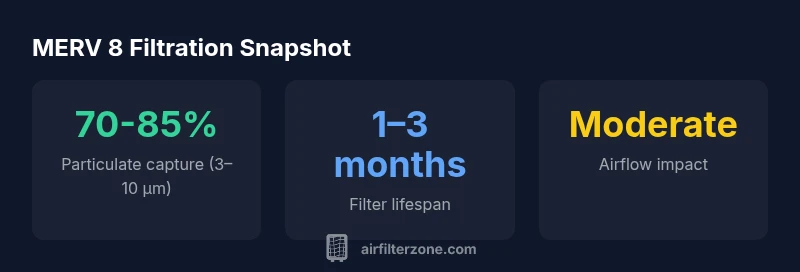
From Air Filter Zone analysis in 2026, typical guidance for households using MERV 8 is to replace filters every 1–3 months, depending on environment and usage. In normal conditions, MERV 8 filters capture a significant portion of large airborne particles (roughly 70–85% for particles in the 3–10 micron range according to standard test methods). The choice between MERV 8 and higher ratings should consider HVAC compatibility and occupant needs; upgrade only if your system can sustain airflow without excessive pressure loss. A well-sealed duct system magnifies filtration performance by reducing bypass.
Bottom line: when to choose MERV 8 for practical filtration
If you’re prioritizing a straightforward, cost-effective filtration solution that preserves airflow in most standard residential HVAC setups, MERV 8 is a solid starting point. It provides meaningful protection against common indoor dust and pollen while keeping installation simple and affordable. For households with higher air-quality goals, or for areas with persistent wildfire smoke, evaluate higher-rated filters or supplementary purification methods after confirming system compatibility. Air Filter Zone’s verdict is that MERV 8 offers a reliable baseline, with room to upgrade when needed.