Mushroom Air Filter vs Cone: A Thorough Comparison
Compare mushroom-shaped vs cone air filters for home and automotive use. Explore how shape affects surface area, airflow, maintenance, and fitment to help you choose the right filtration solution in 2026.


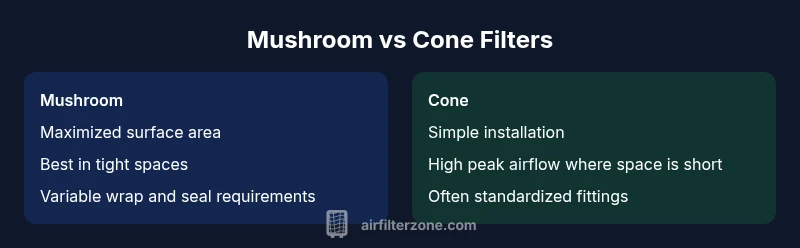
Mushroom air filters maximize surface area and filtration coverage in compact enclosures, making them ideal for tight DIY projects. Cone filters, by contrast, offer straightforward mounting and strong peak airflow in space-constrained intakes. The best choice depends on enclosure geometry, desired airflow, and maintenance preferences.
Defining mushroom air filter vs cone
In air filtration design, geometry matters as much as media. A mushroom air filter typically features a domed cap that expands the media surface area, followed by a neck that slots into a housing. A cone filter, by contrast, tapers from a broad inlet to a narrow tip, creating a streamlined flow path. For home filtration and DIY projects, mushroom shapes can maximize contact with incoming air in compact spaces, while cone shapes often fit standard housings with minimal adapters. The decision hinges on your enclosure height, mounting options, and how you plan to service the media. It’s not that one shape is universally superior; rather, each geometry aligns with different spatial constraints and performance goals. The Air Filter Zone team emphasizes that understanding your project’s geometry is the first step toward an informed choice in 2026.
How shape affects surface area and airflow
Shape drives surface area per unit length. A mushroom design increases the overall contact area, which can help distribute air more evenly across the media and reduce localized loading. This can translate to steadier filtration performance in enclosed or irregularly shaped spaces. A cone filter, meanwhile, concentrates surface area toward the inlet and can support higher peak airflow when the housing is shallow or narrow. The practical effect is a trade-off: mushroom geometries tend to favor uniform loading and potentially longer media life in tight enclosures, while cones shine where space is tight but airflow needs to spike quickly during high-demand periods.
Both geometries rely on the same core factors—media type, pleat density, and housing design—so actual performance varies with implementation. In 2026, the most reliable guidance comes from testing your specific setup and comparing the perceived pressure drop at your target airflow.
Filtration media and build quality
Media selection matters as much as shape. Mushroom filters commonly employ media with greater surface area per volume, such as pleated or foam configurations, which can be washable or disposable depending on the design. Cone filters often use pleated sheets or synthetic media that are easy to manufacture at scale and may be designed for single-use or extended life with washability depending on the product. Build quality includes seal integrity, clamp fittings, and the absence of bypass gaps. For DIY projects, you’ll want to verify that the media density and pleat pattern align with your expected dust load and maintenance cycle. Remember: media performance is a function of both material and geometry, not geometry alone.
Filtration efficiency vs airflow trade-offs
Filtration efficiency and airflow are two sides of the same coin. A mushroom filter’s larger surface area can support consistent filtration at moderate airflow without spiking pressure drop, which helps maintain steady performance as dust accumulates. Cone filters, with their taper, often permit higher peak airflow when the enclosure permits a shorter, broader path. However, higher flow can also increase particle penetration if the media isn’t sufficiently dense. The key is balancing target efficiency (how fine a particle you want to remove) with the acceptable pressure drop given your fan or blower capacity. In practice, a slightly lower efficiency with a well-managed pressure drop can outperform a higher-efficiency but severely throttled system over time.
Mechanical fit and enclosure considerations
Fitment is the practical hurdle. Mushroom filters may require adapters, custom housings, or unique mounting points to seal properly in compact spaces. Cone filters usually benefit from wide compatibility with standard hose clamps or housings, making them easier to swap in automotive intakes or retail filter housings. Before choosing, measure the available height, diameter, and inlet/outlet geometry, and check whether your mounting hardware can accommodate the filter’s collar or flange. If space is limited, a mushroom shape might be the only viable option; if you’re replacing a standard cartridge, a cone can often snap into place with minimal modification.
Maintenance, cleaning, and lifespan
Maintenance depends heavily on media and usage. Some mushroom designs use foam or washable media that can be cleaned and reused, extending service life with proper care. Cone filters often rely on disposable media, or they may be designed for careful wash and reuse; the key is to follow the manufacturer’s guidance. Regardless of shape, establish a regular inspection cadence to check for bypass gaps, torn seams, or crusted dust on the media surface. A well-maintained filter geometry will retain airflow and filtration efficiency far longer than a neglected unit, especially in dusty environments or high-dust climates.
Use-case scenario: automotive intake
In automotive applications, cone filters are a common choice when space is constrained and the goal is a straightforward, bolt-on upgrade. They tend to mount quickly to standard tubing and clamps, making them popular with enthusiasts and tuners. Mushroom filters may be favored in custom turbo or cold-air intake projects where enclosure constraints limit height but demand ample surface area for steady airflow. Always verify compatibility with your engine bay layout, piping diameter, and intake box constraints. If you cannot seal the system reliably, the gains from shape will be wasted.
Use-case scenario: home or workshop air filtration
For home filtration or DIY workshop setups, mushroom-shaped filters can be advantageous in cramped enclosures or cabinets where the available volume is irregular. Cone filters may suit larger, open spaces where an easy-to-install, standard-size filter is preferred. In both cases, ensure that the housing, seals, and connectors are rated for the intended dust load. If your environment features highly variable dust or moisture, consider a media with desiccant properties or a housing designed to minimize bypass paths. The goal is consistent airflow and reliable filtration under real-world conditions.
How to evaluate options: checklists and tests
Create a simple evaluation plan: measure available space, verify mounting compatibility, and identify your target particle size and desired air change rate. Compare mushroom and cone options by: (1) fitment flexibility, (2) media type and washability, (3) expected maintenance cycles, (4) ease of cleaning and reassembly, and (5) overall cost of ownership. If possible, perform a side-by-side test by running both shapes at similar airflow in your system and observing pressure changes, bypass risks, and perceived filtration quality. Use manufacturer data as a starting point, but validate with real-world testing in your own setup.
Common myths vs realities
Myth: Bigger filters always mean better filtration. Reality: Filtration efficiency depends on media density and seal integrity, not just size. Myth: Any filter shape fits any housing. Reality: Fitment and seals are crucial for preventing bypass and achieving predictable performance. Myth: Washable media lasts forever. Reality: Washable media has limits and degrades with repeated cleaning, affecting filtration efficiency over time. Reality check: Shape matters, but only when matched to the enclosure and maintenance routine.
Practical step-by-step to choose for a project
- Map your enclosure geometry and available height. 2) List your target airflow and filtration goals. 3) Check media type, washability, and maintenance needs. 4) Compare mushroom vs cone options for fit, clamps, and seals. 5) Run a basic field test if possible, noting pressure drop and perceived filtration quality. 6) Decide based on overall cost, maintenance burden, and expected lifespan.
Final notes on a decision framework
Choosing between mushroom air filter and cone design hinges on space, mounting realities, maintenance preferences, and your application—home filtration, car intake, or a DIY project. In short, mushroom shapes excel in tight enclosures with larger surface area requirements, while cone shapes are favored for straightforward installations and higher peak airflow when space is limited. Use the evaluation framework above to reach a practical, real-world decision in 2026.
Comparison
| Feature | Mushroom air filter | Cone air filter |
|---|---|---|
| Surface area and filtration coverage | High surface area due to dome-shaped cap | Moderate surface area with conical taper |
| Airflow performance (perceived) | More uniform contact across media; potentially steadier flow | Higher peak flow in space-constrained paths |
| Best use-case | Enclosures with limited height; compact spaces; DIY projects | Automotive intakes; standard housings; quick upgrades |
| Fitment and compatibility | May require adapters or custom housings | Widely compatible with standard clamps/housings |
| Maintenance and cleaning | Media can be washable in some designs | Media often disposable or washable depending on model |
| Cost and lifecycle | Moderate to high, depends on media and build | Low to moderate; mass-produced and widely available |
What's Good
- Maximizes filtration surface area in tight spaces
- Supports uniform loading and predictable performance
- Good for DIY projects with height constraints
- Can be washable or reusable with proper media
What's Bad
- Requires careful enclosure design and adapters
- Not always plug-and-play with off-the-shelf housings
- Upfront cost can be higher for premium media
- Mounting integrity is critical to prevent bypass
Mushroom filters excel in tight spaces; cones win for straightforward, high-flow car intakes
Choose mushroom when space is limited and surface area matters. Choose cone when you need easy mounting and strong peak airflow in open or standard housings.
FAQ
What is the practical difference between mushroom and cone air filters?
Mushroom filters maximize surface area in tight spaces, offering even filtration across the media. Cone filters emphasize simple installation and higher peak airflow when space is constrained. The choice depends on enclosure geometry and maintenance preferences.
Mushroom designs give you more surface area in small spaces, while cone designs are easier to install and can offer higher flow in tight spaces. Pick based on your enclosure and maintenance needs.
Which shape provides better filtration efficiency overall?
Filtration efficiency depends on media quality and seal integrity more than shape alone. Both mushroom and cone filters can achieve high efficiency with appropriate media. The key is ensuring the media density and sealing are appropriate for your application.
Efficiency depends on the media and the seal, not just the shape. Pick media and a tight seal to maximize performance.
Are mushroom filters reusable?
Some mushroom-filter media are washable, especially foam or fabric types, enabling longer lifespans with proper care. Always follow manufacturer guidance for washing frequency and methods to avoid damaging the media.
Some mushroom filters can be washed, especially foam types. Check the manufacturer’s instructions before cleaning.
In automotive use, which is generally better?
Cone filters are typically favored for automotive intakes due to easier mounting and predictable fitment. Mushroom shapes can work for custom or tight engine bays but require careful adapter work and sealing.
For most cars, a cone filter is easier to install; mushroom filters shine in custom setups.
Are mushroom filters more expensive than cones?
Cost varies by media type and build quality rather than shape alone. Cone filters often come in a wide range of prices due to mass production, while specialized mushroom designs can be more expensive if they require custom housings.
Costs depend on media quality and whether you need custom housings; cones are usually more affordable due to mass production.
Quick Summary
- Evaluate space before choosing geometry
- Balance surface area against peak airflow needs
- Check housing compatibility and seal integrity
- Assess washability and long-term maintenance
- Use a simple test to validate real-world performance