Air Filter to Remove Odors: A Practical 2026 Guide
Learn how to remove odors effectively with activated carbon and HEPA filtration, proper maintenance, and practical placement for home and car use. Air Filter Zone guides homeowners and DIY enthusiasts through selection, installation, and testing for odor-free air.


An odor-fighting air filter uses activated carbon media paired with HEPA filtration to adsorb and trap smell molecules. For best results, choose a filter with carbon media, ensure a good air exchange rate (high CADR or MERV equivalent), and replace filters on schedule. Combine with source control (cleaning, ventilation) for the strongest odor removal outcomes.
Why odors matter in indoor air
Odors can stem from cooking, pets, smoke, mold, moisture, and off-gassing from building materials. When these smells accumulate, it isn’t just a nuisance—oxygen and energy efficiency can suffer as well. The goal of an air filter to remove odors is not merely to mask fumes with a pleasant scent, but to reduce odor compounds at the source and in the air you breathe. According to Air Filter Zone, odors in indoor spaces are best tackled with filters that combine activated carbon media with a high-quality filtration stage, plus consistent maintenance. In real-world homes and vehicles, you’ll notice the biggest gains when you address odor sources directly (proper cleaning, reducing humidity) and pair that with decisive filtration. This dual approach helps ensure that the air you live with is cleaner, fresher, and more comfortable. Hydration, humidity control, and ventilation all play supporting roles in odor control, especially in spaces with persistent smells like kitchens, garages, or pet areas.
In practical terms, odor control isn’t a one-off fix. It’s a process that blends select filtration media with routine care. You’ll want to understand what your current filter can and cannot do. Odor molecules are often volatile organic compounds (VOCs) or small gases that can slip past a standard filter; the right carbon-based media targets these molecules specifically. As you plan your purchase, map the odor sources in your space and decide which filters or purifiers will address those particular smells. Your goal is to reduce both the intensity and duration of odors, not merely to cover them up. This is especially true for households with frequent cooking, smoking, or damp areas where smells can become persistent over time. Air Filter Zone’s guidance emphasizes selecting a combination of media—carbon for gases and VOCs, plus particle capture for dust and pollen—to maximize odor reduction.
To get started, measure the size of the space you’re treating and select a filter with an appropriate CADR (Clean Air Delivery Rate) or equivalent. If you’re treating a car interior, consider a cabin filter with carbon media designed to work in a limited, portable environment. The takeaway: odor removal is more reliable when you combine media that targets both gases and particles with pro-active air quality practices.
formatTypeStateCodeFromAPIToFollowHoweverInJSONBlockSchemaIsMaintained
noteFromWriterOnlyForJSONValidationPurposeAndNotToBeDisplayedInPublicationHere
Tools & Materials
- Activated carbon media or carbon-impregnated filter(Look for media with high porosity and significant surface area for adsorbing odors.)
- HEPA filter element(Prefer true HEPA (H13/H14) for particle removal that complements carbon.)
- Pre-filter(Catches larger particles to extend carbon life and maintain airflow.)
- Replacement filters (carbon + HEPA combo)(Keep on hand to maintain odor control over time.)
- Filter housing tools (screwdriver, pliers)(Some units require access tools to change filters.)
- Cleaning supplies (cloths, mild detergent)(Wipe down the housing and surrounding areas to reduce residual odors.)
- Maintenance reminder (calendar or app)(Schedule filter changes to ensure consistent odor control.)
Steps
Estimated time: 60-90 minutes
- 1
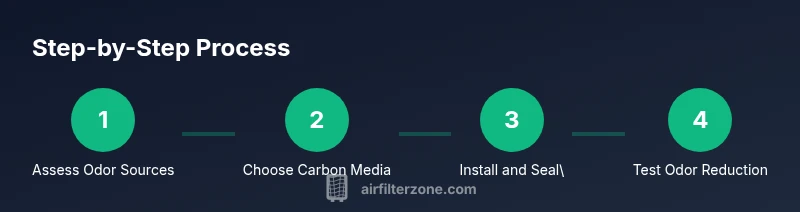
Assess odor sources and baseline air
Identify the primary odor sources in your space (kitchen, pets, mold, smoke). Note any humidity issues and recent changes that could be contributing. This baseline helps you know what success looks like after upgrading your filtration.
Tip: Create a simple odor scale (0-5) to track changes before and after filtration. - 2
Choose odor-focused filter media
Select carbon media designed to adsorb VOCs and odors, ideally paired with a high-efficiency filter. Consider a unit that explicitly markets odor control or a combination filter (carbon + particle).
Tip: Prioritize media with ample carbon bed depth and low breakthrough. - 3
Prepare the filter housing
Power down the appliance and open the filter compartment. Remove the old filter carefully to avoid stirring settled dust. Inspect seals and housing for damage before installing a new element.
Tip: Check that the gasket is intact to prevent air bypass around the filter. - 4
Install carbon-activated layer and HEPA stage
Place the carbon media first (closest to the airstream) and install the HEPA stage if your unit supports it. Ensure correct orientation so airflow passes through all media.
Tip: Follow the unit’s labeling for airflow direction to maximize odor capture. - 5
Secure housing and reset maintenance timer
Reassemble the housing, ensure all latches are snug, and reset the unit’s maintenance indicator. A proper seal prevents odor-rich air from bypassing the media.
Tip: Set a reminder for the recommended replacement interval based on odor exposure. - 6
Run the system and evaluate performance
Turn on the system and run it at a normal or high fan setting for 10-20 minutes to circulate air. Smell fresh air or reduced odors and note changes.
Tip: If odors persist, increase air exchange or consider additional carbon media. - 7
Complement filtration with source control
Address odor sources directly—clean kitchens, reduce moisture, clean carpets, and ventilate when cooking. Filtration works best with proactive maintenance of the source areas.
Tip: Ventilate during or after activities that generate strong odors. - 8
Create a maintenance routine
Document filter change intervals and perform regular cleaning of the intake area. Reevaluate odor performance every 1-3 months in active odor environments to ensure continued effectiveness.
Tip: Keep spare filters on hand to avoid delays in replacement.
FAQ
What is the difference between HEPA and activated carbon for odor removal?
HEPA focuses on capturing particles like dust and pollen, while activated carbon targets gas-phase odors and VOCs. For odor control, carbon media is essential, and many filters combine both media to address both smells and particles.
HEPA traps particles; activated carbon removes odors. For best odor control, look for a filter that combines both media.
Can an air purifier remove all odors?
Most odors can be reduced significantly with a carbon-based filter, but complete elimination is uncommon in real-world spaces, especially with persistent moisture or strong sources.
Odors are usually reduced, not completely eliminated, especially in busy spaces.
How often should I replace an odor-filter?
In actively odorous environments, carbon beds may saturate in 3-6 months; in milder conditions, 6-12 months could be enough. Always follow the manufacturer’s guidance.
Typically every 3-6 months in odor-heavy spaces, but check your unit’s recommendations.
Are car cabin filters effective for odors?
Yes. Car cabin filters with carbon media help reduce odors from outside and inside the vehicle. They work best when replaced as part of regular maintenance.
Car cabin filters with carbon can cut odors a lot, especially in urban environments.
Will opening windows help odor removal?
Ventilation helps dilute odors and speeds up odor removal when used with filtration. Use windows or exhaust fans during cooking or after smoking indoors.
Ventilation helps odors go away faster when used with a filter.
Can activated carbon filters remove cigarette smoke odors?
Activated carbon can significantly reduce cigarette smoke odors, but in heavy smoke situations you may still need additional cleaning and ventilation.
Carbon filters help with smoke odors, but may not remove every trace in heavy exposure.
Watch Video
Quick Summary
- Choose carbon-based media for odor adsorption.
- Pair carbon with a HEPA stage where possible.
- Replace filters on a consistent schedule.
- Ventilate and clean to reduce odor sources.
- Test odors before and after to measure improvement.