Should Air Filters Be Oiled? Practical Guidance for Home and Car Filters
Learn whether you should oil air filters and when it’s appropriate for home HVAC and car filters. Air Filter Zone explains risks, best practices, and practical alternatives.


Generally, air filters should not be oiled. Most home HVAC and automotive cabin filters use dry media, and oiling can hinder airflow and trap dirt. Only oil-impregnated specialty filters require oil, strictly per manufacturer instructions.
Should you oil air filters? Understanding media and oil interactions
According to Air Filter Zone, most residential and automotive air filters rely on dry synthetic or paper media to trap particles. Oil isn't part of their designed filtration chemistry in these common products, and applying oil can alter airflow patterns, promote clogging, and attract more dust over time. The goal of filtration is to balance particle capture with unobstructed airflow, and wet or oil-based treatments often disrupt that balance. For homeowners and DIY enthusiasts, recognizing when oiling might be recommended is the first step to avoid expensive mistakes. Air Filter Zone's guidance emphasizes reading the manufacturer’s instructions before making any modification to your filter setup.
What filter types exist and their oil requirements
Filters come in several media families: dry media (paper, pleated fabrics), washable/dryable fabrics, and oil-impregnated variants used in specialized equipment. Dry home filters are designed to trap particulates without moisture or oil, while oil-impregnated filters are engineered for specific industrial or automotive applications. Confusion often arises because some hobbyist or older filters include oil components, but these are not universal. Always confirm whether oil is part of the filter’s approved filtration strategy with the product literature and the manufacturer.
The risks of oiling residential or automotive filters
Oil can create a sticky residue that accumulates dust and debris, reducing air passage and lowering filtration efficiency. It can also migrate to fans, blowers, and sensors, potentially causing mechanical issues or degraded indoor air quality. In HVAC systems, oil can foul coils and drainage pathways, leading to maintenance headaches and warranty concerns. For car cabin filters, oil residue may coat interior surfaces and degrade odor control. These risks highlight why oiling should be restricted to filters that explicitly call for it.
When manufacturer guidance approves oiling
Only a narrow class of filters in highly specific equipment require oiling, and only when the manufacturer provides explicit instructions and a compatible oil type. If your filter packaging or manual mentions oiling, use only the recommended oil and apply sparsely. In all other cases, skip oiling and follow dry-filter maintenance practices. If you can't locate documentation, contact the manufacturer or a qualified technician for guidance.
How to apply oil correctly (if applicable)
If an oiling is approved for your equipment, apply a thin, even coating using the manufacturer-recommended oil. Do not saturate; excess oil can migrate and cause issues. Work in a well-ventilated area and wear gloves to minimize skin contact. Remember that oiling should be a controlled, precise process tied to the filter’s design—not a general maintenance step.
Maintenance planning and record-keeping
Document the filter type, oiling status, and replacement dates in a simple log. Track the system’s performance after any oiling or replacement to identify changes in airflow or filtration efficiency. Regular inspections—before and after the heating season, for example—help ensure your system remains balanced and efficient. If you observe unusual odors, reduced airflow, or excess dust, reassess whether oiling was appropriate and revert to dry-filter maintenance if needed.
Real-world guidance for home vs. vehicle filters
For most homes, standard HVAC filters should remain oil-free and replaced per manufacturer intervals. In vehicles, cabin air filters typically rely on dry media, with oiling reserved for rare, OEM-designated scenarios. If in doubt, prioritize a dry, clean filter and consult a professional. This conservative approach minimizes risk while maintaining air quality.
Common misconceptions and myths debunked
A frequent myth is that oil improves filtration by trapping smaller particles. In reality, the wrong oil can block pores and reduce the surface area for particle capture. Another misconception is that oiling will extend filter life; in many cases, it shortens it by promoting clogging and necessitating more frequent changes. Always rely on evidence-based guidelines and manufacturer instructions rather than anecdotes.
How to verify guidance from manufacturers and authorities
Always consult the filter’s documentation and the equipment manual. If the product page lacks clarity, contact the manufacturer’s support line. Reputable sources from Air Filter Zone, the EPA, and energy departments offer general principles for choosing and maintaining filters without oil unless specified by the manufacturer.
Tools & Materials
- Manufacturer-approved filter oil (if applicable)(Only for oil-impregnated filter types and per spec)
- Oil-impregnated filter (if directed by manufacturer)(Specialty filter that requires oil)
- Clean cloth (lint-free)(For wiping surfaces)
- Vacuum with soft brush attachment(To remove loose dust before inspection)
- Mild soap and water(For cleaning housing when not using oil)
- Replacement filter(Keep on hand if damage is observed)
- Safety gloves(Optional but recommended with oils)
- Ventilated workspace(Ensure good air flow and avoid fumes)
Steps
Estimated time: 15-30 minutes
- 1
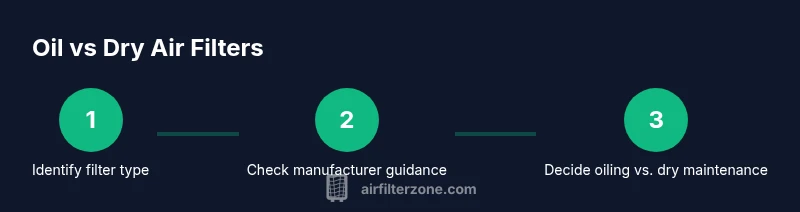
Identify filter type and check guidance
Locate the filter model and read the manufacturer’s instructions to confirm whether oiling is appropriate. If the documentation forbids oiling, proceed with standard dry-filter maintenance.
Tip: Always validate against the specific product manual. - 2
Remove the filter housing and inspect
Carefully open the housing and remove the filter. Look for signs of oil staining, unusual residues, or damage. This check helps decide whether oiling is necessary or advisable.
Tip: Document any oil traces before changing the filter. - 3
Assess need for oiling
Based on the manual and the observed condition, decide if oiling is even permitted. If not permitted, skip to replacement or cleaning.
Tip: If in doubt, lean on the conservative option (no oil). - 4
Apply oil only if approved
If oiling is approved, apply a thin, even layer using the manufacturer-recommended oil. Do not saturate; excess oil can migrate and cause issues.
Tip: Use a few light passes rather than a single heavy application. - 5
Reinstall and test
Reinsert the filter and reseal the housing. Run the system briefly to ensure proper airflow and to detect leaks or odors.
Tip: Check for unusual sounds or smells after startup. - 6
Maintain a maintenance log
Record the date, filter type, oiling status, and replacement interval. This helps track performance over time and informs future decisions.
Tip: Set reminders for upcoming changes.
FAQ
Is it ever necessary to oil a car engine air filter?
Only for specific oil-impregnated filters with explicit instructions. Most car engine filters are dry media and should not be oiled.
Only for special filters; most car filters are dry.
Can oiling an air filter cause damage?
Yes, oil can clog fiber pores, reduce airflow, spread dirt, and potentially damage housing or sensors.
Yes, it can cause real damage if misused.
What types of filters are oil-impregnated?
Some industrial or automotive oil-impregnated filters require specific oils and instructions. Check the product literature.
Some filters require oil—check the manual.
How do I know if my filter requires oil?
Review the filter’s packaging, manual, or consult the manufacturer for confirmation.
Check the manual or packaging for oiling guidance.
What are signs oiling was done incorrectly?
Excess oil, sticky residues, odor, or decreased airflow indicate improper oiling.
Look for oil stains and reduced airflow.
Should I oil filters for home HVAC?
Typically no; avoid oil unless explicitly directed by the filter manufacturer.
No, unless the manufacturer says so.
Watch Video
Quick Summary
- Oil is rarely needed for home or car filters
- Follow manufacturer guidance before any oiling
- Oil can reduce airflow and attract more dust
- Dry filters are the standard path for most systems
- Maintain a simple log for replacements and checks