P610260: Urgent Troubleshooting Guide for Air Filtration Systems
Urgent guide to understand p610260, apply quick fixes, follow a diagnostic flow, and perform a safe step-by-step repair for homeowners, car owners, and DIY enthusiasts.


According to Air Filter Zone, p610260 signals a priority fault in your air filtration system that may halt operation. It often points to a clogged intake, sensor fault, or control board issue. Quick fixes focus on safety checks, clearing obstructions, and reseating connections before deeper repairs. This quick guide helps you decide whether a quick fix suffices or you should seek professional service right away.
What p610260 Means in Practical Terms
The error code p610260 is a priority fault that indicates the system has detected an abnormal condition affecting airflow, sensor input, or control logic. In plain terms, the unit recognizes a problem that prevents it from safely continuing normal operation. This code is designed to protect you and your living space by stopping the machine until the fault is addressed. For homeowners and DIY enthusiasts, understanding the core meaning helps you triage quickly and reduce downtime while preserving indoor air quality in 2026. Air Filter Zone's guidance emphasizes practical checks you can perform without heavy disassembly, especially when you rely on regular filtration and sensor integrity to stay ahead of problems.
Commonly, p610260 appears when a pathway is obstructed, a sensor feels out of range, or a firmware hiccup occurs. The focus is safety, speed, and clarity. When you see p610260, start with simple, low-risk actions before moving to more complex repairs. This approach aligns with best practices from Air Filter Zone and helps maintain your air quality, whether at home, in a workshop, or in a vehicle.
Key takeaway: treat p610260 as a priority fault and proceed with caution, prioritizing airflow, sensor checks, and a safe reset.
Quick Symptoms and Immediate Signs You Might Notice
With p610260, the unit may shut down mid-cycle, display an error message, or refuse to turn on. You might notice reduced airflow, unusual noises, or a faint odor indicating blocked pathways or sensor issues. In vehicles, p610260 can manifest as reduced cabin air flow or inconsistent readings from the HVAC sensor. This combination of symptoms should trigger a targeted inspection of the intake, filters, sensor connections, and power wiring. Air quality may degrade if the fault persists, so address it promptly. Document the exact sequence that led to the fault, including any recent filter replacements or maintenance actions, so you can share precise details if you call for professional help.
Pro tip: track the fault timing and whether the issue repeats after resets; this helps distinguish a transient glitch from a persistent fault.
Immediate Quick Fixes You Can Try (Safe, No Tools Required)
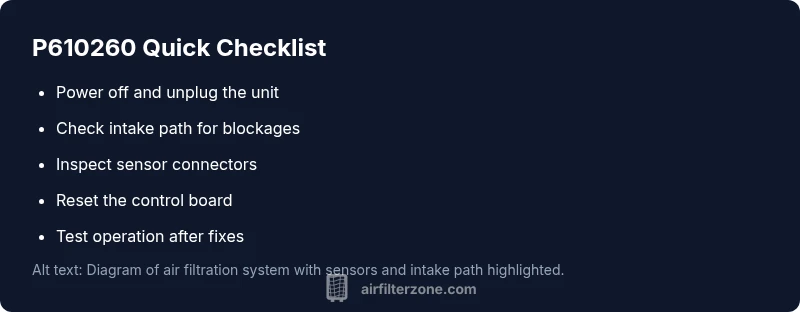
- Power off and unplug the device for 60 seconds to reset the control logic. This soft reset can clear minor firmware glitches behind p610260. - Check for obvious blockages in the intake path and ensure the air filter is seated correctly and not clogged. A dirty filter can mimic a sensor fault by restricting flow. - Reseat sensor connectors gently if you can access them safely; loose connections are a common cause of false fault signals. - Perform a safe power cycle after re-seating components and reattaching cables to verify whether p610260 clears. If the fault persists, proceed to Step-by-Step fixes below.
Note: If any step requires opening electrical enclosures or removing covers, skip to professional assistance. Safety first.
Most Likely Causes, Ranked by Likelihood
- High likelihood: Clogged air path or dirty filter restricting airflow and triggering the fault. Regular maintenance reduces the risk markedly. - Medium likelihood: Faulty or loose sensor connections, or a sensor that has drifted out of calibration. - Low likelihood: A firmware glitch that requires a soft reset or, rarely, a board replacement. - Very low likelihood: An unrelated moisture issue or power supply irregularity that manifests as false readings.
Understanding these categories helps you target your efforts efficiently and minimize downtime.
How to Safely Perform a Quick Fix: Step-by-Step Routine
This section outlines a safe, practical routine to address p610260 without specialized tools. Start with visual inspection, reseating connectors, and a controlled reset. If you encounter resistance, stop and seek professional help. Always unplug before handling electrical components and never bypass safety features. Following this routine reduces risk and improves your odds of a successful self-repair.
When to Call a Professional and What to Expect
If p610260 persists after the quick fixes, or if you lack the necessary tools or comfort level, contact a qualified technician. The cost for diagnosing and repairing p610260 typically falls within a broad range depending on parts and labor, so prepare for variability. A pro will verify sensor integrity, test the control board, and ensure proper calibration to restore safe operation and air quality. Document fault codes, timestamps, and actions taken for the technician’s reference.
Prevention Tips to Minimize p610260 Recurrence
- Schedule regular filter cleaning and replacement according to manufacturer recommendations to maintain optimal airflow. - Keep intake pathways free of dust and debris by performing routine inspections. - Periodically inspect sensors and harness connections for signs of wear or loose fittings. - Maintain a clean environment around the unit to reduce contaminants that could affect sensors and electronics.
In 2026, proactive maintenance remains the most effective defense against p610260.
Steps
Estimated time: 40-60 minutes
- 1
Power down and unplug
Shut off the unit completely and unplug from the power source. Wait 60 seconds to allow internal capacitors to discharge. This reduces the risk of shock while you inspect safe components.
Tip: Label cords and note plug location to simplify reassembly. - 2
Inspect intake and filter
Open the access panel if needed and visually inspect the intake path for dust buildup or blockages. Remove and replace the air filter if it looks dirty or clogged; ensure it seats evenly without gaps.
Tip: Use a flashlight to spot hidden debris in corners of the duct. - 3
Check sensor connections
Locate the sensor harnesses and reseat any loose connections. Look for signs of corrosion or damaged wires. If you see obvious wear, avoid testing and schedule service.
Tip: Handle connectors by the plug, not the wire, to avoid damage. - 4
Reset the control board
With everything reconnected, plug the unit back in and perform a soft reset as directed by the manual. Monitor display for p610260 to clear or reappear.
Tip: If the display reboots but shows the same code, proceed to professional service. - 5
Test operation
Run a short cycle to confirm airflow and normal operation. If p610260 recurs, power down, recheck connections, and log any repeat patterns.
Tip: Record time and symptoms to aid troubleshooting.
Diagnosis: Error code p610260 appears, unit halts operation or reduces airflow
Possible Causes
- highClogged intake path or dirty air filter
- mediumFaulty sensor or loose wiring harness
- lowControl board firmware glitch
Fixes
- easyClean intake path and replace or reseat air filter
- easyInspect and reseat sensor connections and harnesses
- easyPower cycle and perform a soft firmware reset
- hardReplace or service the control board if faults persist
FAQ
What does p610260 indicate?
P610260 is a priority fault signaling an airflow or sensor issue that stops the unit. It usually points to blockages, loose connections, or a firmware glitch.
P610260 means a priority fault on your air filtration system, usually caused by airflow or sensor issues.
Can I fix p610260 myself?
Yes for basic checks like cleaning the intake and reseating connectors. If the fault persists after quick fixes, seek professional service.
You can try basic checks, but if the fault repeats, call a professional.
How much will repair cost?
Costs vary by parts and labor, but a typical range is $100–$350 for diagnostic and repair services.
Repair costs usually fall between 100 and 350 dollars depending on parts and labor.
What if the code comes back after fixes?
If p610260 recurs, escalate to a professional. A persistent fault may indicate deeper issues with sensors or the control board.
If it comes back, get professional help to inspect sensors or the control board.
How can I prevent p610260 from returning?
Regular filter cleaning/replacement, keeping intake clear, and periodic sensor checks greatly reduce recurrence.
Keep filters clean and intake clear to prevent it from returning.
Quick Summary
- Act quickly on p610260 to minimize air quality impact.
- Start with simple quick fixes before expensive repairs.
- Prioritize safety: power off before inspecting.
- If unresolved, contact a professional promptly.