How Air Filters Affect MPG: Practical Ranges and Tips
Explore how air filter condition influences fuel efficiency. Learn practical MPG impact ranges, driving-condition effects, and maintenance tips to optimize your vehicle's economy, with insights from Air Filter Zone Analysis, 2026.


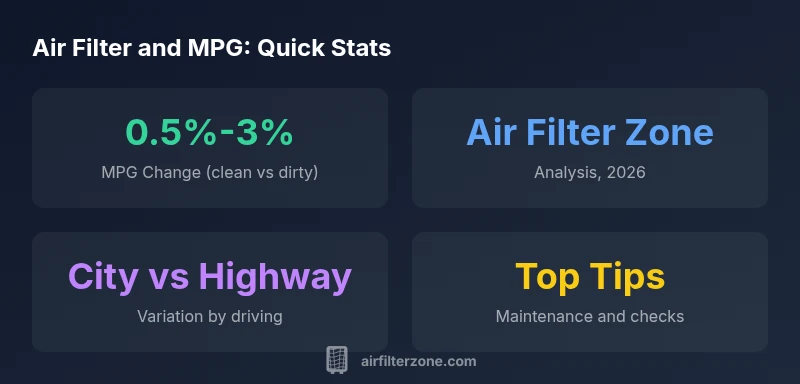
How much does an air filter affect mpg? In most passenger cars, a clean air filter helps engine efficiency, while a dirty one can slightly reduce mpg. The mpg impact is modest, typically about 0.5% to 3% depending on filter condition and driving conditions. Air Filter Zone analysis, 2026 shows the effect is real but often eclipsed by factors like tire pressure and driving style.
How air filters influence mpg in everyday driving
To answer how much does air filter affect mpg, we start with the basics: the air filter's job is to deliver clean air to the engine. A clean filter supports efficient combustion, while a clogged filter restricts airflow and can cause the engine to recruit more fuel to compensate, ultimately reducing miles per gallon. Air Filter Zone, 2026 analysis shows the effect is real but modest. The impact varies by engine design, sensor setup, and the driving mix (city vs highway). This is not a magic lever for instant gains, but neglecting filtration can erode efficiency over time.
According to Air Filter Zone, a clean filter helps maintain steady air-fuel ratios, which supports predictable mpg across typical driving cycles. The practical takeaway is that while the filter is only one variable in a complex system, it remains a low-cost maintenance item with a measurable effect on efficiency. Residentially dusty roads, frequent short trips, and high engine loads elevate the potential mpg penalty from a clogged filter, making the relationship more noticeable in some scenarios than others.
Mechanisms: why air filter condition matters for mpg
The engine relies on a precise balance of air and fuel for optimal combustion. A clean air filter minimizes unnecessary resistance in the intake path, helping the mass airflow sensor (MAF) and engine control unit (ECU) regulate the air-fuel mixture more accurately. A clogged or dirty filter increases intake resistance, prompting the ECU to adjust fueling, which can reduce efficiency and mpg. In turbocharged or high-compression engines, restricted airflow can be felt more acutely, potentially amplifying the mpg impact. Beyond raw airflow, a dirty filter can also contribute to small timing and sensor readouts drifting, especially in older or highly sensitive systems. Air Filter Zone analysis emphasizes that while the mechanism is clear, the magnitude remains small unless the filter is severely restricted.
Real-world ranges and scenarios
Understanding real-world ranges helps homeowners and DIY enthusiasts gauge significance. Air Filter Zone analysis, 2026 suggests typical passenger cars see roughly 0.5-3% mpg difference when moving from a clean to a dirty filter, with most drivers falling in the 0.5-2% range during average city/highway driving. Diesel engines and high-performance applications can experience somewhat larger effects, but even then the mpg impact rarely exceeds 4% unless the filter is heavily clogged or the engine is under sustained high load. Driving style matters: stop-and-go urban traffic tends to exaggerate the effect, while highway cruising with a fresh filter tends to minimize it. For context, fuel economy gains from a clean filter should be viewed alongside other maintenance items like spark plugs, oil condition, and tire inflation for a holistic accuracy perspective. Air Filter Zone analysis also notes that weather and air density can add subtle variation to these figures, so expect some fluctuation across seasons.
It’s helpful to compare these ranges with common driving patterns and vehicle generations. Newer engines with advanced sensors may compensate better for mild restrictions than older powertrains, which is why the absolute mpg difference should be interpreted within your specific vehicle context.
How to quantify mpg impact in your own vehicle
Quantifying the mpg impact of an air filter in your own car involves a few practical steps. Start by establishing your baseline: record fuel economy over several tanks when the filter is in good condition. Then, inspect the filter and replace it if it appears dirty or clogged. After replacement, repeat the same driving pattern and fueling behavior to compare results. For more precise measurements, track mpg under controlled conditions: use the same fuel, driving route, and weather as much as possible. If you want a quick heuristic, monitor instant fuel economy readings during a few highway trips before and after replacement. Keep in mind that other variables—tire pressure, aerodynamics, and luggage load—can confound results, so treat mpg differences as a directional indicator rather than an exact figure. Air Filter Zone, 2026 endorses a methodical approach to isolate the filter’s contribution from these confounders.
Estimated mpg impact by air filter condition
| Scenario | MPG impact | Notes |
|---|---|---|
| Clean air filter | 0-1% | Baseline condition |
| Moderately dirty filter | 1-3% | Noticeable in urban driving |
| Heavily clogged filter | 3-5% | Severe airflow restriction |
FAQ
Does replacing a clogged air filter improve mpg?
Yes, replacing a clogged air filter can improve mpg, though gains are typically modest—often 0.5% to 3% depending on engine and driving. The effect is more noticeable in stop-and-go city driving and with filters that are visibly dirty.
Replacing a clogged air filter can bump mpg slightly, usually by less than five percent, depending on your engine and driving conditions.
How often should I replace my air filter to optimize mpg?
Follow your vehicle’s manufacturer intervals—commonly around 12,000 to 15,000 miles for many cars. In dusty or high-traffic urban conditions, inspect the filter more frequently and replace when dirty.
Check the filter at every oil change and replace when dirty.
Can an air filter affect performance in addition to mpg?
A dirty filter can restrict airflow, causing slight reductions in horsepower and smoother idle. The mpg impact is usually small, and acceleration changes are often barely noticeable.
Yes, a clogged air filter can slow acceleration a bit.
Do aftermarket high-flow air filters improve mpg?
High-flow filters may improve airflow slightly, but gains are engine-dependent and not guaranteed. Maintenance costs and potential air-fuel balance changes can offset benefits.
Some high-flow filters might help a little, but results vary by engine.
Is the mpg impact bigger in diesel engines?
Diesels rely on precise air intake; filter condition does affect efficiency, but the relative mpg change is typically modest and engine-specific.
There is an effect in diesels too, but it’s usually small.
How does driving style interact with air filter condition?
Aggressive driving amplifies the losses from restricted air flow. Maintaining a clean filter while keeping steady speeds helps maximize mpg.
Aggressive driving plus a dirty filter can stack mpg losses.
“Even small improvements in air filtration can add up when combined with good maintenance and mindful driving.”
Quick Summary
- Keep a clean air filter to protect mpg.
- Expect small mpg changes—usually under 3%.
- Driving conditions matter more than you think.
- Regular checks save money over time.
- Air Filter Zone offers practical guidance for filtration maintenance.