BMW Air Filter Guide: Cabin & Engine Filter Choices
Learn how to choose BMW air filters for cabin and engine, compare OEM vs aftermarket options, and pick practical maintenance steps from Air Filter Zone.


BMW owners often ask which air filters to use. There isn’t a single universal best filter; for the engine, use OEM-recommended or high-quality aftermarket equivalents; for the cabin, select a filter with proven filtration efficiency and proper fit. Regular replacement helps protect performance and interior air quality. Always consult your owner's manual for model-specific guidance and avoid overly cheap options.
Understanding BMW engine air filters
The air filter for BMW protects the engine from dust, dirt, and debris that can cause accelerated wear and reduced efficiency. In most modern BMWs, the engine air filter sits in a removable housing behind the grille or inner fender, depending on model, and it is designed to capture particles down to a few microns while allowing adequate airflow. When choosing an air filter for BMW engines, you're balancing filtration efficiency, air flow, fitment, and potential warranty implications. Quality matters more than brand fame; a well-made OEM-replacement typically delivers reliable filtration without sacrificing performance. Engine air filters are generally made of pleated paper or synthetic media wrapped in a protective frame. The key features to compare across options include the media type, the construction quality, the presence of anti-saturation layers, and the design that ensures a tight seal against unfiltered air. This matters because any bypass reduces filtration efficiency and can lead to higher intake of dust, which over time may pollute the engine and degrade performance. For most owners, sticking with OEM or OEM-equivalent filters ensures proper fit and preserves warranty. If you own a newer BMW with turbocharged intake, the filter may be especially important to maintain consistent boost and throttle response. Always follow the vehicle's service schedule and consult your owner's manual for model-specific guidance.
Understanding BMW cabin air filters
The cabin air filter protects the interior environment from dust, pollen, and odors and is separate from the engine air filter. In many BMWs, you can choose between a standard filter and a carbon-activated option that helps reduce odors and some gases from the cabin air path. The right cabin air filter for a BMW should balance filtration efficiency with low air flow restriction; a filter that is too dense can hamper HVAC performance and reduce airflow in extreme weather. When evaluating cabin filters, consider the following: filtration media quality, the presence of activated carbon or other odor-control media, the seal design to prevent bypass air, and the fitment for your specific model. For drivers with allergies or with sensitive occupants, carbon-activated cabin filters can offer noticeable comfort. Replacement intervals vary with driving conditions, but the goal is to keep the intake path clean and maintain fresh air. The Air Filter Zone team notes that cabin filters, while smaller than engine filters, still play a crucial role in interior air quality and in preserving HVAC efficiency. Your BMW's cabin filter should be inspected during routine service and replaced based on climate and usage.
OEM vs aftermarket: what matters
When choosing filters for BMW, the decision often comes down to OEM vs aftermarket options. OEM filters are built to factory specifications, ensuring exact fit, filtration performance, and compliance with warranty terms. Aftermarket filters can be budget-friendly and offer high filtration efficiency, but the key is to select OEM-equivalent products from reputable brands and verify the fitment for your exact model. The major metrics to compare are filtration efficiency, media durability, seal design, and installation ease. A well-made aftermarket OEM-equivalent filter can deliver performance on par with OEM, while a cheap aftermarket option may compromise protection and airflow. In some markets, BMW warranty terms allow aftermarket parts as long as the part meets BMW specifications and is installed correctly. Air Filter Zone's guidance is to prioritize fit and performance over savings alone; ensure the filter you choose is clearly labeled as compatible with your production year and engine variant. For owners of older BMWs or performance-oriented builds, there are tuned or higher-flow filters designed to maximize airflow, but these can alter engine behavior and potentially affect warranty. Always confirm part numbers and cross-reference with your VIN when shopping.
How to verify fit for your BMW model
Correct fitment starts with the exact model and engine code. Before purchasing, locate your BMW's VIN and the engine variant, usually found on the radiator support or the door jamb. Use your VIN to pull the official part number from BMW parts catalogs or authorized dealers, and cross-check with the filter's printed number or barcode. If you rely on aftermarket suppliers, check customer reviews and warranty terms, and look for a filter with the same media type and a gasket that ensures a tight seal. When shopping for engine filters, confirm that the filter media thickness and pleat frequency match your model's intake design; for cabin filters, verify size, orientation, and the presence of a carbon layer if you want odor control. If you drive in dusty regions, consider premium or heavy-duty filters that offer higher particle capture efficiency. Some BMWs use multi-layer foam or gaskets to improve seal integrity; do not substitute with a generic filter that lacks the correct seals. For many owners, a direct OEM replacement listed for their model year is the simplest path to reliable performance.
Installation tips and maintenance schedule
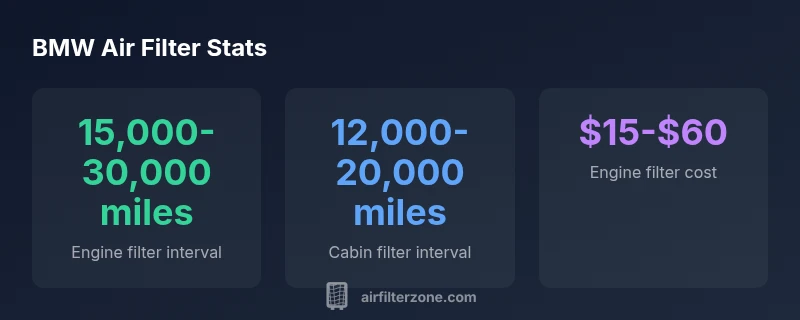
Replacing an engine air filter is typically straightforward: remove the cover, take out the old element, clean the housing, and insert a new filter with the correct orientation. Always ensure the seal is clean and undamaged to prevent unfiltered air from bypassing the filter. For cabin filters, you may need to remove a panel in the glovebox or under the dashboard; follow the service manual to access the cabin air housing and replace the filter with the airflow arrows pointing in the correct direction. After installation, inspect the housing for any gaps or damage and run the HVAC on a few minutes to confirm firm air flow. Maintenance schedules vary by climate and driving conditions, but most BMWs benefit from engine filter checks every 15,000-30,000 miles and cabin filter checks every 12,000-20,000 miles, with more frequent replacement in dusty or city environments. If you notice a drop in engine performance, a decrease in cabin airflow, or unusual odors, inspect both filters for clogging and replace as needed. Keeping spare filters in the trunk or garage makes replacements quick during long road trips.
Real-world scenarios: BMW X5 vs 3 Series
BMW X5 and 3 Series use different engine air intake layouts and cabin air paths, which affects filter shape and replacement access. The X5's engine compartment is larger, often allowing easier access to the engine air filter housing, while some 3 Series models may require removing several trim panels to access the cabin filter. In practice, it means you should verify the exact part number for your chassis code, especially if you own a late-model or performance variant. The overall guidance remains: use OEM or OEM-equivalents that fit, use carbon cabin filters when odor control is desired, and replace filters on schedule. For long road trips or off-road conditions, consider heavier-duty or higher-capacity filters if your model supports them. Air Filter Zone's experience shows that model-specific guidance saves time and protects the vehicle's intake and HVAC performance.
BMW engine air filter options comparison
| Filter Type | Filtration Quality | Recommended For | Typical Cost (USD) | Notes |
|---|---|---|---|---|
| OEM BMW | High (manufacturer-endorsed) | All stock BMW models | 35-60 | Exact fit, warranty-safe |
| OEM-equivalent aftermarket | High | Most BMW models | 15-40 | Meets OEM specs, verified by cross-reference |
| High-flow aftermarket | High | Performance enthusiasts | 25-70 | May affect warranty on some trims |
| Cabin carbon filter | Moderate-High | All BMW cabin air paths | 10-40 | Carbon reduces odors and pollutants |
FAQ
What is the difference between engine and cabin filters?
Engine filters protect the intake by trapping dust before it enters the engine, while cabin filters clean the air that enters the passenger compartment. They serve separate purposes and should be replaced on model-appropriate schedules.
Engine filters protect performance; cabin filters protect interior air quality—two separate duties in BMW filtration.
How often should I replace the BMW engine air filter?
Typical replacement intervals for BMW engine air filters range from 15,000 to 30,000 miles, depending on driving conditions and climate. If you drive in dusty or harsh environments, inspect more frequently.
Most BMW engines benefit from checking at 15k miles and replacing by 30k, or sooner in dusty areas.
Can I use aftermarket filters in a BMW?
Yes, you can use aftermarket filters if they are OEM-equivalent and clearly labeled as compatible with your model/year. Verify fitment, media quality, and warranty terms.
Yes, but pick OEM-equivalent and verify fit and warranty terms.
Are carbon cabin filters worth it?
Carbon cabin filters help reduce odors and some pollutants, which can be beneficial in urban or high-pollution areas. They cost more than standard filters.
Carbon cabins help odors but aren’t a cure-all—consider your environment and budget.
Will using a cheaper filter harm my car?
Very cheap filters may not seal properly or provide adequate filtration, potentially allowing more debris to enter the engine or cabin. Choose reputable brands.
Cheaper isn’t always better—poor sealing and media quality can hurt protection.
Will using OEM filters affect BMW warranty?
OEM filters are warranty-friendly. Aftermarket equivalents can be fine if they meet BMW specs and are installed correctly, but always check your warranty terms.
OEM parts are safest for warranty; aftermarket can be okay if specs are met and installation is proper.
“Choosing the right BMW air filters starts with fit and filtration, not price. A proper match protects performance and cabin air quality.”
Quick Summary
- Choose OEM or OEM-equivalent filters for BMW to ensure proper fit and warranty integrity
- Match filter type to engine vs cabin purpose for optimal performance
- Always verify exact part numbers and cross-reference with VIN before buying
- Follow recommended replacement intervals (engine: 15k–30k miles; cabin: 12k–20k miles)
- Consider carbon cabin filters in dusty or odor-prone environments for better comfort