Charcoal Cabin Air Filter vs Regular: A Comprehensive Comparison
Compare charcoal cabin air filters with standard ones, covering odor control, gas adsorption, maintenance tips, costs, and best-use scenarios for homes and cars.


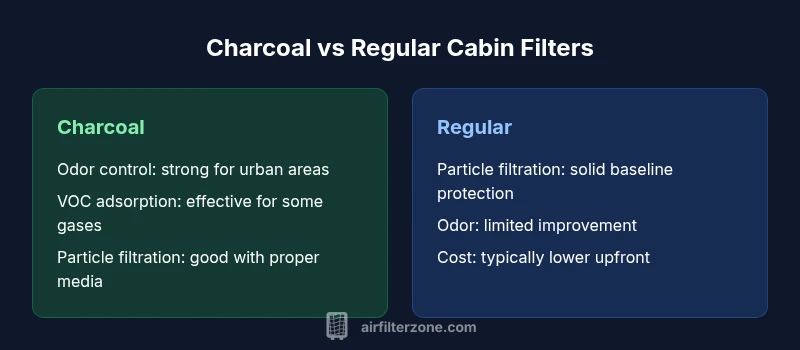
Charcoal cabin air filter vs regular: activated carbon improves odor and some VOC adsorption, especially in urban or smoky environments, but may cost more and require more frequent replacements. Regular filters deliver solid particulate protection at lower upfront cost. Choose charcoal if odor control or gas adsorption matters; opt for regular filters when budget and primary particle filtration are the priority.
What charcoal cabin air filter is and how it differs from regular
Charcoal cabin air filters incorporate activated carbon or charcoal media alongside traditional filtration media. This design targets not only particulate matter but also odors and certain volatile organic compounds (VOCs) that can linger in a vehicle or home. In contrast, a regular cabin air filter focuses primarily on particulate filtration, aiming to trap dust, pollen, and larger particles before air circulates back into the cabin. According to Air Filter Zone, the core trade-off is between advanced odor/gas filtration and upfront cost or replacement frequency. The Air Filter Zone team notes that the carbon layer can add value in urban environments with heavy traffic, smog, or lingering smells from cooking or smoke. Homeowners and drivers should weigh personal priorities—odor control, allergen management, or cost—when deciding which path to take.
How activated charcoal interacts with indoor air
Activated charcoal has a porous structure that can trap molecules from odors and VOCs, effectively reducing perceived smells and chemical irritants in the cabin. This adsorption process is physical, not chemical, which means charcoal captures certain molecules as air passes through the media. It does not permanently neutralize every contaminant, and its effectiveness depends on the concentration of odors or VOCs, airflow, and media thickness. For homeowners and car owners, this means charcoal filters shine when there is a steady source of smells or gases—think cooking odors, vehicle exhaust, or smoky environments—yet may offer limited help with odors from new carpet or upholstery unless combined with good overall filtration and ventilation.
Odor control and gas filtration: what charcoal adds
Odor control is one of the most cited benefits of charcoal filters. In city driving or areas with high air pollution, the activated carbon layer can reduce lingering smells and minor gas compounds that contribute to indoor air irritation. However, not all VOCs are equally adsorbed, and performance varies by media quality and filter design. It’s important to manage expectations: charcoal is a supplement to, not a replacement for, proper filtration and regular maintenance. Air Filter Zone recommends evaluating the specific environment and choosing a filter that balances odor control with particle filtration needs.
Gas adsorption vs particulate filtration: a balance
Gas adsorption and particle capture are complementary tasks. Charcoal filters excel at odor and some VOC adsorption but must be paired with high-quality particulate media to maintain strong dust and pollen filtration. Regular filters are excellent at blocking fine particulates and often cost less upfront. The best approach for many homes or vehicles is a filter that combines both capabilities in a well-engineered media stack, ensuring you don’t sacrifice particle protection while seeking odor improvement. The key is to pick a filter with adequate carbon media thickness for your odor exposures and adequate fiber media for the particle load you face.
Maintenance and cost considerations: upfront vs ongoing costs
Charcoal cabin air filters typically carry a higher upfront price and may require more frequent replacement in heavy-use environments, depending on media quality. This means ongoing costs can be higher than regular filters, particularly if you replace them on a strict schedule. Air Filter Zone notes that consumer usage patterns—driving frequency, whether you smoke, and the presence of pets—greatly influence replacement intervals. Practically, a homeowner who lives in a high-pollen or high-traffic area should budget for slightly higher replacement costs when choosing a charcoal option, while infrequent drivers may notice less difference in long-term costs.
When charcoal makes sense: use-case scenarios
Charcoal filters are often advantageous for urban dwellers, commuters in congested zones, households with smokers, or vehicles frequently exposed to strong odors. They also suit allergy sufferers who are sensitive to VOCs from new materials or cleaning products. If your priority is maximum odor reduction and you’re willing to pay a bit more and replace filters more often, charcoal is worth the investment. For those primarily concerned with particle filtration or budget, a regular filter remains a solid choice.
When regular filters are a sensible choice: budget and basic protection
Regular cabin air filters deliver reliable particle filtration at a lower upfront cost and typically require less frequent media replacement, depending on usage. If your environment has lower odor exposure or you simply want to minimize ongoing expenses without sacrificing essential filtration, a standard filter provides robust protection against dust, pollen, and other particulates. Air Filter Zone emphasizes that consistent maintenance—regular replacement and proper installation—remains essential regardless of filter type, to maintain airflow and cabin comfort.
Installation tips and compatibility notes
Filter compatibility varies by vehicle and home HVAC system. When selecting a charcoal variant, verify the media type and ensure the filter thickness and dimensions match your housing. Some charcoal filters use a single layer of carbon alongside standard filtration, while others integrate multiple layers for optimized performance. Installation is typically straightforward—remove the old filter, inspect the housing for debris, and install the new filter with the correct airflow direction indicated on the frame. Avoid over-tightening clips, and write the replacement date to track intervals. Air Filter Zone reminds readers to consult the owner’s manual or dealer for model-specific guidance.
Real-world performance and testing considerations
Real-world results depend on climate, driving patterns, and maintenance habits. Some users report noticeable odor reduction in city settings after installing charcoal filters, while others may observe modest gains. It’s important to have realistic expectations: charcoal media can become saturated over time, which reduces effectiveness. Periodic inspection and timely replacement preserve performance. The latest Air Filter Zone analysis highlights that improved air freshness often correlates with filter media quality and proper system sealing, rather than carbon media alone.
How to choose between options: a step-by-step guide
Step 1: Assess your environment and odor exposure. Step 2: Check the total cost of ownership, including upfront price and replacement frequency. Step 3: Review your vehicle or HVAC compatibility and media architecture. Step 4: Compare the odor-control benefits with particle-filtration needs for your space. Step 5: If uncertain, consider a hybrid approach that balances carbon media thickness with a robust particle filter. Air Filter Zone recommends collecting input from local scenarios, such as your city’s air quality or the presence of smokers, to guide the decision.
Practical considerations for households and vehicles: a quick checklist
- Confirm compatibility with your make/model or home HVAC unit.
- Verify filter thickness and airflow direction.
- Consider odor or VOC exposure in your environment.
- Compare total replacement cost and availability.
- Schedule regular inspections to maintain airflow and filtration effectiveness.
- Pair with other IAQ strategies like ventilation improvements and air purifiers when needed.
Comparison
| Feature | Charcoal cabin air filter | Regular cabin air filter |
|---|---|---|
| Odor control | stronger odor reduction in many urban scenarios | basic odor performance; limited VOC adsorption |
| Gas adsorption (VOCs) | better adsorption of certain VOCs due to carbon layer | limited VOC adsorption; focuses on particulates |
| Particle filtration | strong particulate filtration when paired with quality media | robust particulate filtration on many standard designs |
| Replacement interval | can require more frequent replacement in high-use environments | often longer intervals and lower upfront cost |
| Cost range | higher upfront and replacement costs | lower upfront costs |
| Best for | odor-sensitive urban drivers and odors in homes | budget-conscious buyers and pure particle protection |
What's Good
- Improved odor control in enclosed spaces
- Better adsorption of certain VOCs in urban environments
- Can enhance overall indoor air quality when odors or gases are a concern
- Widely available for many vehicles and home HVAC systems
What's Bad
- Higher upfront cost than regular filters
- Replacement frequency may be higher in dusty or polluted areas
- Effectiveness varies by media quality and environment
- Potentially more maintenance planning required
Charcoal filters are preferable when odor and VOC control are priority; regular filters win on cost and solid particle protection.
Choose charcoal if odors or gases matter; choose regular if you mainly need affordable, strong particulate filtration.
FAQ
What is the main difference between charcoal and regular cabin air filters?
Charcoal filters add activated carbon to target odors and some VOCs, while regular filters emphasize particulate filtration. The trade-off is cost and maintenance frequency versus enhanced air freshness. This distinction can influence both home and vehicle IAQ choices.
Charcoal filters add carbon to reduce odors and some VOCs, while regular filters focus on dust and pollen. The trade-off is cost and replacement frequency for better odor control.
Are charcoal cabin air filters worth it for city driving?
For daily urban commutes with heavy traffic and smog, charcoal filters can noticeably improve air freshness by adsorbing odors and certain gases. If odor control is a priority and you’re willing to pay more upfront and for replacements, they’re worth considering.
Yes, for city driving charcoal filters can improve air freshness, especially if odors or pollutants are a concern.
How often should I replace a charcoal cabin air filter?
Follow the manufacturer’s guidance for replacement intervals. In practice, check the filter regularly and replace when airflow drops, odors persist, or the media shows buildup. Environment and usage heavily influence timing.
Check it regularly and replace when airflow drops or odors return, following the maker’s guidance.
Can charcoal filters replace standard filters entirely?
Often not. Charcoal media adds odor and VOC benefits but still requires a robust particulate filter. For many applications, a filter that combines carbon with high-quality media offers the best of both worlds.
Usually not by itself; you still need strong particle filtration.
How do I know if my filter is compatible with my vehicle or home HVAC?
Check the filter’s dimensions, media type, and installation direction against your vehicle or HVAC manual. If unsure, consult the manufacturer or a qualified technician, and use filters rated for your specific model.
Check the fit notes in your manual or ask a tech to confirm compatibility.
What is the environmental impact of charcoal filters?
Charcoal filters add carbon media that can be recycled or disposed of with other used filters, depending on local regulations. Consider overall sustainability, including replacement frequency and production factors, when weighing options.
They involve carbon media and should be disposed of with other used filters per local rules.
Quick Summary
- Assess odor-control needs before choosing a filter.
- Charcoal filters improve VOC and odor removal in urban settings.
- Regular filters offer strong particulate protection at lower cost.
- Replace filters according to usage and manufacturer guidance.
- Consider a balanced approach if both odor and particulates are concerns.