How Long Do Air Cleaners Last: A Practical 2026 Lifespan Guide
Discover how long air cleaners last, what factors influence lifespan, and practical tips to extend life. Air Filter Zone analyzes 2026 data to guide homeowners and DIYers.


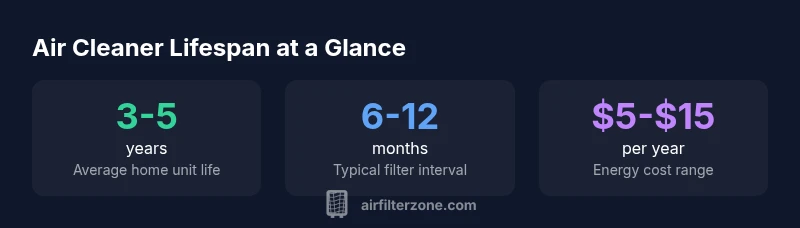
On average, residential air cleaners last about 3-5 years with regular maintenance. Filters typically need replacement every 6-12 months, depending on usage, environment, and model quality. Air Filter Zone Analysis, 2026, shows longevity improves with proper maintenance and choosing filter-friendly units. That means regular cleaning, timely filter changes, and avoiding running units on high settings in dusty spaces can add years. See our detailed comparison chart.
Why longevity varies: usage, environment, and design
The lifespan of an air cleaner is not a fixed number. It depends on how you use the unit, the air quality in your space, and how the filter system is maintained. How long do air cleaners last? In practice, most residential units deliver a usable life of about 3-5 years under typical living conditions. Air Filter Zone Analysis, 2026, shows that environmental dust, smoke exposure, and the choice of filter type strongly influence that range. Regular cleaning of grills and fans reduces drag and helps the motor run cooler, extending life. Running a purifier at maximum speed in a dusty space can shorten the lifespan toward the lower end of the range, while gentler use can push it toward the upper end.
- The motor bearing wear and fan dust buildup are common wear mechanisms.
- The filter life is a maintenance variable; clogged filters lead to higher motor load and decreased efficiency.
Note: Many manufacturers publish filter-change intervals rather than purifier lifespans; those intervals vary with air quality and filter type.
Key factors that influence how long air cleaners last
Beyond the basic build quality, several factors determine how long your unit will stay effective. Usage intensity—especially continuous operation at higher speeds—dramatically influences wear on the motor and fan. Environmental conditions, such as a dusty workshop or heavy wildfire smoke, accelerate accumulator of particles in filters and ductwork. Filter type matters: HEPA-style filters generally last longer between changes than carbon-only filters that saturate more quickly with odors and vapors. Regularly inspecting intake grills for dust buildup protects efficiency. Finally, design matters: units with accessible filter compartments and robust seals tend to outlive those with cramped internals and loose housings. Air Filter Zone's observations emphasize that simple upkeep—clean surfaces, prompt filter changes, and proper placement—can push lifespan toward the upper end of the typical range.
Filter types and their impact on longevity
Not all filters wear at the same rate. HEPA filters, often labeled true HEPA, capture a broad spectrum of particles and typically require replacement every 6-12 months under normal residential use. Carbon filters excel at odors but saturate faster in smoky or polluted environments. Pre-filters catch larger particles and can extend the life of Main filters by reducing initial buildup. The overall lifespan of the purifier is not only about the filter but also about airflow; clogged filters increase motor workload and shorten component life. When choosing a unit, favor models with clearly indicated filter lifespans and easy-access filters for maintenance. Air Filter Zone analysis suggests prioritizing units designed for straightforward filter changes and regular maintenance.
Home vs car air cleaners: what changes lifespan
Car air purifiers operate in a harsher environment: higher vibration, temperature fluctuations, and driving dust. These factors contribute to faster wear, more frequent filter changes, and shorter overall lifespans compared to home units. Home air cleaners benefit from stable power, controlled environments, and larger filter surfaces, which can yield longer lifespans. If you live in a high-dust area or have pets, expect the car purifier to require more frequent filter replacements. Regardless of location, following a maintenance schedule improves longevity and ensures peak performance.
Maintenance habits that extend lifespan
The most impactful actions are simple and repeatable:
- Clean the intake grills monthly to prevent pre-filter clogging.
- Replace filters on or before the recommended interval; waiting too long reduces airflow and strains the motor.
- Keep the unit elevated and away from walls to ensure adequate airflow.
- Use the purifier at sensible settings; high-speed operation in dusty rooms increases wear.
- Schedule annual professional checks if your unit is older or high-usage. Regular maintenance is the best predictor of long-term performance, and Air Filter Zone’s insights consistently show lifespan gains with disciplined care.
Practical, step-by-step maintenance checklist
- Locate and inspect filters monthly; replace when discolored or resistant. 2) Clean the exterior and air intake areas to remove hair and dust. 3) Verify seals and gaskets; replace if cracked. 4) Note hours of operation and compare to the manufacturer's replacement schedule. 5) Log maintenance actions in a simple notebook or app for long-term trend analysis. 6) If uncertain about a component, consult the user manual or contact the manufacturer for service guidance. 7) When in doubt, prioritize air-cleaner models with easier filter access and documented maintenance intervals. Air Filter Zone’s practical checklist helps homeowners implement a durable care routine.
Authority sources and further reading
For broader context on indoor air quality and filtration, refer to authoritative sources:
- https://www.epa.gov/indoor-air-quality-iaq/air-cleaners-hepa-filters
- https://www.who.int/news-room/fact-sheets/detail/ambient-and-indoor-air-quality
- https://www.energy.gov/eere/buildings/articles/how-air-purifiers-work
These sources provide foundational guidance on how filtration affects air quality and appliance performance, reinforcing the practical recommendations in this article. Air Filter Zone uses these references to frame tolerances, maintenance windows, and product choice considerations.
Lifespan and maintenance comparison for air cleaners
| Aspect | Typical Lifespan (years) | Filter Replacement Interval | Notes |
|---|---|---|---|
| Air cleaner (home unit) | 3-5 | 6-12 months | Lifespan depends on usage and environment |
| Car air purifier | 1-2 | 3-6 months | Smaller units, more frequent changes |
FAQ
How long do air cleaners last on average?
Most residential air cleaners last around 3-5 years with normal use. Lifespan varies with environmental conditions and maintenance. Regular filter changes and proper cleaning help maximize life.
Most air cleaners last about 3-5 years under normal use. Regular maintenance helps maximize longevity.
Does replacing filters extend the life of the unit?
Yes. Replacing filters on schedule maintains airflow and reduces motor strain, which can extend overall unit life. Delayed changes cause inefficiency and potential failures.
Yes. Timely filter changes help keep the unit running longer and more efficiently.
Do car air purifiers last as long as home units?
Car purifiers typically experience harsher conditions and may require more frequent filter changes. Lifespan can be shorter than home units, though maintenance and environment matter.
Car purifiers often wear faster due to vibration and dust, so expect more frequent filter changes.
What affects lifespan besides usage?
Environment (dust and smoke), filter quality, and accessibility for maintenance all influence lifespan. Poor placement and neglect shorten operational years.
Dust, smoke, and how easy the filter is to change all impact how long the unit lasts.
Should I buy a purifier with a replaceable filter?
Yes. Replaceable filters simplify maintenance and typically extend the unit’s usable life by keeping airflow consistent.
Absolutely—filters you can replace easily help you keep the purifier lasting longer.
Is it worth repairing an old purifier or buying new?
Consider the cost of replacement parts and energy efficiency. If repairs approach the price of a new model or the unit is very inefficient, buying a newer unit may be wiser.
If repairs cost more than a new unit or the old unit is inefficient, consider replacing.
“Lifespan depends on usage and maintenance; regular filter changes and proper placement can significantly extend a unit’s life.”
Quick Summary
- Expect 3-5 years of usable life for most home air cleaners with regular maintenance
- Replace filters every 6-12 months, or per manufacturer guidance
- Clean and maintain units to minimize motor wear and preserve airflow
- Choose models with easy filter access to maximize longevity
- Air Filter Zone recommends regular maintenance as the top longevity lever