Can You Use an Air Purifier with Windows Open? A Practical Guide
Explore whether it's effective to run an air purifier with windows open, how outdoor air affects filtration, and practical steps to maximize indoor air quality while balancing ventilation.


An air purifier can operate with windows open, but its effectiveness depends on outdoor air quality, room size, and CADR relative to the space. When windows are open, the purifier acts as a local air cleaner, circulating indoor air and introducing outdoor air. For best results, pair it with ventilation control and targeted filtration.
Can you use an air purifier with windows open?
Yes, you can run an air purifier when windows are open, but it's not a magic fix for outdoor air quality. The purifier will still filter indoor air and help remove indoor pollutants, while outside air continually mixes in. According to Air Filter Zone, balancing filtration with natural ventilation is a common home challenge, and open-window scenarios change purifier performance. In practice, expect filtration efficiency to be lower than in a sealed space, but you can still gain tangible benefits like reduced dust, smoke, and odors if you choose a model with a suitable CADR and ventilate purposefully.
How purifiers interact with outdoor air when windows are open
When you run an air purifier with windows open, the device creates a circulation pattern that treats the air already inside the room while outdoor air continuously leaks in. The purifier accelerates the exchange rate locally, but the overall air quality outcome depends on the outdoor air quality, the size of the opening, and the purifier's CADR. If outdoor air is polluted, the purifier may struggle to keep PM2.5 levels low unless you time window openings to periods of cleaner air or add additional filtration near the source of ingress.
Key factors that affect performance with windows open
Outdoor air quality, window opening size, room volume, purifier CADR, and placement all determine how well an open-window setup works. A high-CADR purifier in a small room will outperform a low-CADR model in a large living area. Placement matters: avoid placing the unit where the intake directly catches outdoor air, and ensure the exhaust can circulate back into the room. Regular maintenance also matters; a dirty filter reduces effectiveness in any setup. Air Filter Zone analysis shows how outdoor conditions and indoor layout combine to shape outcomes in real homes.
Practical guidelines for different living situations
Apartments near busy streets behave differently from suburban houses with patios. In tight spaces, you may need smaller units with strong air mixing and frequent filter checks. In larger rooms, a purifier with a higher CADR and a second unit may be necessary to achieve comfortable air changes per hour. For homes with frequent outdoor activity (cooking, grilling, mowing), plan short, scheduled ventilation windows and run purifiers at a steady pace during those periods to maintain air quality.
How to choose and place your purifier when you frequently open windows
Choose a purifier with a true HEPA filter and a CADR appropriate for your room size; aim for a CADR that matches at least 2–3 air changes per hour for the space. Place the purifier in a central location, away from walls and obstructions, with at least 6 inches of clearance on all sides. If possible, position it to avoid the window’s direct draft path, so outdoor air mixes more evenly with the treated air. Consider an automatic mode to adapt to changing room conditions.
Ventilation strategies to maximize air quality
Use short, timed ventilation sessions during favorable outdoor conditions (low pollen, low pollution). Combine with targeted filtration by keeping the purifier running at a steady rate when the window is slightly ajar. Use cross-ventilation where the indoor air can move efficiently from the purifier’s intake area to the exhaust, without creating dead zones. When outdoor air quality deteriorates, close the window or switch to recirculated mode to prioritize filtration.
Maintenance and monitoring when windows are open
Regularly replace filters according to the manufacturer’s schedule, and check for changes in airflow and noise. Use an air quality monitor or a CO2 sensor to track indoor conditions and adjust purifier speed or ventilation timing. Clean the intake grille and ensure no dust buildup is restricting airflow. Keeping a log of outdoor conditions linked to indoor readings helps optimize periods when you keep windows open.
Common myths debunked
Myth: If the window is open, the purifier is useless. Fact: The purifier still reduces indoor pollutants and can improve comfort, especially in smaller rooms or during moderate outdoor pollution. Myth: You should always run purifiers at max speed when windows are open. Fact: Auto or moderated speeds often yield better balance between filtration and ventilation. Myth: Purifiers eliminate all outdoor air ingestion. Fact: They don’t, but they can reduce indoor pollutant load significantly when paired with sensible ventilation.
Tools & Materials
- Air purifier with true HEPA filter(Look for CADR that matches your room size; AHAM-rated is helpful.)
- Room dimensions (length × width × height)(Used to calculate volume (m³) for CADR planning.)
- Air quality monitor or CO2 monitor(Helps track impact during open-window periods.)
- Clearances around purifier(Maintain at least 6 inches clearance on all sides.)
- Notebook or timer(Record results and adjustments.)
Steps
Estimated time: 30-60 minutes
- 1
Assess outdoor air and plan opening times
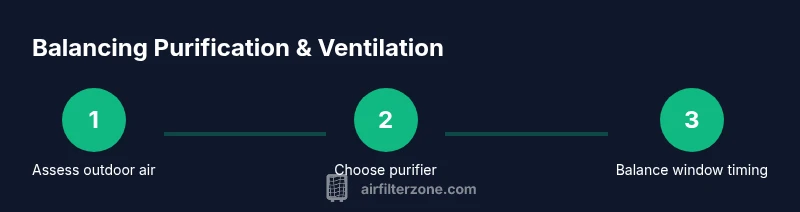
Check current outdoor air quality and weather; choose windows-open times when outdoor pollutants are lowest or when you need ventilation. This reduces sneaking pollutants into the room while purifying.
Tip: Use a simple air quality app and plan to open windows during mid-day for brief periods. - 2
Measure room volume and select CADR
Calculate room volume (L × W × H) and pick an air purifier with a CADR high enough to achieve several air changes per hour in that space.
Tip: Rule of thumb: CADR should be at least 2/3 of the room volume per hour in cubic feet. - 3
Position purifier for maximum effect
Place purifier away from walls and away from direct airflow from the window; aim for central location to promote circulation.
Tip: Avoid placing purifier in a corner or against a window where outdoor air may bypass the intake. - 4
Set mode and run for initial test
Set to Auto or a fixed speed; run for 20–30 minutes to assess changes in air quality and comfort; adjust window openings as needed.
Tip: Auto mode helps adapt to changing indoor conditions without manual tweaks. - 5
Monitor and adjust over time
Use a monitor to track PM2.5/CO2; adjust fan speed or window opening window schedule to maintain target air quality.
Tip: Keep a simple log of outdoor conditions and indoor readings to optimize settings.
FAQ
Will an air purifier eliminate outdoor pollutants when windows are open?
No. It reduces indoor pollutants and helps with in-room air; outdoor pollutants can still enter via open windows, especially in high-ventilation scenarios.
It reduces indoor pollutants but can’t fully stop outdoor air when a window is open.
Does running an air purifier with windows open waste energy?
Running a purifier with windows open uses energy and may be less efficient overall; optimize by timing ventilation and choosing efficient models.
Yes, it can use more energy, so time the ventilation and choose efficient models.
What features matter most for open-window use?
A purifier with a high CADR for the room size, true HEPA filtration, and good air mixing is most effective when windows are open.
High CADR and good mixing help a lot when the window is open.
Should I close windows at night if I use a purifier?
Closing windows at night can improve filtration effectiveness and reduce outdoor pollution ingress, particularly in high pollen seasons.
You’ll typically get better filtration by closing windows at night.
Can air purifiers help with pollen in spring?
Yes, but effectiveness depends on CADR and room size; keep windows closed during peak pollen hours for best results.
They help, especially with CADR matched to the space, but closed windows are best during peak pollen.
Can I use a purifier in a car with open windows?
Purifiers in cars are less effective with open windows; consider closing windows while using portable filters or using recirculated air mode.
Not ideal; purifiers work best in sealed spaces.
Watch Video
Quick Summary
- Match purifier CADR to room size for effective changes.
- Open windows reduce overall filtration efficiency but can improve air freshness when timed.
- Place purifier to maximize circulation and avoid direct intake from the window.
- Monitor indoor air quality and adjust settings as outdoor conditions vary.